Active time: 30 mins
Total time: 1 hr
Serves: 6 to 8
Why this Kansai-style okonomiyaki works
- Potato starch replaces the more customary grated mountain yam, creating a light yet well-bound batter.
- Steaming the pancake lets the cabbage become tender while preserving a slight crunch.
- Instant dashi granules bring extra savoury depth to this substantial pancake dinner.
Crisp around the edges and soft and airy at its centre, this shredded cabbage pancake delivers plenty of umami. This take on okonomiyaki, the well-known Osaka street food, comes from Shota Nakajima, a Seattle restaurateur and 2021 contestant on Top Chef. His recipe turns an everyday cabbage into an impressive dish that is straightforward to make at home.
Across Japan’s Kansai region, okonomiyaki is a beloved street-food staple. Nakajima begins by incorporating finely shredded green cabbage into a savoury egg batter. Baking powder, potato starch and tempura bits combine to make the pancake particularly light and tender. Although grated mountain yam features in many traditional recipes, Nakajima suggests readily available potato starch instead. After mixing, leave the batter at room temperature for 30 minutes, giving the flour time to hydrate completely.
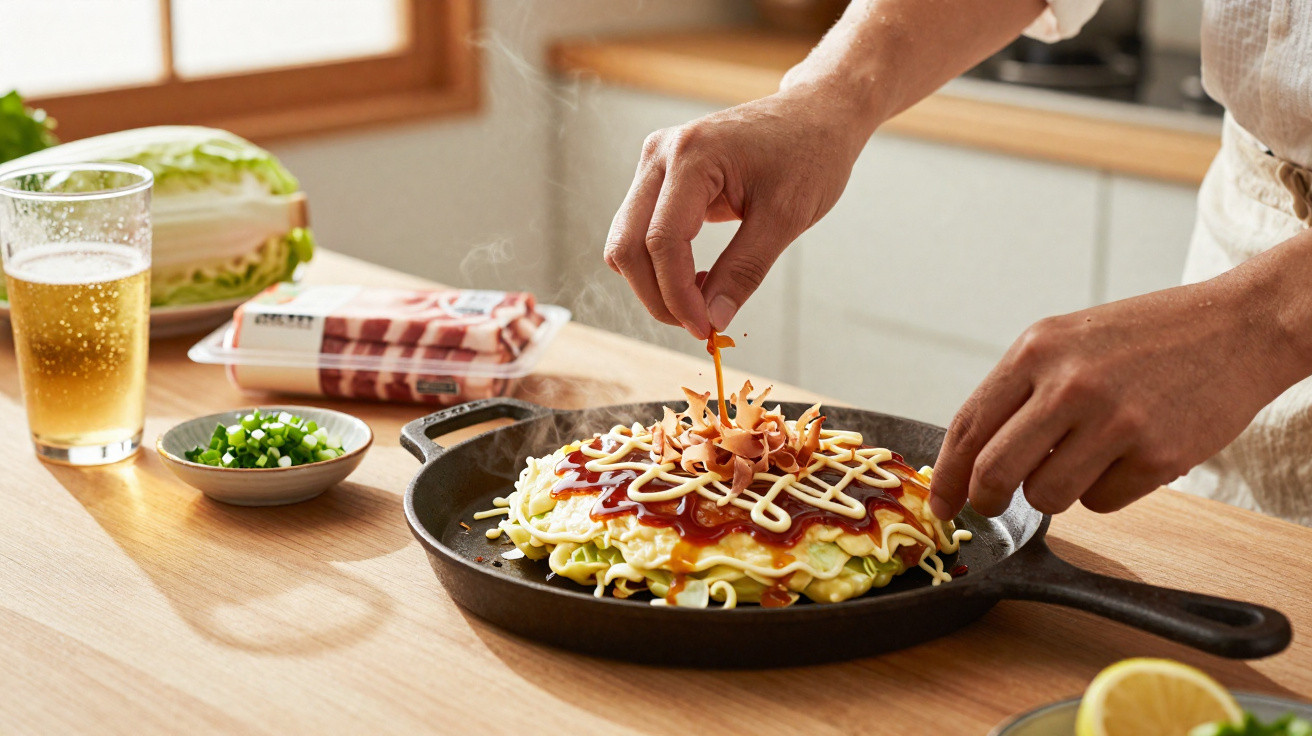
The pancake cooks in two stages. It is first steamed gently under a lid, which softens the cabbage and helps the pancake hold its form. Removing the lid then allows surplus moisture to evaporate. Lay fine slices of pork belly across the top, turn the pancake over, and cook until it is golden and the pork belly is crisp. Finish it with sweet-savoury okonomiyaki sauce, a drizzle of Kewpie mayonnaise, dried seaweed flakes and smoky bonito flakes. Okonomiyaki shows that modest cabbage can be the star of the plate.
What does Kansai-style okonomiyaki mean?
Okonomiyaki has several regional forms throughout Japan. Kansai-style, also called Osaka-style, describes the version where every ingredient is stirred into the batter, rather than arranged in separate layers.
Okonomiyaki belongs to the wider Japanese food category called konamona, meaning “flour-based things.” Osaka’s other popular konamono dishes include yakisoba, or fried noodles, and takoyaki, or octopus balls.
What is the difference between pork belly and bacon?
Both cuts come from the pig’s belly, but their processing differs. Pork belly is fresh, uncured meat from the belly. Bacon is pork belly cured-normally with a mixture of salt, sugar and nitrates-and generally smoked.
As bacon is considerably saltier and smokier than pork belly, pork belly is the better option for okonomiyaki. Its gentler flavour lets the other components of the cabbage pancake come through.
Notes from the Food & Wine Test Kitchen
- Hondashi powder, tempura bits, pickled red ginger (beni shōga) and okonomiyaki sauce-ideally the Otafuku brand-are available from most Asian grocers or online at asiamartsr.com.
- Most Asian grocers sell finely sliced pork belly; alternatively, ask your local butcher to prepare it.
- Use two spatulas to make turning the pancake more manageable.
Suggested pairing
Serve this salty, savoury street food with a medium-bodied Grenache, such as Melville Caden’s Block Estate Grenache.
This recipe was developed by Shota Nakajima; the text was written by Paige Grandjean.
Ingredients
- 195 g plain flour
- 4 teaspoons potato starch
- 2 1/2 teaspoons Hondashi powder (instant dashi)
- 2 teaspoons baking powder
- 3/4 teaspoon kosher salt
- 4 large eggs
- 325 ml water, divided
- 8 cups finely shredded green cabbage (from 1 small head)
- 1/2 cup tempura bits (tenkasu) (optional)
- 1 1/2 tablespoons drained pickled red ginger strips (beni shōga) (optional)
- 1 spring onion, finely chopped
- 60 ml rapeseed oil, divided
- 170 g very finely sliced pork belly, divided
- Okonomiyaki sauce, Kewpie mayonnaise, dried seaweed flakes (aonori) and bonito flakes, to serve
Directions
In a large bowl, whisk the flour, potato starch, Hondashi powder, baking powder and salt. In a medium bowl, whisk the eggs with 240 ml water until thoroughly blended. Stir the egg mixture into the flour mixture only until combined. Fold in the cabbage, tempura bits, if using, ginger, if using, and spring onion, stirring just enough to coat the cabbage evenly. Do not overmix. Leave at room temperature for 30 minutes.
Heat the oven to 95°C. Warm 2 tablespoons of the oil in a large non-stick frying pan over a medium heat. Add half the batter, about 2 3/4 cups, and spread it into an even 25 cm round. Cook for about 2 minutes, until the edges are only beginning to brown. Pour 3 tablespoons water around the pancake’s edge. Cover the pan and cook without disturbing for 2 to 3 minutes, until the cabbage is vivid green. Remove the lid and let any remaining water evaporate. Spread half the pork belly evenly over the top. Using a large spatula, carefully turn over the pancake; cook for 4 to 5 minutes, until the second side is golden and the pork belly is crisp.
Turn the pancake on to a baking tray and keep warm in the oven. Clean the frying pan, then repeat with the remaining 2 tablespoons oil, remaining half of the batter, remaining 3 tablespoons water and remaining half of the pork belly. Put each pancake on a serving plate and finish with okonomiyaki sauce, Kewpie mayonnaise, seaweed flakes and bonito flakes. Serve hot.
Originally appeared in Food & Wine magazine, March 2026
Reviews
5 out of 5 - 1 Ratings
- 5 star: 1
- 4 star: 0
- 3 star: 0
- 2 star: 0
- 1 star: 0
OrangeStrainer7776 - 5 star
02/23/2026
“This is such a fun way to eat cabbage!”
Helpful (0)










Comments
No comments yet. Be the first to comment!
Leave a Comment