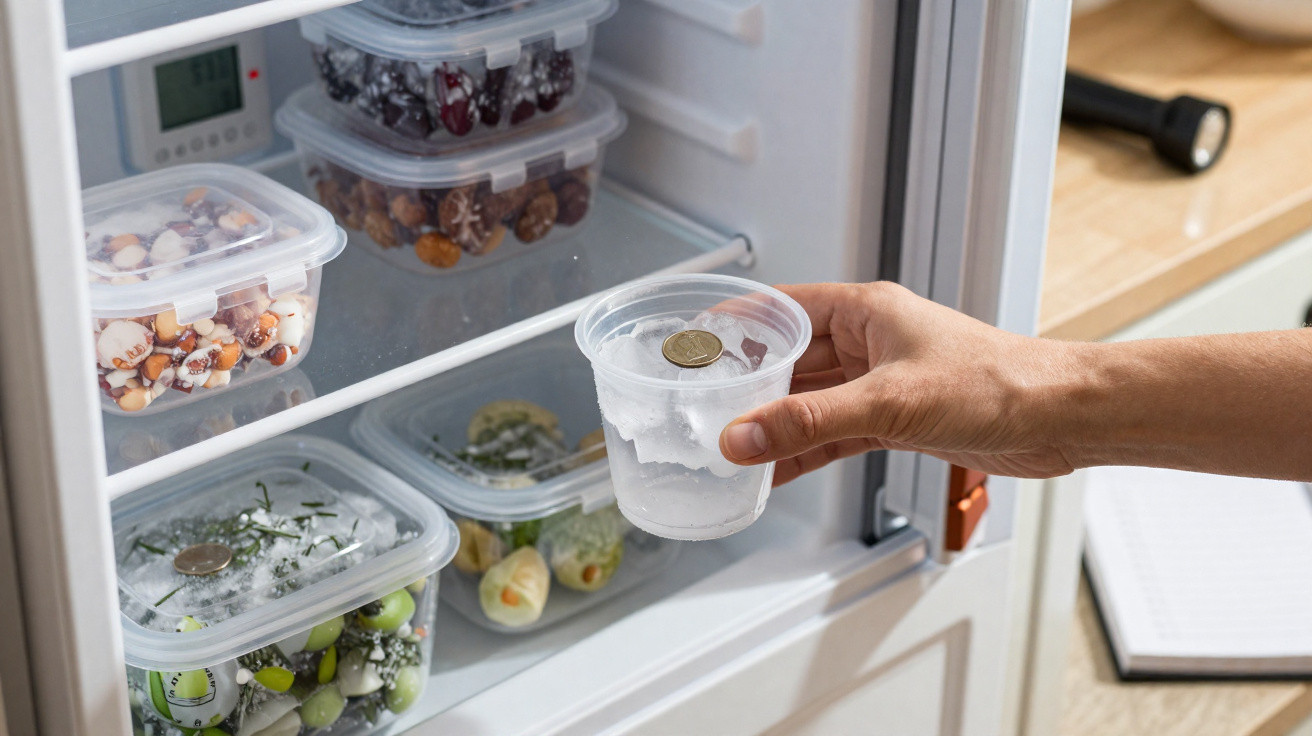
Power cuts can happen without a sound. At times, you may not notice them at all, such as while on holiday or away for a weekend. The fridge is humming again, the lights are on – everything appears normal. Yet an invisible risk may have developed in the freezer in the meantime: spoiled food. This is exactly where a remarkably simple coin trick comes in, currently circulating on social media and taken seriously by experts.
How the coin trick works in the freezer
The method is straightforward and takes only a few minutes. All you need is a small container, tap water and any coin.
- Fill a small freezer-safe container with water.
- Place the container in the freezer without the coin and allow it to freeze completely.
- Once the water has become a solid block of ice, put a coin on top of the ice surface.
- Return the container and coin to the freezer, then simply leave it there.
That sets up your “silent alarm system”. From then on, the coin's position can indicate whether the contents of the freezer have thawed at any point, for example during an extended power cut.
“If the coin is no longer sitting on top of the ice, the freezer was too warm at some point – and that could be critical for food.”
What the coin's position tells you
The coin acts as a simple yet smart indicator:
- Coin remains on top of the ice: The temperature has stayed sufficiently low throughout, meaning the ice has not melted, or has melted very little. Frozen food is very likely still safe.
- Coin has sunk slightly: The ice has thawed at least partially before freezing again. Take a closer look, especially at sensitive products such as meat or fish.
- Coin is embedded in the middle or sitting at the bottom of the container: The water has nearly or entirely melted, then frozen again later. The freezer became substantially too warm – food may have been seriously affected and should be assessed carefully.
The deeper the coin is in the ice, the longer or more severe the temperature fluctuation is likely to have been. Although this trick is no substitute for a professional measuring device, it offers a clear visual sign of whether the freezer temperature held steady.
Why maintaining the cold chain matters so much
The coin trick has a serious principle behind it: the cold chain. This refers to the uninterrupted journey of food from production, transport and the supermarket to your fridge at home, all under controlled temperatures.
According to guidance from international food safety authorities, frozen food should be stored at around -18 °C or colder. If it rises to more than a few degrees above zero and remains there for a prolonged period, it becomes a concern: bacteria can multiply without being visible, detectable by smell or noticeable in taste.
“Food that repeatedly thaws and refreezes can look normal on the outside – but its microbial load may already have changed inside.”
Hidden risks during power cuts
Power cuts, faulty fuses and freezer doors that have not been closed properly often occur while nobody is at home. Once everything is running again, you cannot tell from a frozen pizza or steak whether it became soft in the meantime.
These apparently harmless scenarios create particular risks:
- Harmful germs: Bacteria such as salmonella and listeria are more comfortable at fridge temperatures than in frozen conditions. When temperatures rise, they can multiply rapidly.
- Changed texture: Even if it is not obvious immediately, the product's structure can deteriorate. Meat may become watery, ice cream can develop ice crystals and vegetables may lose their bite.
- False reassurance: Refrozen products may appear to have been “saved”, but they are not always safe from a health perspective.
A coin in ice makes this otherwise invisible process visible afterwards. It shows that the ice melted sufficiently for the coin to sink – a clear indication of significant warming.
What to do if the coin indicates a problem
Anyone checking the coin after a holiday or a reported power cut and finding that it has sunk noticeably, or even reached the bottom of the container, should act cautiously.
Check food and throw it away if in doubt
Food safety specialists recommend one clear rule: if in doubt, throw it out rather than take a risk. This applies particularly to:
- raw and thawed meat
- fish and seafood
- ready meals and frozen food containing egg, cream or cheese
- dairy products and ice cream
If it is unclear how long the outage lasted, inspect food critically: does it smell unusual? Does the packaging look distorted? Has water collected in the bag? If so, dispose of it. Replacing a few food items costs less than a hospital stay caused by food poisoning.
Check the appliance and take precautions
If the coin has provided a clear warning sign, it is also worth inspecting the appliance:
- Check the appliance seals: Worn or dirty door seals can allow heat to enter continuously.
- Monitor the temperature: The freezer should realistically be set to -18 °C or colder.
- Establish the power situation at home: Were there wiring faults, tripped fuses or planned shutdowns by the electricity network operator?
- Consider emergency options: In areas prone to frequent outages, a small backup power system, or at least a thermometer with a memory function, may be worthwhile.
“A coin in ice does not replace a high-tech system, but it is an inexpensive, practical everyday aid that can prevent costly losses and harm to health in an emergency.”
Who can benefit most from the coin trick
The coin trick is especially useful for people who do not check their freezer every day. Everyday examples include:
- families away for several weeks during the school holidays
- people with irregular working hours who freeze large quantities of food in advance
- residents of rural areas where the electricity supply occasionally falters
- households with a large chest freezer in the cellar or garage
In precisely these situations, no one may notice if the appliance stops working for a few hours before starting up again. The coin does not provide an audible alert, but it can “tell” the real story of the appliance's temperature afterwards.
How to combine the coin trick with other measures
For added reassurance, combine the coin trick with other simple strategies:
- Keep the freezer well stocked: A full freezer retains cold for longer because the large quantity of frozen food acts as a cold store.
- Open the door as rarely as possible: Particularly during a known power cut, keep the door shut so cold air does not escape.
- Use a thermometer: A small freezer thermometer with a maximum temperature display shows how warm the appliance actually became.
Anyone who regularly batch cooks and freezes plenty of food should also understand the correct way to thaw it: slow thawing in the fridge is ideal, rather than thawing at room temperature. This reduces the risk of germs multiplying substantially during the transition.
Why the trick also raises awareness
Ultimately, a coin in ice is not only a clever indicator but also a small prompt for reflection. Many people rely blindly on the sound of the appliance and forget that temperature and time play a crucial role in food safety.
Taking a few minutes to freeze a container of water and place a coin on top creates a simple early-warning system. It also gives you a better understanding of how sensitive frozen food really is – and when caution is clearly the healthier choice.














Comments
No comments yet. Be the first to comment!
Leave a Comment