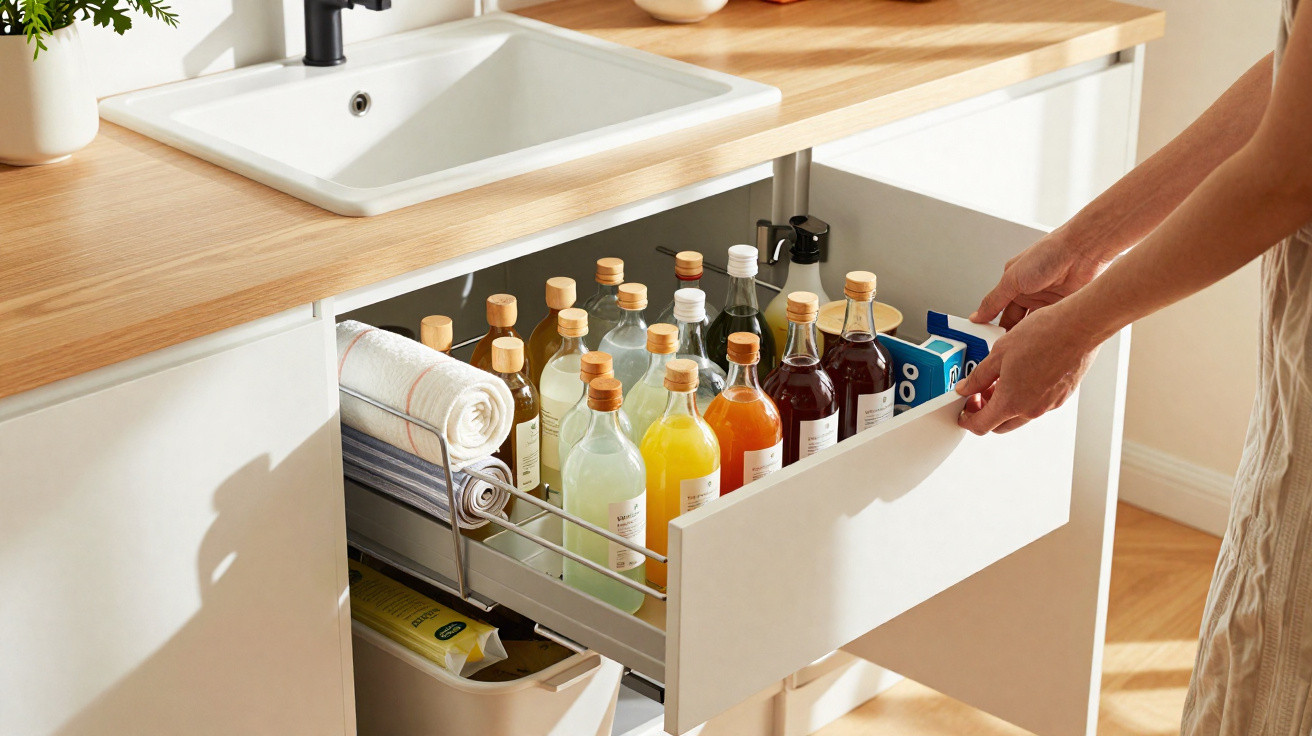
If you live in a rented flat or a smaller house, you will know the issue: the cupboard below the sink quickly becomes a chaotic dumping ground. Cleaning products, sponges, bin bags and perhaps a few supplies all end up in the dark space beneath the sink. In 2026, an almost forgotten interior feature is returning to the spotlight. It is not only more practical than conventional cupboard doors, but also makes the room feel far more homely: the sink skirt, or a curtain in place of doors.
Why the space beneath the sink is so often wasted
Every centimetre matters in modern kitchens. Yet the area directly below the sink is often poorly arranged. The reason is obvious: pipes, the trap and, in some cases, a water filter all get in the way of a standard cupboard solution. As a result, many people give up and simply cram everything in wherever it fits.
- Cleaning products are scattered about.
- Bin bags slip to the back and become impossible to find.
- Sponges, cloths and rubber gloves are left loose.
- The cramped, dark recess makes it hard to see what is there.
This is precisely where the 2026 trend comes in. Rather than bulky doors, which often stick anyway, a fabric curtain takes their place. It is an old idea, but one that suits compact kitchens, retro interiors and anyone looking for greater flexibility.
The sink skirt: a retro solution with surprising comfort
A sink skirt is simply a curtain fitted below the sink to conceal the open area underneath. Once a standard feature in country-style kitchens, it is now reappearing in many homes - and looks more contemporary than you might initially expect.
“The curtain turns unsightly clutter into a calm, tidy-looking surface - even if everything behind it is not yet perfectly organised.”
The most noticeable everyday benefit is easier access. There is no need to open cupboard doors, knock into them yourself or struggle with doors left half open. One quick pull moves the fabric aside and puts everything within reach.
The benefits of a sink skirt in 2026
- Quick access: One pull of the fabric is all it takes to open up the area.
- Visual calm: Cleaning-product bottles and kitchen bins are kept out of sight.
- Flexible styling: The colour, pattern and material can be changed whenever you like.
- Easy care: The curtain can simply go into the washing machine.
- Budget-friendly: It is considerably cheaper than replacing cupboard doors or installing made-to-measure units.
For anyone who likes to redecorate regularly, a curtain is especially useful. Instead of fitting cabinet fronts that then have to stay in place for years, a new piece of fabric can completely change the look of the kitchen.
How to choose the right curtain for your kitchen
Anyone rethinking the space beneath the sink will first face the familiar questions: which fabric works best? What colours can the room handle? And how should it be fitted? A few basic guidelines make the choice easier.
Fabric, length and fitting: what matters
- Material: Cotton or blended fabrics are easy to care for and wash well. In particularly humid kitchens, a slightly denser fabric is worthwhile.
- Length: The curtain should cover the whole area and hang slightly below it, but it must not be so long that you keep stepping on it.
- Fitting: A small curtain rod or tension rod fitted beneath the sink is the simplest option. Wire cables or hook-and-loop strips can also work.
- Style: Stripes, checks, subtle patterns or plain fabric - anything that suits the rest of the kitchen is appropriate.
Those who enjoy a country-house look can opt for checks or ruffles. In minimalist kitchens, understated plain fabrics create a noticeably calmer effect. If you prefer something more playful, change the curtain with the seasons: light pastel shades in spring and more muted colours in autumn.
Organisation behind the curtain: making clever use of the space
The curtain mainly resolves the visual issue. To stop the area behind it becoming cluttered as well, it needs a clear system. The advantage is that planning is more flexible because cupboard doors no longer get in the way.
Practical systems for better order
Modular elements that can be adapted around pipes and the trap are particularly helpful. The following options have proved especially effective:
- Stackable baskets or boxes made from plastic or metal for cleaning products.
- Shallow crates for bin bags, dishwasher tablets and sponges.
- Adjustable shelves that can be arranged around the pipework.
- Hook rails or rods for hanging cloths and rubber gloves.
“Anyone who assigns every product a fixed place will find everything on the first attempt, even in the rush of everyday life.”
A simple basic arrangement by category is sensible:
- Keep all bottles of cleaning products in one box.
- Store bin bags and spare sponges in a second box.
- Put rarely used specialist cleaners at the back.
- Keep everyday items such as washing-up liquid and cloths easily accessible at the front.
2026 trends: sink skirts meet organisation systems
Until recently, a curtain below the sink was considered rather old-fashioned. In current interior trends, however, it is taking on a new role: a deliberate contrast to sleek cabinet fronts, paired with smart storage aids.
Many interior enthusiasts use the curtain as a textile statement. Bold colours add accents in otherwise understated kitchens, while small patterns soften the severity of handleless units. The same approach can work beneath a bathroom basin too - ideal where there is no conventional vanity unit.
Safety and hygiene points to consider
Where cleaning products are stored, safety is important. Households with children in particular should ensure that hazardous cleaning products are not left within easy reach.
- Position dangerous products further back or higher up.
- Use child locks or lockable boxes.
- Do not remove labels, and keep dosage instructions legible.
- Wash the fabric regularly, especially if cleaning products get onto it.
If you also keep a bin beneath the sink, odours need consideration. In this case, remain flexible about ventilation: a curtain allows air to circulate, whereas closed doors are more likely to trap smells.
Practical examples: what a newly organised sink area can look like
In a small city flat with just one run of kitchen units, a curtain can become a genuinely useful organisation aid. A slim tension rod and a half-length curtain in a calm shade can sit in front of two adjustable shelves: cleaning products go on the upper shelf, while bin bags and storage jars go below. A hook rail for cloths is mounted on the inside of the worktop overhang.
In a larger family kitchen, a two-part system is a good option. On the left beneath the sink sits a lidded bin; alongside it are two crates containing cleaning products and sponges. The curtain has a central split, allowing you to open only the side you need. Cleaning products for children are placed right at the back or in a lockable box.
Anyone feeling creative can make double use of the fabric. Some curtains can be fitted with small sewn-on pockets. These can hold gloves, cloths or lightweight cleaning tools that are used particularly often.
Why switching to a sink skirt is genuinely worthwhile
In most cases, the change can be completed in one afternoon. Remove the old doors, fit the rod, cut or adjust the fabric to the correct width and arrange the storage system - the effort is manageable. The everyday effect, however, is clearly noticeable: the kitchen looks calmer, access is simpler and the styling options increase considerably.
In addition, anyone reorganising the area beneath the sink will often also question how many cleaning products they really need. Many are surprised to discover that a few multipurpose products and clearly defined categories make daily life far more structured. What begins as a purely visual upgrade therefore becomes a tangible boost in comfort for everyday kitchen use.








Comments
No comments yet. Be the first to comment!
Leave a Comment