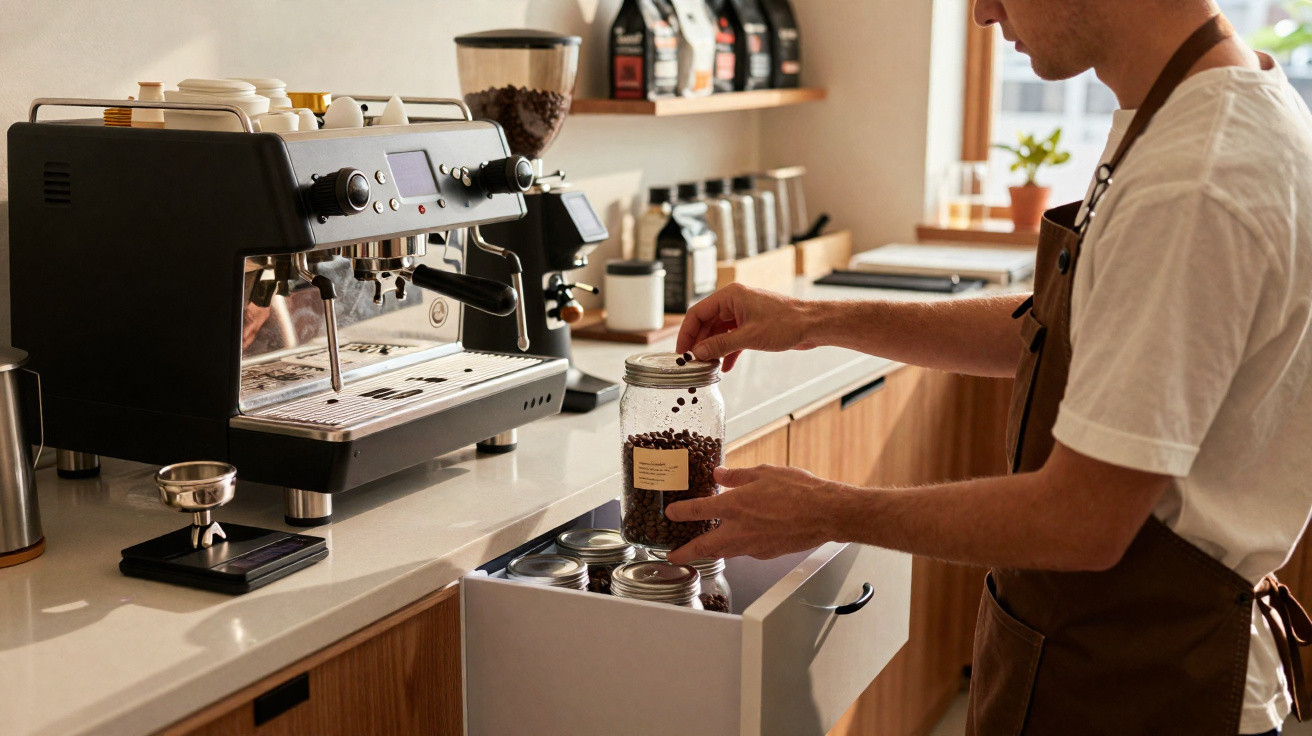
While drinking an espresso with coffee consultant Jaymie Lao, I mentioned my concern that beans I had brought back from a recent trip to Panama would go stale before I could finish them. Her recommendation was straightforward: “Just freeze it.”
“Did you say freeze it?” I asked, wide-eyed. “Yes,” she replied, “You just can’t have any air or moisture in the bag.”
For years, advice about coffee storage made freezing beans sound forbidden: an amateur error that would spoil valuable coffee beans.
Previous generations often stored coffee in battered tins in the cupboard or put loose beans in flimsy bags in the freezer. Yet that approach creates an inconsistent environment, allowing beans to take on moisture and unwanted smells.
As the second wave of coffee, led by Starbucks and Peet’s, gave way to a third wave focused even more closely on artisanal sourcing, roasting and brewing, interest also grew in keeping specialty coffee beans fresh.
Even if, like me, you spend plenty of time around cafés, roasters and barista competitions, you may not realise that freezing is an option when you have more coffee than you can drink before it loses freshness.
Freezing coffee beans for major barista competitions and specialty café menus
If freezing is suitable for some of the world’s leading specialty coffee shops and barista competitions, it is certainly worth considering at home.
Freezing coffee carefully can retain its freshness and help you brew every one of your valuable beans.
When Esben Piper, founder of Danish coffee company La Cabra, launches new roasteries, this frozen bean-storage method forms part of the plan.
“The program [includes] a freezer menu with rare and limited lots that we acquire through auctions and our network of long-time producing partners over the past decade,” says Piper.
Freezing coffee carefully can retain its freshness and help you brew every one of your valuable beans.
At La Cabra, the team has been testing how to identify the best time to serve coffee for maximum flavour. Light-roasted coffee remains fresh for longer than dark-roasted beans. “It’s all about raw material and its density,” says Piper.
Kyle Ramage, co-owner of Black and White Roasters in Raleigh, North Carolina, has tested frozen coffee beans for competition. He now applies some of what he learnt to preserve the coffees the brand values most for drinking in the future.
“Black & White focuses on small producers and seasonality,” says Ramage. “So, when I find a coffee that does it for me, then those are the ones to save some to drink later.”
Ramage relies on a vacuum-sealing machine to protect beans, and Black & White has stored coffees for roughly 12 months, including some from its Black Label club competition coffee subscription. This year, the brand will introduce a freezer menu featuring 20 to 25 coffees in its cafés.
Matt Lewin of Australian specialty roaster ONA Coffee also supports storing roasted coffee beans in the freezer. While getting ready for a barista competition, Lewin trialled frozen coffee with Hidenori Izaki, World Barista Champion 2014. Both found that low temperatures improved the coffee’s flavour.
That experience prompted Lewin to investigate how rare coffees could be frozen and served in ONA Coffee cafés across Australia, while also advising customers on freezing beans at home. “One of the critical insights from experimenting with freezing coffee beans is understanding the perfect ‘peak flavor window,’” he says.
According to Lewin, coffee beans should ideally be frozen 10 days after roasting.
“At this point, the beans have released most of their CO2 from the roasting process, and the balance between CO2 and oxygen is just right allowing the beautiful aromas of the coffee to come through,” he adds.
Freezing beans at home
Avoiding the waste of high-quality beans makes sense from both a financial and sustainability standpoint.
If you want to freeze a whole bag still sealed by the roastery, a few straightforward measures can help it stay fresh for later brewing.
“Regardless of the bag size, push out as much air as you can before freezing,” says Lewin. “This step is crucial in maintaining the coffee's quality. Once the air is out, cover the bag's one-way valve with tape. This valve usually lets CO2 out, but covering it ensures no air can get in.”
Avoiding the waste of high-quality beans makes sense from both a financial and sustainability standpoint.
For the strongest results, Lewin recommends vacuum-sealed bags. “This method helps maintain the coffee’s quality and prevent any potential freezer burn or other issues,” he says. Whether you are freezing a large quantity or a small one, excluding air and sealing the bag correctly makes a substantial difference to flavour preservation.
Alejandra Jaimes of Estellar Coffee uses a Foodsaver Vacuum Sealer Machine to preserve coffees she brings home from their farm in Colombia.
Estellar’s central aim for Jaimes is sharing the sensory experience of drinking coffee, so keeping coffee beans fresh is extremely important. She hopes that sharing this information will help people feel confident buying coffee, storing it properly and learning to brew delicious coffee at home.
Keeping coffee beans fresh
When Michael Phillips, World Barista Champion 2010 and global director of culture for Blue Bottle Coffee, sought an efficient way to store beans, he began looking into keeping them in individual doses.
“When you open a bag of coffee beans, the clock is ticking,” says Phillips. “Oxygen is the enemy. I saw people using Weber Workshop tubes that hold 25 grams of coffee beans. They reignited the game for me.”
Weber Workshops bean cellars are constructed from BPA-free polypropylene. Their caps use a one-way valve system that lets CO2 outgas, producing an ideal setting for maintaining bean freshness while providing easy access to a single dose for brewed coffee or an espresso shot.
Phillips has since filled several tubes, creating his own coffee bean library for saving special coffees to drink later or share with friends and colleagues. After filling a tube with gasket caps that keep oxygen out, he labels it with all the details and stores it in Ziplock bags sorted into categories such as “filter coffee” and “espresso”, plus “Japan” and “Korea” for recent trips.
Asked about the ideal temperature for stored beans, Phillips says, “The colder the better.”
Brew coffee like the pros
After removing a full bag of coffee from the freezer, give the beans the best chance of remaining fresh by placing them in a vacuum canister somewhere cool and away from sunlight. Fellow produces a range of canisters that remove air and limit oxidation with a few turns of the lid.
What should happen next once beans kept in single-dose tubes have come out of the freezer?
“When it comes to brewing frozen coffee beans, the answer is delightfully simple,” says Lewin. “Grind them straight from the freezer.”
Others may suggest allowing the beans to reach room temperature first. Provided fresh coffee beans have been stored and frozen correctly, either method could make a delicious cup.






Comments
No comments yet. Be the first to comment!
Leave a Comment