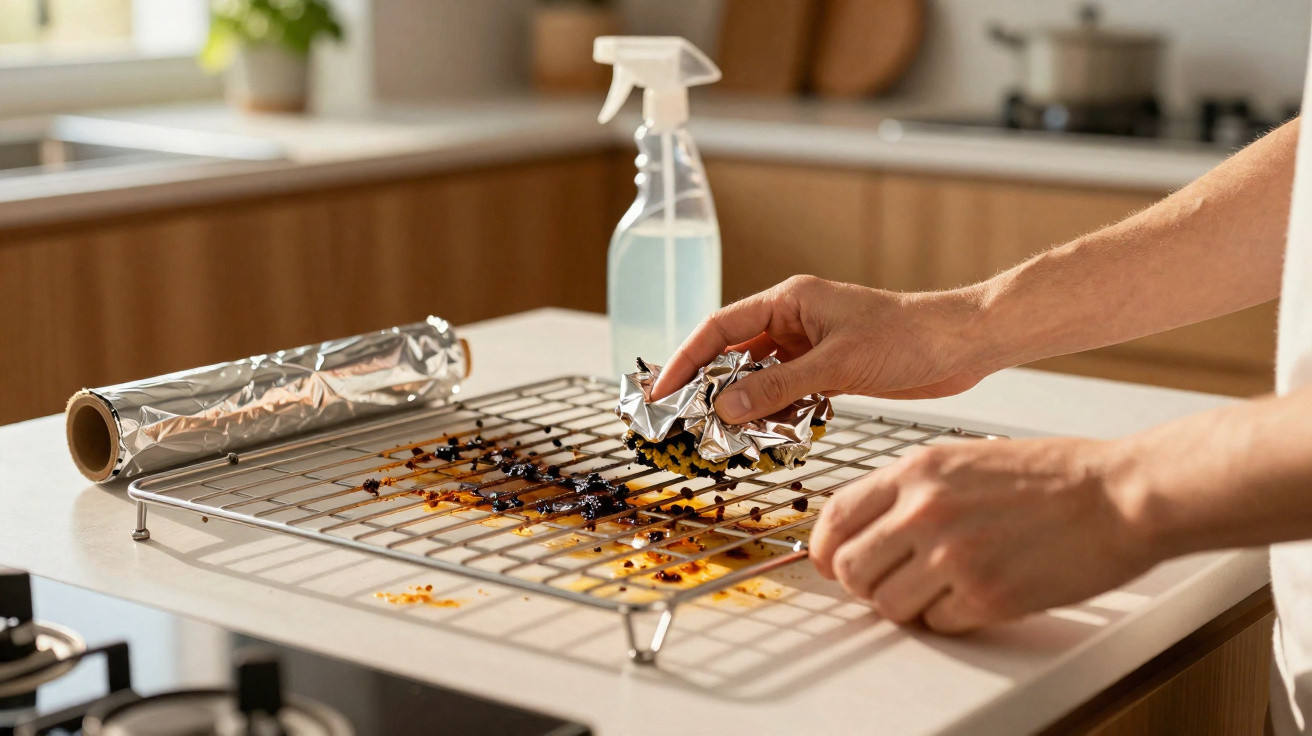
Sometimes, all it takes is opening the oven door after a slightly over-generous gratin to face the problem: the rack has turned black, sticky and almost unrecognisable. You put off dealing with it, telling yourself that “it can wait until the next clean”, then the baked-on grease marks become firmly established. We all know that moment when we scrub with a sponge, our arms already aching, and get very little in return. Yet a simple ball of crumpled aluminium foil can make a difference, without expensive stripping products or an endless scrubbing session. It is a cupboard trick that seems almost too easy. And that is precisely what makes it intriguing.
This ball of aluminium foil that tackles burnt-on residue
An oven rack is a thankless item: it catches splashes of cheese, meat juices and grease, then sits there being baked for a second time with every use. Over time, its surface becomes rough and dark, even in an otherwise well-kept kitchen. Crumpled aluminium foil works like an improvised small scouring pad, but has a less harsh texture than a stiff wire brush. Damped with a little hot water and washing-up liquid, it grips carbonised deposits and gradually lifts them away. The process is surprisingly satisfying, particularly when the first areas of metal start to reappear beneath the grime.
Claire, who cooks extensively for her family on Sundays, had an oven rack that had taken on a dark brown-black colour after several batches of roast chicken and savoury tarts. She had tried using an ordinary sponge for nearly twenty minutes without any visible result, before picking up a piece of aluminium foil intended for recycling. After a few passes over the still-damp bars, the thickest marks began to crumble away. It did not make the rack look brand new in thirty seconds, let us be honest: nobody really does that every day. However, it spared her an overnight soak and the chore that eventually puts off even the most motivated people.
The idea is fairly straightforward: burnt-on deposits cling in layers, particularly when they have dried without being cleaned after cooking. The ball of aluminium foil creates numerous tiny raised points that rub against uneven surfaces without requiring excessive force. Hot water helps soften the grease, while washing-up liquid makes it easier to rinse away. This is not a chemical miracle, but a well-targeted mechanical action. The most useful tips are often those that reduce everyday resistance. On a chrome oven rack in good condition, the outcome can be genuinely impressive.
The right way to clean an oven rack without damaging it
Start by taking the oven rack out and allowing it to cool completely, an obvious precaution that is sometimes forgotten when you want to get the job done quickly. Place it in the sink, a large basin or directly on an old towel at the bottom of the bath if it will not fit anywhere else. Pour over hot water with a few drops of washing-up liquid, then leave it for five to ten minutes. Crumple a used sheet of aluminium foil into a compact ball, without compressing it until it is hard as a stone. Scrub one bar at a time using steady movements, concentrating on dark build-ups rather than the entire surface.
The most common instinct is to tackle the rack dry and with great force from the first few seconds. The urge is understandable: when the grease is black, you want it gone immediately. However, moisture does much of the work and stops you exhausting yourself for no reason. Rinse the ball of aluminium foil once it becomes loaded with residue, then add a little more soapy water if needed. Avoid this method on a rack with a delicate, painted or enamelled coating, as rubbing could leave marks. It is better to test an inconspicuous corner before treating the whole surface.
For older stains, leave the rack to soak for longer in very hot water with washing soda crystals, following the product instructions and wearing gloves. The ball of aluminium foil can then be used as a finishing step, once the deposits have lost their hardness.
“Good cleaning is not the method that takes the most effort; it is the one you are willing to repeat rather than put off until the following month.”
Keep a few simple steps in mind before you begin:
- protect your hands with household gloves;
- work on an oven rack that is cold and slightly damp;
- rinse thoroughly before putting the rack back in the oven.
A small habit that also changes how you view cleaning
This tip is appealing because it brings a little common sense back to a task that is easy to make into a bigger ordeal than it needs to be. A crumpled sheet of aluminium foil, often destined for the bin, becomes a practical tool for rescuing an oven rack without adding lots of specialist bottles to the cupboard. The result will inevitably depend on its starting condition: a layer of grease that is several years old will take time, and may sometimes need a second pass. Yet seeing the metal become lighter again is often enough to restore your motivation. A clean oven rack does not transform a kitchen, but it removes that small visual burden you eventually stop noticing.
There is also a sense of relief in choosing an accessible method, with no lingering chemical smell or extra packaging. Some people may prefer bicarbonate of soda, others soft soap or a prolonged soak: it all depends on the equipment available, the time you have and the oven rack’s actual condition. The aim is not catalogue-perfect results, but a rack that is clean, hygienic and pleasant to handle. The next time a dish overflows in the oven, the response can be simpler: act once it has cooled, before the mark turns into a battle. And what is the tip that stops you putting cleaning off until tomorrow?
| Key point | Detail | Added value for the reader |
|---|---|---|
| Crumpled aluminium foil | Used damp with hot water and washing-up liquid | Lifts burnt-on residue with minimal equipment |
| Soaking beforehand | Five to ten minutes, longer for old stains | Reduces scrubbing effort and saves your arms |
| Testing an inconspicuous area | Recommended for coated or delicate racks | Limits the risk of scratches or visible marks |












Comments
No comments yet. Be the first to comment!
Leave a Comment