The first time I stripped and re-seasoned a cast iron pan, I almost cried. It was not because the job carried some poetic, inherited-kitchenware significance; my flat simply smelled as though a tyre fire had broken out, and I was convinced the building alarm was about to sound. The instructions I had used said to turn the oven up as far as possible, cover the pan in oil and bake it until the smoke became “normal”. None of that seemed remotely normal. I flung open every window, waved a tea towel about like a lunatic and swore I would never repeat the experience.
Several months later, amid the steady hum of a working kitchen, a chef showed me an entirely different approach. There was no dense smoke, panic or concerned neighbours wondering whether I had set fire to my home. It was slower, softer and, frankly, rather dull to watch. But the very same pan began performing like a far pricier bit of equipment. Food no longer clung to it, its finish remained smooth, and, best of all, it appeared to keep going. That was when I understood that chefs had been quietly relying on a low-heat seasoning method that home cooks are rarely taught.
The myth of “blast it and hope for the best”
Most people first encounter cast iron seasoning through a macho, mildly alarming version of the same process: turn the oven up to near-volcanic temperatures, drown the pan in oil, burn it on for an hour and repeat until the smoke alarm gives in. It sounds forceful and effective, which is likely why it feels trustworthy. High heat must mean better results, surely? Yet that harsh treatment can be exactly what makes a pan deteriorate early. The thick, uneven coats it produces may initially seem dark and shiny, but they can chip, flake or become tacky within a matter of weeks.
We have all experienced the disappointment of slipping a fried egg into a freshly seasoned pan, then having to lift it out in rubbery fragments minutes later. You are left holding a spatula and asking what happened to the “non-stick miracle” everyone talks about. That subdued frustration is often the first indication that the usual high-heat technique is not as miraculous as the internet makes it sound. It certainly has an effect, but that effect is not always beneficial, particularly with an older or thinner pan, or one that has already been through rust and restoration.
Then there is the odour: that scorched-oil smell that settles into the curtains and makes you question every decision that led to “seasoning day”. You tell yourself it only needs doing every few months, which usually means putting it off until the pan is too far gone to overlook. In truth, hardly anyone carries out a complete high-heat seasoning routine as often as they supposedly should. It is such a disruptive, demanding task that the pan instead falls into a peculiar pattern of neglect followed by emergency treatment.
The low-heat cast iron seasoning trick chefs quietly use
Ask a professional chef how they keep cast iron skillets going through punishing double shifts and relentless use, and their response may not be what you expect. They will mention washing, drying and avoiding long soaks in soapy water, of course. But the discussion generally turns to something much simpler and calmer: low heat, a light coating of oil and patience. There is no theatre, no smoke and no oven struggling at 260°C.
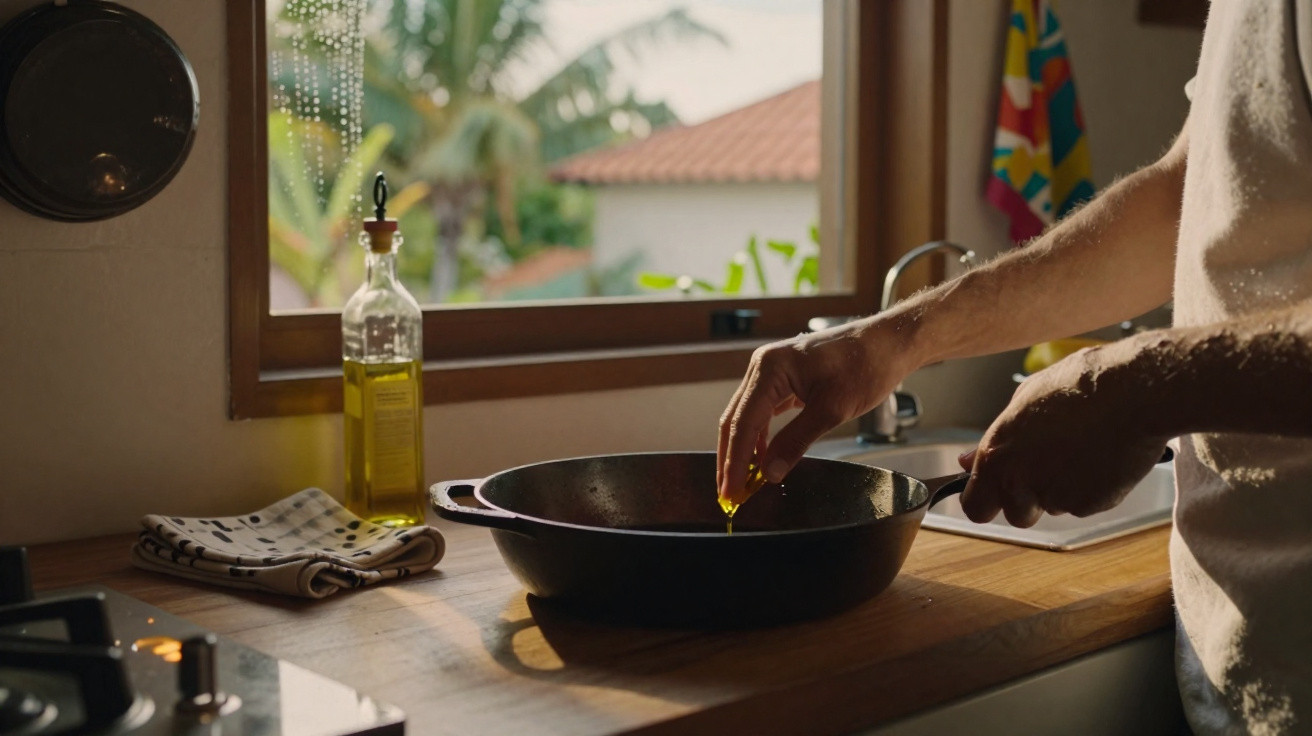
In a London kitchen, a sous-chef simply shrugged when I asked about their “secret seasoning technique”. She took a worn black pan that was still warm after service and returned it to the lowest flame. In went no more than a teaspoon of neutral oil. She tipped the pan until the oil moved around it like a slow tide, then used a folded cloth to wipe it away until only the faintest sheen remained. “Then we just forget about it for a bit,” she said. That was the whole method: no ceremony, sacred schedule or announcement to the entire kitchen.
To someone trained to think in terms of maximum heat, what she did almost looked wrong. The flame was barely there, a small blue murmur beneath the pan. Yet that mild warmth allowed the oil to alter slowly, firming and drying into an incredibly thin, tough coating. Rather than building one thick, sticky layer that might peel away, it created microscopic layers stacked over one another, quietly added night after night. Chefs rely on it not because it is dramatic, but because it delivers results when nobody is looking.
Why low heat helps cast iron last longer
Without the intimidating chemistry, the science is almost frustratingly straightforward. Seasoning is essentially oil changing into a tough, plastic-like layer that adheres to the metal. Subject oil to fierce heat and it may overcook, gather in pools and leave soft sections that never properly cure. Those weak areas are responsible for the tackiness you feel on a pan, or for the strange glossy flakes that break off after a few weeks of cooking.
Gentle, consistent heat applied regularly rather than aggressively lets those coatings polymerise gradually and uniformly. Whenever the pan is warmed with only the slightest residue of oil, it gains another near-invisible layer. There is no bubbling or obvious transformation, only the slow formation of protection. Instead of merely looking black, the cooking surface begins to feel like one continuous, smooth piece of metal, without rough spots or raised patches.
This is why a pan seasoned at low heat generally remains dependable year after year instead of alternating between brilliant and infuriating. You are not forcing the iron through repeated miniature house fires. You are allowing it to mature as good leather does: gradually and quietly, gaining character rather than damage. That small shift in method can determine whether your cast iron remains in use 30 years from now or sits at the back of a cupboard, sticky, rusty and unwanted.
The step-by-step method chefs use at home
There is a chef’s version suited to a frantic professional kitchen, and a home version that fits into ordinary life. Fortunately, they are almost identical. Begin with a pan that is clean and dry. It does not need to gleam or be obsessively scrubbed, but it should have no obvious food remnants. If you have just washed it, place it on the hob over low heat for a few minutes until every trace of water has disappeared. The pan should be warm rather than fiercely hot.
Next, use the smallest amount of oil possible. Do not pour in a glug or add a generous spoonful; for a medium-sized pan, think half a teaspoon. Choose sunflower, rapeseed or grapeseed oil: something neutral with a reasonably high smoke point. With kitchen roll or a lint-free cloth, rub the oil over the entire pan, inside and outside, until it appears almost dry once more. If you can see a clear shine or any oil collecting in places, you have applied too much.
Put the pan over low heat. Not medium-low, and not the setting you choose when tempted to “speed this up a bit”, but the lowest flame or hob setting that still produces warmth. Let it sit there for 10–15 minutes. You may notice the slightest shimmer, or detect a mild warm-oil scent if you lean close, but there should be no smoke. Switch off the hob and allow the pan to cool where it is. That completes one layer: calm, controlled and free from stress.
Make cast iron seasoning part of cooking rather than another chore
The real benefit arrives once this no longer feels like a separate task and simply becomes the way you finish cooking. Do it once daily, every few days, or whenever the pan has been used and you are not rushing out of the house. Once it is clean and dry, low-heat oiling becomes the final bedtime kitchen step, much like locking the door or turning out the lights.
One chef told me that he does it while waiting for the kettle to boil for his late-night tea. Pan on the hob, low heat, a tiny amount of oil, wipe it over, then leave it alone. By the time the kettle clicks off, the seasoning has already started to cure. That small maintenance ritual is strangely satisfying. It changes cast iron from a high-maintenance diva into something you look after quietly, almost automatically.
Because every coating is so thin, there is no need to wait for a mythical large-scale seasoning day every few months. The pan gets better in the background, service after service and dinner after dinner. Missing one evening will not ruin anything. But after a few weeks of this pattern, the pan performs like an entirely different object: more forgiving, more dependable and always prepared for use.
What it feels like when the pan finally “clicks”
A few weeks into low-heat seasoning, there is often a point when the pan begins to feel as though it is cooperating. Onions slide around rather than fusing to the base. Salmon skin crackles, then releases without that dreadful tearing sound. Browning starts to seem effortless instead of becoming a fight against scraping and sticking. The pan may also heat more evenly, almost as though the fine layers have softened its old scars.
You start trusting it with fragile foods: eggs, pancakes and delicate fish. These are the ingredients that once let you down, sticking firmly to the surface and forcing you to soak and scrub afterwards. Suddenly, they behave as though you have invested in expensive premium non-stick cookware. At the same time, the pan still sears steak beautifully and still produces the bold, satisfying crusts that made cast iron appealing in the first place.
There is an emotional change too, although it is harder to put into words. The pan ceases to be a project and becomes more like a relationship. You learn that it prefers to heat gradually. You understand that a minute of low-heat oiling at night will repay you tomorrow, when you are hungry, tired and have only 15 minutes to make dinner. That understated, mutual confidence is why people become so devoted to cast iron after a positive experience with it.
The honest details nobody includes in the instructions
Many online guides present cast iron care as though it were a test of character: season it flawlessly or you have failed. That is nonsense. Actual kitchens are untidy. Someone forgets to dry the pan fully, uses an unsuitable oil, or a visiting friend attacks it with washing-up liquid and a scouring pad while you are not looking. Life gets in the way. Fortunately, low-heat seasoning is remarkably forgiving, and you can restart even when the pan is in less-than-ideal condition.
If your pan is already sticky or patchy, the low-heat method is still your way out. Remove as much built-up residue as possible using hot water, a scrubber and some patience. Dry the pan completely, then begin again with ultra-thin layers at low heat. It may not be restored in a single day, but a couple of weeks of regular cooking and careful oiling will help the surface become even again. Cast iron is stubborn in the most useful sense: it wants to recover.
There is another reality worth remembering: perfection is unnecessary. If you miss a day or occasionally forget the oil, it does not matter. The aim is not to follow a ritual without deviation, but to escape the cycle of abandonment and rescue. Low-heat seasoning works because it rewards the small, almost lazy version of consistency – the kind normal people can actually manage.
Why gentle seasoning keeps the pan in the family
People who have inherited cast iron from parents or grandparents often call those pans “bulletproof” or “indestructible”. That durability is not accidental. It comes from decades of precisely this type of low-key attention: warming the pan, oiling it and allowing the layers to accumulate like tree rings. It is not the product of dramatic oven sessions performed a few times each year, but of modest acts of care repeated hundreds of times.
Chefs favour the low-heat approach partly because they cannot spend hours fussing over equipment, and partly because they see the effects of mistreatment firsthand. A pan that is continually blasted with heat, overheated, rapidly cooled and scrubbed relentlessly will not endure as long. Slight warping develops, the seasoning splits and rust finds its way into corners. A pan seasoned gently, over and over, develops a quiet toughness. It does more than tolerate heat; it adjusts to it.
That’s the real promise hiding inside this method: not just a non-stick surface, but a pan that might outlive you. There is something unexpectedly reassuring about that. In a kitchen packed with appliances that fail as soon as their guarantee ends, cast iron is among the rare possessions that improve as they age. Low heat is not only a technique; it is a long-term commitment. It says, “I plan to be cooking on this in ten, twenty, thirty years.”
The small end-of-day ritual that changes everything
Imagine the final plate is washed and the worktops have been wiped down. The kitchen is still, apart from the quiet fridge hum and the fading scent of whatever you have cooked. You take up the cast iron pan, still slightly warm, and set it over a low flame. Add a drop of oil, give it a quick, unthinking wipe with the cloth reserved for the job, then leave it over gentle heat for a few minutes while you look at your phone or chat with somebody nearby.
It does not register as work. It scarcely feels like a task at all. Yet this tiny routine is what can turn an inexpensive second-hand skillet into the pan your children may one day argue over. It is the one that knows your fried eggs, late-night toasted cheese sandwiches and Sunday roasts. It is the pan that almost never disappoints you.
You do not need a chef’s jacket or access to a professional kitchen to season cast iron as chefs do. You only need low heat, the merest trace of oil and a little patience. The cast iron handles the rest. Then, one day, you will turn out a perfect golden omelette that slides free without resistance and realise that, all along, the pan has quietly been looking after you too.










Comments
No comments yet. Be the first to comment!
Leave a Comment