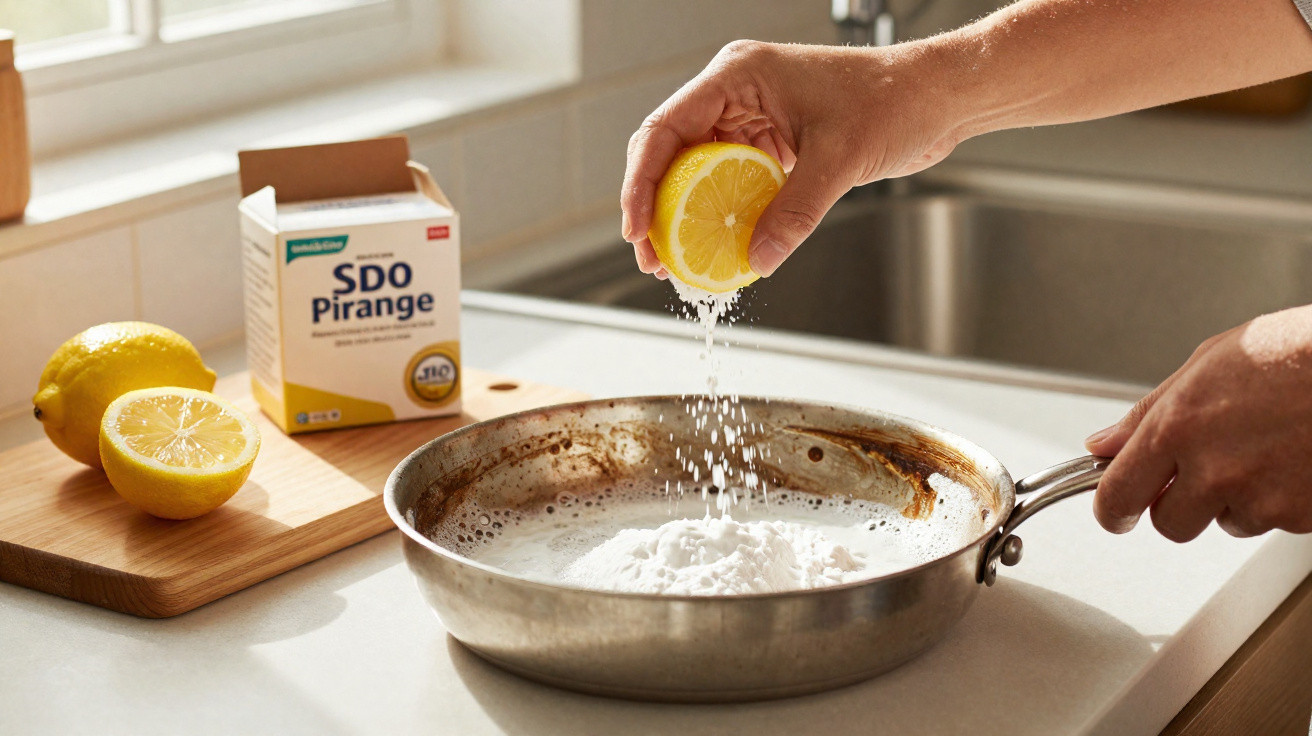
The pan had been dull for months. It was coated in caramelised oil, scorched sauce and a stubborn sticky ring that had defeated every supposed “miracle” cleaner you had tried. In the unforgiving kitchen light, the mark seemed virtually permanent, fused to the metal like an unwanted habit.
Then one evening, you reach for the weary lemon rolling around in the fruit bowl and the partly opened box of baking soda tucked at the back of the cupboard. There are no glossy labels or loud television adverts involved. Only two ordinary kitchen ingredients beside that unyielding stain.
You press, scatter, and wait.
Then the surface begins to transform.
The subtle strength of a simple kitchen combination
It is strangely pleasing to see a greasy, lacklustre hob regain its former appearance. At first, the metal is concealed by yellowed splatters, brown rings and the tacky coating that appears to collect every crumb in the house. Then lemon juice and baking soda start fizzing across it, creating a small chemistry demonstration you did not realise you wanted.
The fragrance arrives before anything else: fresh, sharp and almost like pressing reset on the entire room. Next, the sponge starts to move more freely, while grime that once held fast begins to release. Beneath your fingertips, you can feel that resistance easing away.
Imagine a Sunday morning following a large Saturday meal. You enter the kitchen after waking and immediately regret every bit of enjoyment from the previous evening. There are baking trays with burnt-on cheese, roasting tins edged with charred fat, and wooden spoons stained by tomato sauce. It is the sort of kitchen mess that makes closing the door and acting as though the room is not there feel tempting.
A friend of mine says she nearly threw away her favourite oven tray. Instead, she squeezed half a lemon over its dark crust, added a generous covering of baking soda and left it on the worktop while drinking her coffee. On returning, she found the worst deposits could be scraped away in slow, gratifying curls. The tray appeared almost new, as though it had forgiven her.
There is no magic at work on that tray; it is chemistry. Lemon contributes acid, while baking soda provides alkalinity, and their combination produces a mild fizz that can help release grime from surfaces. The acid helps break down mineral deposits and aged grease, while baking soda's gentle abrasive quality gives a sponge more purchase without scratching most metals.
As they react, the bubbles may force tiny particles out of the scratches and pores where dirt tends to settle. Rather than merely moving residue around, you are helping weaken the connection between a stain and its surface. That persistent brown ring in the sink suddenly has a rival.
Using lemon and baking soda for everyday kitchen disasters
Begin with the straightforward approach. For burnt pans and oven trays, spread a generous layer of baking soda over the cooled surface. Squeeze fresh lemon juice over it until a foamy paste forms and gently hisses. That sound signals that the reaction is under way.
Leave the mixture in place for at least 10–15 minutes. If stains are particularly stubborn, give it 30 minutes. Return with a soft sponge or non-scratch scourer and work in circles. Rinse using hot water, repeating the process on the darkest areas if necessary. Stainless-steel sinks can be treated in exactly the same way: sprinkle, squeeze, let it fizz, then wipe and rinse until the metal gleams again.
Many people lose heart during the stage when it seems that nothing is happening. After sprinkling and scrubbing for 30 seconds, it is easy to decide the method is simply another internet myth when the stain does not disappear instantly. In reality, some grime builds up in layers, much like old paint. It requires time, patience and, occasionally, a second application.
Take care with delicate materials such as marble and natural stone, as acidic products are not suitable for them. Try the mixture first on a small concealed area. Avoid tackling every mark with excessive force: allow the lemon and baking soda to handle some of the work, then finish with measured, even movements. Honestly, nobody does this every day. However, spending an additional ten minutes now and then may rescue a pan you had written off.
Sometimes the lemon-and-baking-soda method feels like an old family trick that quietly survived the era of neon-colored cleaning sprays. One woman told me, “My grandmother used this on her sink every Sunday. She never owned a single ‘degreaser’ in her life, but her kitchen always smelled like lemons and looked spotless.”
- For greasy hobs
Apply baking soda to cooled grease splashes, drizzle over lemon juice, leave for 10 minutes, then wipe with a damp cloth. - For marked chopping boards
Cover with baking soda, use half a lemon as a “scrub brush”, leave for 5 minutes, then rinse and stand upright to dry. - For tea and coffee stains in mugs
Use 1 teaspoon of baking soda with a squeeze of lemon, scrub with a soft brush, then rinse thoroughly so no taste remains. - For smelly sink drains
Tip baking soda into the drain, add lemon juice, and follow with hot water once the fizzing has settled. - For oven-door glass
Create a thick paste from baking soda and lemon, apply it to the glass, wait 20 minutes, then remove it with a damp microfibre cloth.
Why this traditional duo still seems surprisingly modern
There is real comfort in opening the cupboard and finding that the answer has been there all along, between the flour and sugar. There is no complicated process or 12-step cleaning ritual: just a lemon, baking soda and a little effort. You are doing more than cleaning; you are cutting through the noise in the kitchen and returning to the basics.
Everyone knows the feeling of a mess seeming larger than the energy available to deal with it. Yet something changes when cleaning is no longer a task driven by harsh odours and plastic bottles, but becomes almost…quiet. You try, scrub, rinse, and the surface gradually recalls how it once looked. Perhaps that is why this uncomplicated pairing remains popular. It is not flawless, but it feels manageable, human-scale and curiously considerate of the place where you prepare food, eat and live.
| Key point | Detail | Value for the reader |
|---|---|---|
| Natural chemistry at work | Lemon acid and baking soda react to loosen grease, stains and residue | Explains why this combination works, rather than merely showing how to reproduce it |
| Simple, low-cost routine | Relies on ingredients found in most kitchens instead of specialist cleaners | Saves money and cuts down on clutter beneath the sink |
| Versatile on many surfaces | Can be used on pans, sinks, hobs, mugs and more through one approach | Makes deep cleaning seem more manageable and accessible |













Comments
No comments yet. Be the first to comment!
Leave a Comment