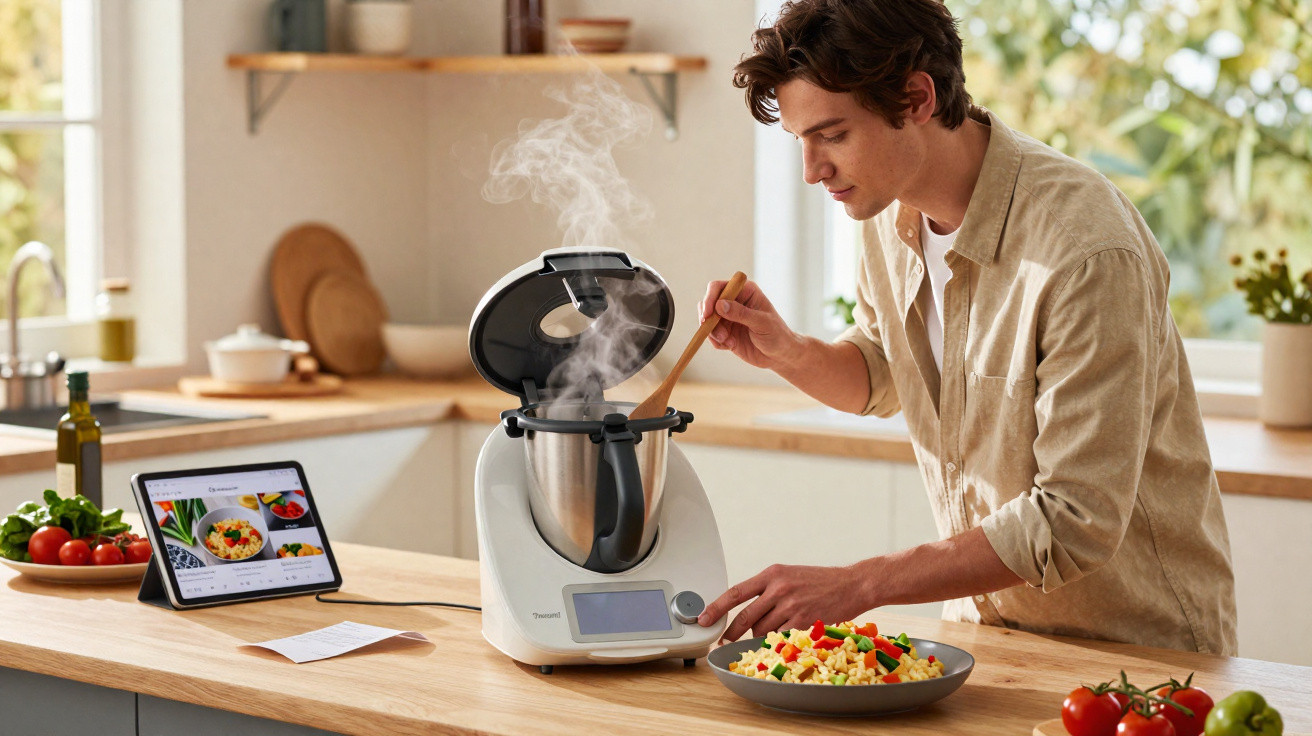
£599 – yet this exact price is currently sparking heated debate.
Vorwerk’s new Thermomix TM7 is being treated as a luxury appliance, even as conventional food processors continue to fall in price. Even so, many professionals describe it as the most sensible all-round package currently available in the cooking machine segment. So what is behind that view – and when does this appliance genuinely pay off in day-to-day life?
A market with fewer serious rivals
A few years ago, the market was still packed with ambitious cooking robots: major brands launched their own all-in-one appliances with cooking functions, while discounters followed with cheaper alternatives. The picture has changed noticeably since then.
Several familiar models are quietly disappearing from shop shelves, replacements are slow to arrive or have been significantly stripped back. Some manufacturers are pulling out for cost reasons, while others are focusing on simpler appliances that require less support and software maintenance.
“The TM7 benefits from a market in which serious alternatives are becoming rarer – especially at the premium end.”
Anyone now looking for a powerful cooking robot with long-term support, regular updates and an extensive recipe catalogue will almost inevitably end up considering Vorwerk. That is precisely what makes the price debate so interesting: the TM7 is expensive, but it occupies a market that has become considerably less crowded.
What the Thermomix TM7 actually offers technically
To put its price into context, it is worth examining the specification. The TM7 is not simply a conventional blender with a heating function; it is a complex system combining a motor, heating unit, sensors and software.
- Powerful motor with several speed settings and interval functions
- Built-in scales for gram-accurate measuring directly in the bowl
- Programmable heat settings, from gentle melting to intensive frying
- Guided cooking with step-by-step instructions shown on the display
- Wi-Fi connectivity for the recipe database and software updates
Compared with many less expensive cooking robots, the TM7 stands out chiefly through its blend of precision and ease of use. Its electronics control temperature and time very precisely, which can make a noticeable difference with delicate recipes such as creams, sauces or doughs.
Software: the hidden driver of the price
A substantial part of its value lies not in the steel and plastic, but in its software. Vorwerk maintains a large, curated recipe library with countless cooking programmes that are linked directly to the appliance. Ingredient quantities, stirring speeds and temperatures are all coordinated with one another.
This removes much of the guesswork from cooking. Those who follow the guided recipes will often achieve repeatable results, regardless of their own cooking ability. Families in particular, who want to prepare meals quickly and reliably during the week, value exactly this approach.
Does an appliance costing £1,599 really make financial sense?
The key question remains: can a kitchen appliance priced at £1,599 still be considered sensible? The answer depends heavily on everyday routines. In households where meals are cooked every day, the calculation shifts considerably.
A notional stocktake that is often underestimated:
- Fewer ready meals, because cooking fresh food becomes easier
- Less reliance on takeaway delivery services, as quick recipes can be completed in 20–30 minutes
- More manageable use of leftovers, since soups, stews and sauces can be made in no time
- Fewer separate appliances, including a blender, chopper, steamer and food processor
If a household uses the TM7 several times a week, its cost is spread across many years. In addition, Vorwerk is known for supporting its products over the long term and making spare parts available. That lowers the risk of having to invest again after only a short time.
“The Thermomix is not a bargain; it is more of a long-term kitchen project – similar to a high-quality oven or a good dishwasher.”
Where cheaper alternatives fall short
Lower-priced cooking robots have their appeal, particularly for occasional cooks. In daily use, however, typical stumbling blocks emerge that frustrate many owners:
- Less accurate temperature control, which can cause problems with demanding dishes
- Noisier motors and less smooth running
- Smaller or inconsistent recipe selections, often without genuine quality control
- Less frequent software updates, leaving functions frozen at the level available on the purchase date
- Customer service and repairs that can be difficult or uneconomical
For people who “just want to cook”, this may be sufficient. However, anyone who genuinely relies on the appliance – perhaps because several meals are prepared every day – quickly notices how important reliability and convenience become.
Five stars, but not a miracle machine
Despite its high review scores, the TM7 remains a kitchen tool rather than a magic box. Anyone who never tastes as they cook can still get things wrong, even with guided recipes. Nor will every dish on the recipe platform suit every palate.
The learning curve also matters. During the first few weeks, users need time to work through the menus and functions. The TM7 only reveals its strengths at everyday pace once favourite recipes have been saved and the routine steps become familiar.
Who the TM7 suits – and who it does not
Not every household benefits to the same degree. A few typical profiles can help with the assessment:
| Household type | Is the TM7 worthwhile? | Why / why not |
|---|---|---|
| Family with children | Usually yes | Fast everyday meals, larger quantities, predictable routines |
| Single person, rarely at home | Probably not | The appliance often goes unused, so any cost benefit disappears |
| Couples who enjoy cooking | Often yes | Willingness to experiment, many functions, recipe-led convenience |
| Occasional cooks | Questionable | Simpler appliances are often enough, and the price is hard to justify |
| Technology enthusiasts | Frequently yes | They value updates, connectivity and guided cooking |
Anyone who uses the TM7 only to purée soups from time to time is paying far too much. The price only starts to make sense when the appliance plays a more central role in the cooking routine.
Why the Thermomix TM7’s overall value is rising now
The timing is particularly interesting. Alternatives are currently weakening in many areas. Some long-standing competitors are leaving the market, while new projects are only getting under way hesitantly. Brands unwilling to take on the considerable work involved in recipe maintenance, software development and service are withdrawing.
This changes the perception of the TM7. A few years ago, it was easy to say: “Too expensive, I’ll choose model XY for half the price.” That choice is shrinking today. Buyers who care about long-term availability, a dependable platform and repairability have fewer genuine alternatives than they did in 2019 or 2020.
“The TM7 feels less like a luxury gadget and more like the last major all-rounder backed by a system designed for the long term.”
What buyers should consider before purchasing
Anyone considering spending £1,599 on the TM7 should consciously examine a few points:
- How often will meals realistically be cooked, and how much of that work will the Thermomix take on?
- Are guided recipes desirable, or do they feel more limiting?
- Is there enough worktop space so that the appliance does not disappear into a cupboard?
- Will the online connection be used, or will the appliance sit somewhere without stable Wi-Fi?
- How important are service, warranty and repair options for the intended pattern of use?
Those who answer these questions honestly will quickly see whether the TM7 would be a suitable kitchen companion or an expensive toy.
Practical examples from everyday cooking
For families, the added value often becomes apparent in everyday staples. Risotto, which once required constant stirring, can now run largely automatically while a salad is prepared at the same time. Bread dough achieves a repeatable consistency, which is especially helpful for beginners.
The TM7 also plays to its strengths when people change their diet. For example, anyone wanting to eat more healthily can use the recipe platform to switch specifically to healthier dishes without spending hours searching through blogs. Guided preparation lowers the barrier to trying new meals.
At the same time, there is a risk: some users become so dependent on automation that their traditional cooking skills deteriorate. Anyone who wants to remain flexible in the long run should regard the appliance as support, not as a replacement for every manual task.
A frank conclusion: expensive, but often the most rational choice
The Thermomix TM7 remains a high-priced kitchen luxury, and no amount of marketing changes that. Yet in a market where credible alternatives are becoming rarer, that luxury appears surprisingly rational.
People who cook regularly, value reliability and genuinely use the appliance receive very solid value for money. For occasional users, the TM7 remains excessive. But anyone intending to build their kitchen around a digital cooking assistant for the long term will currently find it difficult to avoid this appliance.

















Comments
No comments yet. Be the first to comment!
Leave a Comment