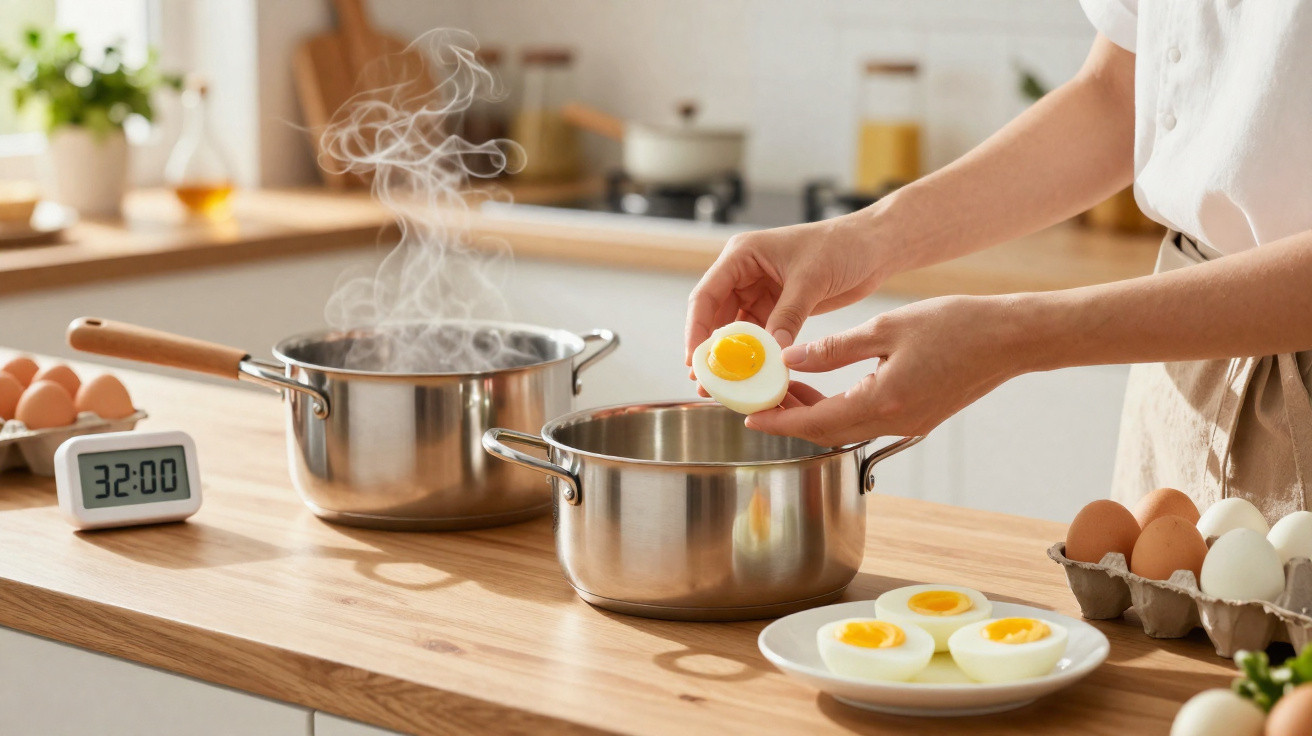
For generations, people have debated the ideal length of time for boiling an egg.
Now, physicists have done the calculations.
Breakfast tables and brunch menus have long been filled with views on “the right way” to cook an egg. However, a new Italian study says there is an exact, scientifically derived cooking time for the perfect hard-boiled egg - and it is far longer and more complicated than most home cooks might expect.
Why a hard-boiled egg is trickier than it looks
Hard-boiled eggs may appear to be one of the most foolproof dishes imaginable: a saucepan, water, heat, a timer, and you are finished. Plenty of people rely on a simple approach: put the eggs into boiling water, cook them for about ten minutes, then cool them rapidly.
French home cooks frequently refer to the “3-6-9 rule”: three minutes for soft-boiled eggs, six for medium eggs and nine for hard-boiled eggs. It is a neat formula, and generally an effective one.
Researchers at the University of Naples Federico II, though, say a genuinely “perfect” hard-boiled egg is more complex. In their view, it is a question of physics, involving heat transfer, protein denaturation and carefully controlled temperatures within the egg.
The ideal hard-boiled egg, by their definition, needs the white and the yolk to reach two different internal temperatures at the same time.
This is where the difficulty starts.
The science: two temperatures, one egg
The Italian researchers, who specialise in the structure of matter, published their work in the journal Communications Engineering. Their study modelled the movement of heat through an egg and the response of its proteins.
They found that the “perfect” result occurs when:
- the white (albumen) reaches close to 85°C
- the yolk (vitellus) stays around 65°C
At roughly 85°C, the egg white becomes firm, producing the clean, easily sliced consistency that many people prefer in sandwiches and salads. At around 65°C, the yolk is cooked through while remaining soft and creamy instead of dry, crumbly or chalky.
The problem is clear: both sections sit within the same shell, so how can the yolk remain cooler while the white reaches a higher temperature?
The surprising number: 32 minutes, not 9
The researchers’ proposed solution is plenty of time. Their calculations indicate that reaching both temperature targets takes approximately 32 minutes overall, in tightly controlled conditions.
According to the study, a textbook “perfect” hard-boiled egg requires about 32 minutes of carefully managed cooking.
For anyone accustomed to a fast weekday breakfast, that number may come as a surprise. The team is not advising people to simmer an egg for 30 minutes without interruption, however. Their method is considerably more involved.
How the two-pot method works
The scientists devised an approach to control the way heat enters the egg. You will need:
- 2 saucepans filled with water
- 1 cooking thermometer
- fresh eggs at room temperature, if possible
- a timer you can reset every two minutes
Step-by-step “laboratory” hard-boiled egg
To begin, keep one pan at a rolling boil, at around 100°C, while maintaining the other at a gently warm 30°C.
- Carefully lower the eggs into the boiling-water pan.
- Cook them for 2 minutes.
- Move the eggs into the pan at 30°C.
- Leave them there for 2 minutes.
- Repeat this four-minute sequence eight times.
| Cycle | Time in boiling water | Time in 30°C water | Cumulative time |
|---|---|---|---|
| 1 | 2 minutes | 2 minutes | 4 minutes |
| 4 | 8 minutes total | 8 minutes total | 16 minutes |
| 8 | 16 minutes total | 16 minutes total | 32 minutes |
Switching between the hot and warm water is intended to drive heat quickly into the white before slowing the process, allowing the yolk temperature to increase more gradually. Following eight cycles, the egg moves towards the target result: a firm white with a tender yolk that is fully cooked.
Do these eggs really taste better?
The Naples researchers looked beyond temperature graphs and also assessed the outcome nutritionally. They state that eggs made using this intermittent process have slightly better nutritional values than eggs boiled conventionally at a constant temperature.
The researchers suggest that the 32-minute method may better preserve some nutrients compared with straightforward boiling.
Prolonged, precisely managed heating seems to affect the setting of egg proteins and the breakdown of particular compounds. In principle, this may alter the bioavailability of some amino acids and vitamins. The changes will not make breakfast a superfood, but they offer an interesting detail for cooks concerned with nutrition.
Why most people will never cook eggs like this
There is one major drawback: practicality. The study resembles a physics experiment more than a recipe. Few people in a domestic kitchen are likely to monitor two saucepans and a thermometer for more than 30 minutes merely to prepare eggs for toast.
With its exact temperatures, continual transfers and lengthy cooking period, the modest hard-boiled egg begins to resemble a laboratory specimen. For most homes, a straightforward nine- or ten-minute boil remains sufficiently good, and, frankly, it probably is for daily meals.
Nevertheless, the research makes one point unmistakable. A task many cooks see as routine is, scientifically speaking, a complex exercise in heat engineering within a fragile oval shell.
What this means for your usual egg routine
You do not have to reproduce the experiment to benefit from its findings. The study points to several useful principles that any home cook can apply:
- Beginning with boiling water firms up the white faster.
- Lower heat over a longer time generally helps the yolk stay creamier.
- Cooling eggs quickly in cold water can halt cooking and preserve their texture.
If you dislike dry yolks with grey edges, try shortening your usual boiling time slightly, then leave the eggs covered off the heat for a few more minutes. This reflects the principle of slower, controlled heating without transforming your hob into a science station.
Key terms behind the “perfect” egg
Two scientific concepts underpin all of this concern over timing.
Coagulation
Egg proteins set through coagulation - meaning they unfold and bond together as they are heated. These proteins react at differing temperatures. This explains why the white begins to turn opaque while the yolk still appears raw, and why continued heating keeps altering the texture.
Heat transfer
Heat invariably travels from hot areas to cold ones. In an egg, it must pass from the water through the shell and the white before eventually reaching the yolk. Consequently, the exterior cooks more quickly than the centre. The alternating-pan technique is essentially a means of controlling that process so the centre falls behind by precisely the right degree.
When science meets breakfast reality
The Italian experiment lends itself to some entertaining possibilities. Picture an upscale brunch venue proudly serving “32-minute physics eggs”, with laboratory-style timers and thermometers placed on each table. Or imagine a cookery class in which students handle a carton of eggs as test specimens, recording temperature curves rather than tasting during the process.
For everyday cooks, the lesson is less dramatic: time, temperature and patience have a greater effect than you may expect on this small parcel of protein. Minor adjustments - such as a gentler simmer, a briefer boil or more deliberate cooling - can move ordinary hard-boiled eggs nearer to the scientific ideal, without requiring two saucepans and an engineering degree.













Comments
No comments yet. Be the first to comment!
Leave a Comment