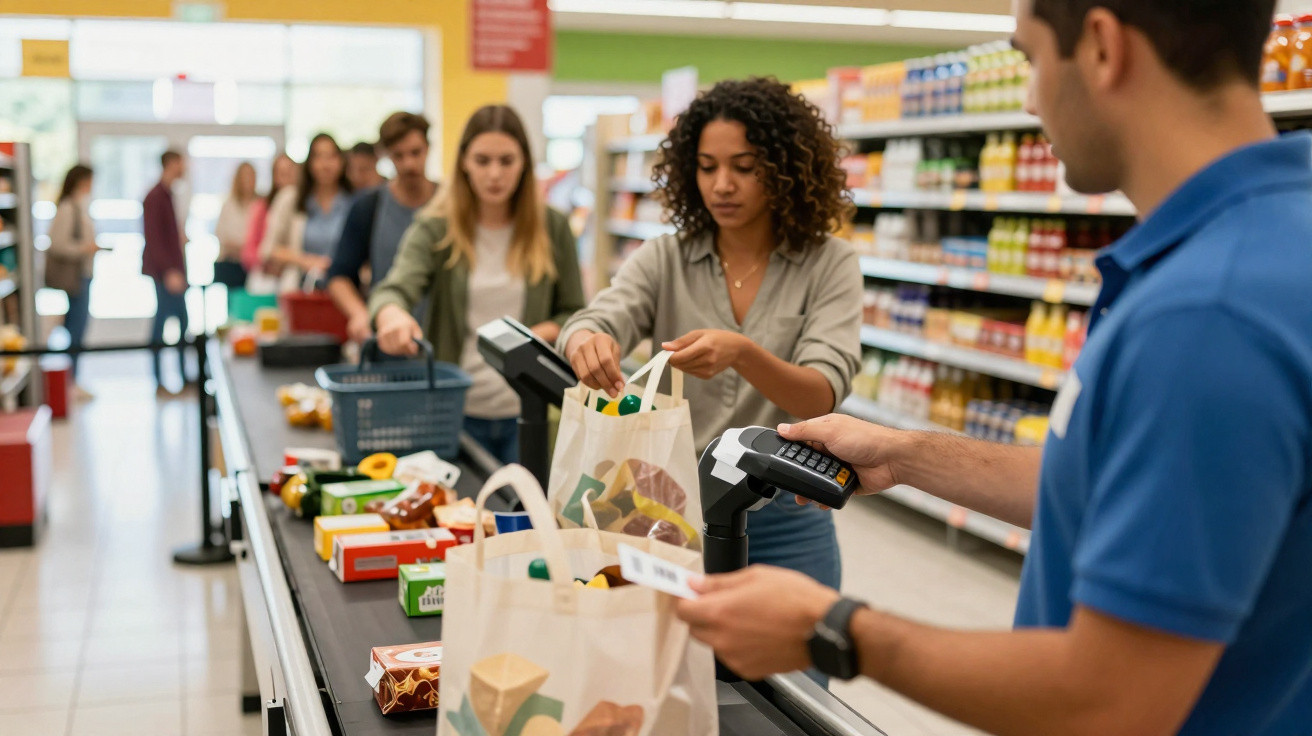
The checkout lanes at Lidl can feel almost choreographed: items race over the scanner, shoppers hurry to keep pace, yet the queue continues to move. This familiar scene is underpinned by a deliberately engineered system that combines technology, shop layout and discreet psychological prompts to accelerate transactions and maintain low prices.
How Lidl designs a checkout built for speed
At Lidl, virtually every store detail serves a purpose. The floor plan, checkout equipment and even product barcodes are all intended to cut precious seconds from each shop.
A standardised store that staff can “read” instantly
Lidl keeps the layout of its branches almost identical. Although shoppers may recognise the consistency, employees gain the greatest advantage: whether changing branch or shift, they immediately know where products and facilities are located.
Customers generally enter via a “fresh market” section, where flowers, bakery items, fruit and vegetables are placed together at the front. This arrangement is about more than presentation. It lets staff replenish and rotate products with short shelf lives swiftly, rather than having to travel around the whole shop.
This repetition of layout means staff waste less time walking, searching or asking questions, and can be reassigned to the tills at peak moments.
Reducing unnecessary movement away from the tills creates more capacity for the priority in a hard-discount business: moving shoppers through checkout quickly.
Triple scanners and supersized barcodes
The checkout stations are also designed to process a high volume of goods. In many Lidl branches, scanners can detect barcodes from multiple angles simultaneously, so staff do not have to carefully turn every item into position.
In addition, many own-brand products feature larger barcodes, or the same code printed on several surfaces. A milk carton, for example, may display a barcode on two or three sides rather than only one.
By reducing the number of times a cashier has to rotate an item, Lidl can hit speeds of roughly 29 to 32 products scanned per minute, according to industry estimates.
When queues extend along the aisles, those fractions of a second saved on every product soon become significant.
The hard-discount economics behind the pace
Lidl operates within the “hard discount” retail sector, where low prices come not from eye-catching promotions but from stringent operational efficiency.
More customers, fewer hours on the payroll
Each additional shopper processed by a cashier in an hour reduces the staffing time needed to generate the same revenue. This lowers labour spending, which is among the largest costs in grocery retail.
- Faster scanning = more shoppers per hour
- More shoppers per hour = fewer staff needed at peak times
- Lower staff costs = pressure to keep shelf prices down
Comparable discount retailers, including Aldi, follow much the same approach. Employees are directly encouraged to work as efficiently as they can, and their training is designed to help them match the pace of the shopper ahead of them. From management’s perspective, the principle is straightforward: fast checkouts help safeguard low prices.
The speed at the checkout is not a quirk of company culture; it is a central mechanism in the cost-cutting engine that makes discount prices viable.
Why there’s rarely time to chat at the till
In many supermarket models, checkout offers an opportunity for small talk or light upselling. Hard-discount retailers take the reverse approach: exchanges are kept short, with no loyalty-card prompt or “have you seen our new range?” routine.
This no-frills style of service keeps the line progressing and enables one cashier to assist substantially more customers during a shift. Some shoppers may regard it as impersonal, but for the retailer it is simply an element of its pricing model.
The quiet psychological pressure on shoppers
Technology and cost control account for only part of the story. Shoppers contribute to the pace too, encouraged to move faster by subtle design decisions.
Short conveyor space that forces you to act fast
Regular customers often spot one particular feature: the section beyond the scanner where purchases collect is commonly much shorter than expected. It holds only a modest build-up of shopping before items begin to topple or pile back towards the scanner.
As the cashier scans at speed, goods become compressed in this restricted space. Faced with an increasingly large barrier of groceries, the shopper feels compelled to clear it before it spills over.
The cramped area after the scanner turns the checkout into a small time trial, gently pushing shoppers to pack faster and free the space.
This layout limits delays. Rather than slowing down to prevent products from backing up along a long packing area, the cashier can continue because the customer is already rushing to make room.
The social gaze from the queue behind you
Physical limitations are accompanied by social pressure. A queue of customers waits directly behind the person paying, with their baskets, trolleys and faces all in view.
Few people want to become “that person” delaying ten others. Instinctively, many adopt the fastest method: put every item straight back in the trolley, pay, leave the checkout area, then organise their bags at a side shelf or in the car.
This effect is intentional. When quick behaviour is socially reinforced and slower behaviour becomes mildly awkward, the shop gains further speed without needing to tell anyone what to do.
What this means for customer experience
The outcome is a distinctive shopping environment that some people enjoy and others experience as stressful.
| Aspect | Benefit | Potential downside |
|---|---|---|
| Fast checkout | Less time in queues | Feeling rushed or clumsy |
| Minimal chit-chat | Efficient, direct service | Less human connection at the till |
| Short packing area | Steady flow through tills | Risk of items falling or getting squashed |
| Low staff numbers | Lower prices at shelf edge | Less visible help on the shop floor |
For plenty of households, the compromise is acceptable: a frantic ten minutes at the till in return for a lower monthly grocery bill.
How to handle a “Lidl-speed” checkout without stress
Customers can adjust to the system as well. Several straightforward habits can make its tempo far easier to handle.
- Put heavy products together in the trolley first, so they are scanned first and can return to the bottom.
- Open and prepare your bags before reaching the till, rather than when goods are already accumulating.
- If the pace feels overwhelming, place items back in the trolley and pack them unhurriedly at a separate packing shelf.
- Ready your payment in advance, particularly when paying contactlessly, to prevent a last-minute rush.
These approaches can ease the panicked sensation that arises when the scanner beeps more quickly than you can keep up.
Behind “just scanning fast”: training, ergonomics and limits
Lidl and similar retailers depend on more than equipment and store layout. Employees receive focused training to achieve a quick but sustainable pace, including how to move their arms effectively, where to place products and how to make brief eye contact while continuing to scan.
Ergonomic design is important as well. Seating, scanner position and till configuration are adjusted so cashiers can repeat the same actions for hours with less strain. Retail unions regularly caution companies that demanding excessive speed raises the likelihood of repetitive strain injuries and fatigue.
Maintaining a reliable, even pace is usually more productive over a full shift than working in frantic bursts. Most chains understand this, training staff to sustain controlled speed rather than merely to rush.
Why this strategy isn’t used everywhere
Although many full-service supermarkets could technically replicate Lidl’s methods, they frequently opt for another model. Their businesses place greater emphasis on brand loyalty, premium own-label ranges and customer experience.
A more leisurely checkout, allowing room for conversation and loyalty schemes, may better serve these aims than a high-pressure queue. Seen this way, the Lidl checkout visibly reflects the retailer’s wider strategy: reduced comfort, fewer formalities and every possible second removed from each transaction to keep prices competitive.








Comments
No comments yet. Be the first to comment!
Leave a Comment