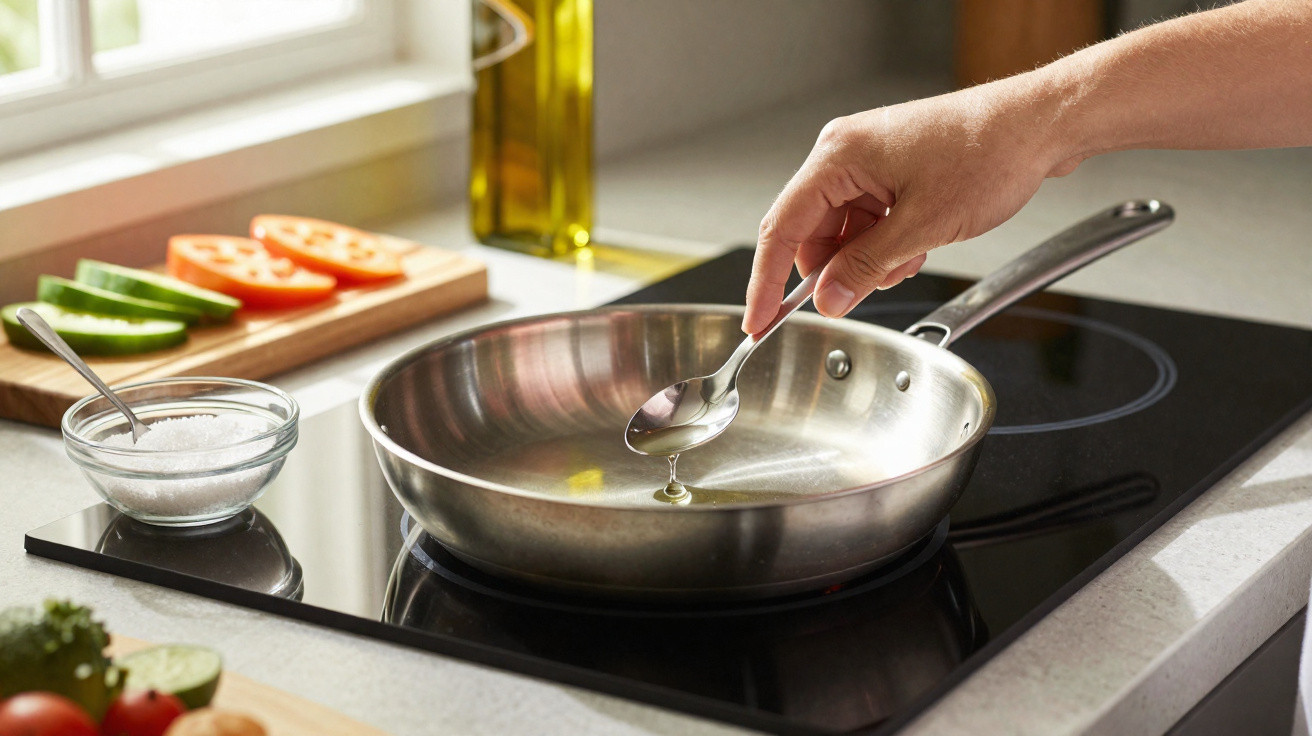
The pan appears ready.
Or at least, that is what your hungry mind tells you. You place a chicken breast in it, hear a faint, disappointing hiss, and moments later pale meat is clinging firmly to the metal. There is no golden crust-only torn strands and irritation. You prod it while the heat creeps sluggishly over the surface, already aware that this will not resemble the Instagram photo.
The following day, you use the same hob and the same pan. This time, though, you wait. There is nothing in the pan, only metal over flame: a quiet standoff. A minute later, the air feels different. Hold your hand above it and a wash of heat rises up, rather like opening an oven door. Add oil and it glints and shimmers like glass. When the steak goes in, your kitchen suddenly sounds like a restaurant.
Same pan. Same hob. An entirely different world.
Why an empty pan makes all the difference
An empty pan warming on the hob is oddly dramatic. Visually, nothing is going on. Yet this is precisely when good cooking is made-or spoiled. Begin with a cold pan and cold food, and you get steaming and sticking. Put cold food into a hot pan, however, and you get the immediate, exciting sizzle everyone wants.
Preheating is not merely a chef’s obsession. It connects the recipe you have read with the meal that reaches your plate. When the pan is already charged with heat, food does not simply sit there releasing moisture. It sears, browns and crackles. What happens in those first three seconds can determine whether dinner tastes like restaurant magic or lukewarm disappointment.
One Tuesday evening, a home cook called Sarah attempted to recreate a viral “5-minute crispy salmon” video. She used the same ingredients, followed the same method and cooked with the same cast-iron pan. Her first result looked… grey. Rather than a sear, it had a slight tan colour and stuck badly. For the second attempt, she altered just one thing: she waited for the pan.
She warmed the cast iron for a few minutes, poured in oil and waited until it lightly rippled before setting the fish in skin-side down. The change was immediate. The salmon sang. A toasted, nutty aroma filled the kitchen. When she turned it over, the skin remained whole, blistered and glossy, exactly as it had in the video. It was the same recipe, but the outcome was radically different because of those extra minutes of unseen preparation.
Professional kitchens are quietly built around this practice. Pans are heated well before the tickets begin printing. That is one reason restaurant food can seem to defy time. A line cook does not place a steak in a tepid pan and cross their fingers. First, they create a store of heat, then use it during 60 seconds of direct contact with the food.
The reasoning is straightforward. Metal needs time to take in energy. Once hot, a pan holds that energy and gives it up rapidly when food lands in it. A cold pan does the reverse: it draws heat out of your ingredients. Rather than browning, meat sits in a lukewarm pool and releases its juices. Those juices boil, meaning you steam the food instead of searing it. Preheating puts the physics on your side, changing the pan from a thief of heat into a source of it.
How to preheat a pan properly
Treat preheating as though you are charging your pan. Set it over a medium or medium-high heat while it is empty. No oil, butter or food-just metal over a gas flame or electric ring. After a minute, hold your hand a few inches above the surface. You are not trying to prove your bravery; you are simply checking for warmth.
Once the heat resembles that which escapes from a hot oven, it is time to add oil. Keep watching. In a stainless-steel or cast-iron pan, the oil will loosen and spread before becoming more fluid and creating fine, shimmering ripples. When it behaves this way, the pan is ready to cook. That brief shimmering stage is ideal for searing, sautéing and building colour quickly.
With non-stick cookware, follow the same routine at a lower intensity. Keep the heat at medium and allow a little more time. You are looking for a gentle movement in the oil, never smoke. Cast iron presents the opposite challenge: it retains heat exceptionally well. Preheat it for slightly longer, but avoid full power or the pan will become an incinerator for food.
Everyone has experienced oil beginning to smoke, followed by panic, open windows and apologies to the smoke alarm. Usually, this happens because the pan has been left unattended or the heat was turned up and not monitored. The aim is not extreme heat. It is control.
A relaxed approach is to think in terms of three cooking heat “zones”. Use gentle heat for eggs and pancakes, when the pan is warm and the oil moves freely rather than fiercely. Choose medium-high heat for chicken, vegetables and most weekday meals, when the oil shimmers and food sizzles the instant it touches the pan. Reserve high heat for rapid searing in robust pans, when you are prepared to work quickly. Let’s be honest: nobody really does this every day. Even so, simply aiming for a “good shimmer” will save half your meals.
Food can stick for many reasons, but an insufficiently hot pan is one of the less obvious culprits. Proteins require that first burst of heat to make a light crust and release naturally. When the surface is not hot enough, the proteins attach themselves directly to the metal and refuse to let go. People then scrape at the food, turn it too soon or flood the pan with oil, assuming extra fat will solve what is actually a problem of heat timing.
“If the pan isn’t hot enough to scare you a little, it’s not hot enough to cook like a pro,” a Paris-trained chef once told me, laughing over a row of fiercely smoking skillets.
That does not mean your kitchen needs to become a battlefield. It means paying attention to what you see and hear. Do you hear a restrained, assured sizzle the moment food touches the pan? Or do you get silence followed by a hesitant hiss? That is a remarkably effective test of pan temperature.
- Watch: the oil should ripple or shimmer, rather than remaining thick and glassy.
- Listen: an immediate sizzle is good; a delayed hiss or fierce splattering means the balance is wrong.
- Smell: nutty, toasted aromas are acceptable, while a sharp, acrid smell means the pan is too hot.
- Feel (from a distance): a distinct wave of heat above the pan shows that it is charged.
- Adjust: if it overheats, move the pan off the hob for a few seconds.
How preheating affects flavour, texture and confidence
Once you begin noticing it, something unusual becomes clear: preheating changes more than the appearance of food. It alters the experience of cooking. Rather than panicking over sticking chicken or pale mushrooms, you become better aligned with what is happening in the pan. Those opening three seconds become satisfying instead of stressful.
Golden crusts are not purely decorative. They are chemistry at work. When a hot pan meets the natural sugars and proteins in food, the Maillard reaction begins. It belongs to the same type of browning that gives toasted bread its appealing smell. A properly preheated pan starts this reaction quickly, developing flavour on the outside before the centre overcooks. Steak tastes more intensely beefy. Vegetables become sweeter and more layered. Even tofu becomes less sponge-like and more snackable.
If you cut short the preheating stage, you often fall into a familiar trap: increasing the heat too late. The food has already released its juices into a lukewarm pan, so you turn up the hob in the hope of “rescuing” it. The result is uneven cooking. Some pieces burn, others remain rubbery, and the pan is still trying to replace the heat it lost. Starting hot and then reducing the heat is nearly always easier than starting cold and pursuing a result that never quite appears.
There is an emotional element to this modest ritual too. Warming the pan before adding anything is a moment of intention. It says: “We’re about to cook, not just heat things until they’re edible.” On a difficult day, that distinction can matter. It offers a few additional minutes to act with purpose rather than on autopilot, while listening for the gentle crackle that confirms you are heading in the right direction.
One home cook put it this way: preheating became their “switch” from work to real life. Pan on, phone down, day on pause. That brief wait became a breath. A reset. The final sizzle was the reward.
If all of this seems like too much to monitor on a busy evening, remember one simple truth: you do not need chef-level precision. You only need to avoid cooking in a cold pan.
Preheating is a small habit with a disproportionately large effect. It prevents sad, steamed mushrooms. It stops chicken breasts tearing themselves to pieces against the pan’s surface. It allows vegetables to char rather than becoming soft, watery heaps. It makes your kitchen smell as you wish it always would: toasted, savoury and alive.
As you notice this more, you may begin changing other related habits. Perhaps you salt meat a little earlier, pat it dry so its surface browns sooner, or avoid overcrowding the pan so its stored heat does not disappear. All of these are related to the same principle: give heat sufficient room and time to do its best work.
At a large scale, preheating is simply physics. At a smaller, deeply human scale, it is a promise to your future self. It is a way to say that the meal matters enough to wait a few extra breaths. Somehow, the food remembers.
| Key point | Detail | Benefit for the reader |
|---|---|---|
| Pan as a heat battery | Preheating enables metal to store energy before food is added | Better searing and less sticking with the same ingredients |
| Visual oil cues | Shimmering, rippling oil indicates that the cooking surface is ready | A simple, repeatable test for any hob and any pan |
| Improved texture and flavour | Rapid browning creates rich Maillard flavours | Restaurant-style crusts on meat, fish, tofu and vegetables at home |








Comments
No comments yet. Be the first to comment!
Leave a Comment