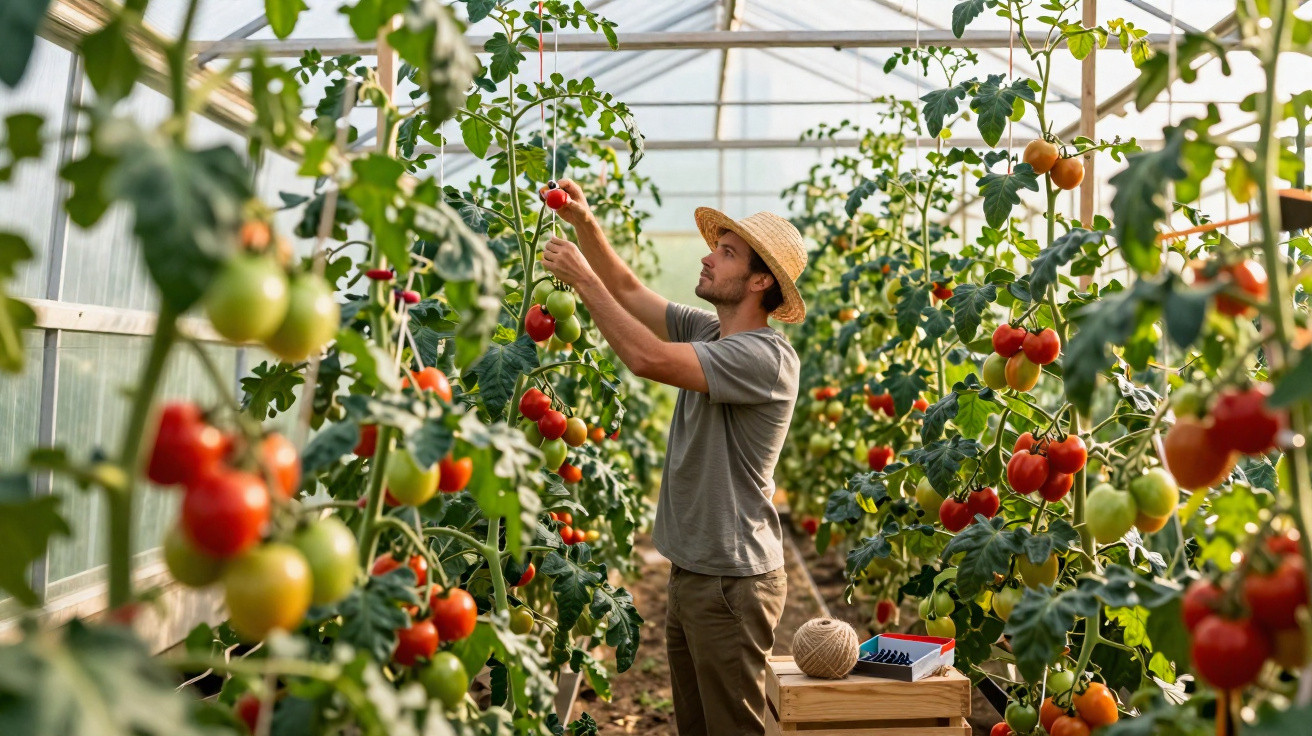
Tomatoes can grow upwards while using hardly any ground space – and many amateur gardeners are now completely changing their approach.
Anyone who drives wooden or metal stakes into the soil every spring will know the issue: supports wobble, topple in the wind, obstruct paths and, after a while, look more chaotic than tidy. As a result, an increasing number of gardeners are moving away from traditional tomato supports in favour of a method previously associated mainly with commercial greenhouses. It opens up entirely new possibilities, particularly in small gardens, on patios and balconies.
Why traditional tomato stakes reach their limits
For years, a single stake beside each tomato plant was the usual solution. You push it into the ground, tie the plant to it and hope it stays upright until the fruit ripens. In reality, this arrangement quickly reveals its weaknesses.
- The stake takes up bed space and often gets in the way.
- It can easily lean or fall over in wind or under the weight of heavily laden plants.
- Shoots need continual tying in to prevent them from snapping.
- Moisture builds up in a dense forest of stakes, allowing diseases to spread more quickly.
This is particularly frustrating for anyone with only a few square metres available, whether in a raised bed or on an urban balcony, where every centimetre of lost space matters. This is exactly where the alternative approach comes in.
The principle: tomatoes on string rather than stakes
The idea comes from professional vegetable production: instead of growing against a rigid pole, tomatoes are trained up strings, wires or a lightweight frame. It is known as hanging cultivation, or horizontal and suspended training.
“The plant climbs upwards on a taut string – leaving the ground largely clear.”
The system works as follows:
- A strong wire, beam or frame is fitted overhead, for example to a pergola, a simple timber structure or a balcony ceiling.
- A durable string or purpose-made plant twine is suspended from it.
- As it grows, the tomato plant is gently wound around the string or secured with soft clips.
- The main stem follows the support upwards, while side shoots can be shortened as needed or trained lightly too.
This method is especially effective for varieties that continue growing and can easily reach two metres or more. Rather than cutting the plant back, its natural vigour is deliberately put to use.
Higher yields in less space: how the system saves room
The main benefit is at ground level: only the plant itself occupies the soil, rather than a bulky support. That leaves room for additional crops or simply more freedom to move around the bed.
Typical locations where hanging cultivation excels include:
- Balcony planters and large containers on a loggia
- Narrow patio beds alongside house walls
- Compact raised beds in terraced-house developments
- Tiny gardens in courtyards or on flat roofs
With sensible planning, tomatoes can be planted more closely together without creating an impenetrable jungle. Air circulates more freely around the plants, and leaves dry faster after rain or watering. This significantly reduces the risk of fungal diseases such as blight.
Harvesting also becomes more convenient: fruit trusses hang freely downwards at an accessible height. There is less bending involved, and it is easy to see which tomatoes are ripe at a glance.
What materials you actually need
Switching systems does not mean building a commercial greenhouse. In most cases, straightforward, hard-wearing materials are enough, and many may already be in the shed.
| Component | Suitable options |
|---|---|
| Overhead support | Timber beam, metal pipe, fence post, pergola, underside of a balcony |
| String / twine | Plant twine, coconut string, sisal, strong polypropylene twine |
| Fastenings | Soft clips, rubber rings, fabric ties, specialist plant hooks |
| Extra support | Lightweight trellis or mesh for the first few weeks |
Many of these items can be reused for several consecutive years. Metal frames and good-quality strings in particular will last for more than one season if stored somewhere dry over winter. That makes the method not only space-saving, but cost-effective too.
Step by step: create your own hanging tomato system
1. Build the structure before planting
Timing is often where the biggest mistake happens: anyone who plants first and improvises later has to deal with bent shoots and awkward alterations. It is better to put up the framework first, then add the plants.
- Fit a sturdy beam or wire at around two metres high.
- Prepare one separate string for every tomato plant.
- Secure the string firmly at the top, leaving a loop at the lower end for the base of the plant.
2. Plan for the support while planting
Plant the tomatoes as usual, but fix the string directly beside the root ball in the soil or at the edge of the pot. Some gardeners even place the end of the string slightly beneath the soil so that it cannot shift later.
3. Train and pinch out weekly
Once the plants start growing strongly, the real work begins, although it remains manageable. A brief weekly check is usually sufficient:
- Carefully wind the main stem around the string or attach it using clips.
- Remove side shoots in the leaf axils as required, so the plant does not become too dense.
- Make sure nothing is being constricted and keep all fastenings loose.
“Those who invest a few minutes regularly will be rewarded with sturdy plants and neatly hanging fruit trusses.”
Ideal for greenhouses, tunnels and narrow paths
Tomatoes have hung from strings fixed to greenhouse ceilings for years in many commercial operations. That is no coincidence. Every square metre matters twice as much in protected spaces, while ventilation is also crucial.
Home gardeners can easily adopt the same principle: in a polytunnel or glasshouse, a tensioned wire beneath the roof is often enough to hold all the strings. Plants grow upwards, paths remain clear and maintenance becomes much more pleasant.
Vegetables can look this good
Practical benefits are one thing, but the visual impact surprises many people the first time they see it. A line of tomatoes hanging like a green curtain has an almost architectural quality. In small urban gardens especially, hanging cultivation quickly becomes a focal point.
Popular options include:
- A planted arch over a garden path
- A tomato curtain against an otherwise uninspiring wall
- An “edible pergola” above a patio seating area
When the fruit glows through the foliage, the effect is almost like living decoration. It also helps many people overcome their hesitation about combining productive and ornamental gardening.
Practical considerations: watering, varieties and potential risks
Anyone switching to hanging cultivation should keep a few everyday points in mind. The plants often grow more vigorously and therefore use more water and nutrients. Soil dries out particularly quickly in pots.
- Water regularly; on hot days, it is better to give a little in the morning and evening than too much at once.
- Add a mulch layer to the soil to slow evaporation.
- Use slow-release fertiliser or organic fertiliser to keep growth even.
Tall-growing varieties are particularly worthwhile. Indeterminate cordon tomatoes make the best use of the string. Bush and balcony varieties also work, but remain more compact and may need extra cross-supports.
The main risk is a structure that is too weak. If several vigorous, fruit-laden plants are hanging from a thin wooden pole, it may break. It is better to make the construction slightly over-specified from the start than to find the entire structure lying in the bed later.
Why so many gardeners are switching now
The move towards smaller gardens, city balconies and raised beds has changed what people need: solutions should take up little room, remain flexible and look attractive. Hanging tomato cultivation meets these needs remarkably well.
Anyone who has seen how neat a bed of suspended plants can look, and how easily the crop can be picked by hand, rarely returns to unstable individual stakes. With a little planning at the start of the season, it is possible to create a system that works reliably for years and takes tomatoes upwards without wasting unnecessary ground space.















Comments
No comments yet. Be the first to comment!
Leave a Comment