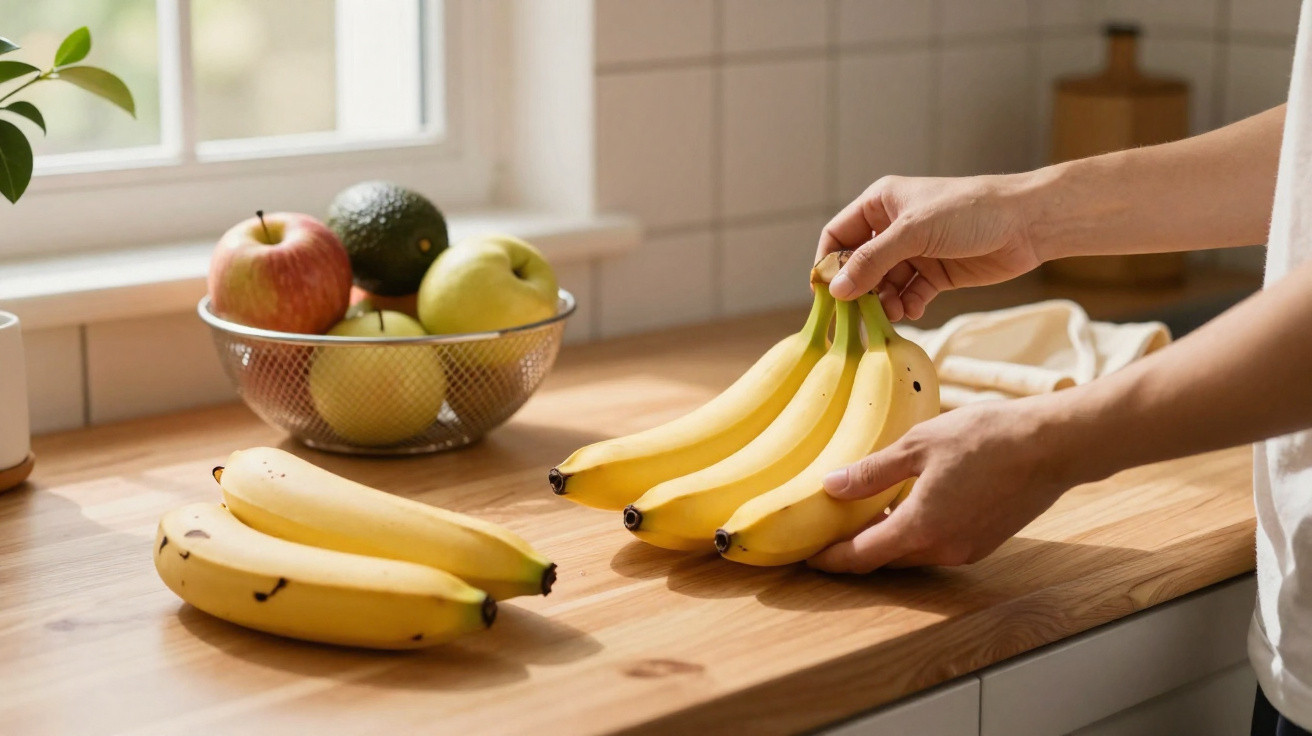
Bananas sitting on the worktop always give you away.
Their speckles show how long they have been left untouched, how many breakfasts you missed and how disorganised the week really became. One day they are sunny yellow; the next, they seem to have lived three lifetimes. You lift one, your thumb brushing a fresh brown mark, and that small voice in your head says: “Already?”
That is when the little kitchen dilemmas begin. Should you make banana bread, freeze them, bin them or act as though the spreading soft patch is not there? It is also when many people ask the same thing: can you slow this down without turning the kitchen into a laboratory?
You can. It starts with giving them space.
Why bananas brown so quickly when kept together
Imagine a fruit bowl on a well-used kitchen island: bananas lying across apples, oranges pressed around the sides and perhaps an avocado lurking at the back. It feels warm and homely, but it also creates ideal conditions for bananas to ripen rapidly.
On Monday, you take one and it is firm and bright. By Thursday, the entire bunch has taken on a leopard-print look. Brown spots spread like office gossip. You have not altered the temperature or handled them particularly often, yet they have gone from ideal to “probably only suitable for a smoothie” almost overnight.
You are not imagining it. It is chemistry.
Bananas give off ethylene, a gas that triggers ripening. You cannot see it, and it does not come with a dramatic smell, but it quietly runs the fruit bowl. When bananas are crowded together, they sit within their own small ethylene cloud. Each one effectively tells the rest: “Time to ripen, let’s go.”
Bring in other fruits that react to ethylene, including apples, pears and kiwis, and the process accelerates further. The gaps between fruits suddenly matter. Less airflow traps more gas; more trapped gas means quicker ripening and, in turn, deeper browning in very little time.
Within a banana, ethylene hastens the breakdown of chlorophyll, the green pigment in its skin. Once the chlorophyll disappears, the peel turns yellow, then brown as more complicated reactions begin. Sugars increase, cell walls become softer and small bruises spread. All of it is driven onwards by an invisible gas.
How separating bananas slows browning
The simplest way to interrupt this chain reaction is almost laughably straightforward: give bananas a space of their own. Keep them separate from the rest of the fruit bowl. Put them on a small plate at the opposite end of the worktop, hang them on a hook or simply move the bunch 40–50 cm away from apples and pears.
When bananas are on their own, the ethylene they produce disperses into the surrounding air rather than being held in a close-packed cluster. The gas is still present, but it is more diluted. Ripening continues, only at a slower and easier-to-manage rate. The period between vivid yellow fruit and heavily speckled fruit can be extended by a couple of days, and occasionally longer.
It is not magic. It is simply space.
A home cook from Manchester told me that she once bought six bananas on a Sunday, only to throw away two or three by Friday. Her fruit bowl was always crowded: apples for packed lunches, avocados for toast and nectarines during summer. She assumed browning was simply “what bananas do”.
Then, one week, her children accidentally left the bananas on a separate side plate by the kettle. Distance was the only difference. On Thursday, she noticed that they remained largely yellow, with only faint freckles. By Saturday, they were spotted but had not started collapsing.
She looked over her shopping receipts. Over a month, this small change meant she stopped binning bananas and no longer made impulse purchases of “emergency” fruit halfway through the week. There were no costly gadgets and no plastic wrap involved. She simply stopped piling everything into one overflowing bowl “because it looks nice”.
Food-waste researchers observe the same tendency on a wider scale. Bananas regularly rank among the fruits most often discarded in households. Many people buy them when they are slightly green, then feel that they leap from “just right” to “too late” in a single step. Lengthening that ideal period by even 48 hours means more bananas are eaten, fewer are guiltily binned and less money is wasted.
So what changes when you spread bananas out? You disrupt the feedback loop. With fewer bananas in contact, there are fewer bruises, less local ethylene build-up and more cool air moving around every fruit. That minor physical adjustment shifts the entire ripening curve.
Practical ways to store bananas separately
The key is to separate bananas in a way that works in your real kitchen, rather than in a Pinterest-perfect one. The lowest-effort option is to leave them in their original bunch while moving that bunch away from other fruit. A hook beneath a cupboard, a banana stand or even a repurposed mug tree can all work well.
Even in a very small kitchen, you can make this work. Take advantage of vertical space by hanging bananas from a cupboard handle overnight. Alternatively, place them on top of the microwave and move apples and oranges to the far end of the worktop. The separation does not have to be huge. Simply keeping them from touching and out of the same cramped bowl already helps slow ripening.
If you purchase a large bunch for the family, try dividing it into smaller groups of two or three. Put these in different locations. It takes a little more effort on the first day, but can mean less waste by day five.
This is where many people stumble: they begin with good intentions, then return to putting “everything in the bowl” after a hectic week. On a rushed Tuesday evening, you unpack the shopping, place every fruit in the same spot and tell yourself you will sort it out later. Spoiler: you will not.
Let’s be honest: nobody really does that every day.
The aim is to make separate banana storage automatic, rather than an extra task. That could involve buying an inexpensive banana hook that is impossible to overlook on the worktop, or reserving one particular clear corner as “banana land”. It is a tiny routine with a worthwhile result.
Another common error is putting bananas in the fridge while they are still green in an attempt to “keep them longer”. That can slow ripening too much initially, affect the texture and leave you with bland, rubbery fruit. Allow them to reach the yellow stage at room temperature, then refrigerate them to slow browning of the flesh, even though the peel may become darker.
“The biggest change wasn’t the science,” says a London-based food educator I spoke to. “It was giving bananas an actual ‘home’ in the kitchen, instead of treating them like decoration in the fruit bowl. Once people do that, the waste drops almost overnight.”
For simplicity, here is a quick cheat sheet you can screenshot:
- Keep bananas away from apples, pears, kiwis and avocados.
- Hang them up or space them out so they are not squashed together.
- Let them ripen at room temperature, then refrigerate ripe bananas.
Beyond the fruit bowl: what slower browning means for you
Once you begin storing bananas separately, the everyday rhythm of the kitchen changes slightly. Breakfast no longer feels like a race against spoilage. That single banana on Thursday is not a guilty reminder of snacks you forgot about; it is still edible, still cheerful and still good on toast.
On a busy morning, you can pick up a banana without having to wonder, “is this already too brown for me?” That quiet confidence makes you less likely to put it back in the bowl “for later” - which often means never. One modest habit removes a surprisingly large amount of everyday friction.
We have all experienced finding a blackened banana underneath paperwork or cereal boxes and feeling quietly defeated. Adding even a few days to their usable life reduces those small but dispiriting moments.
The effects reach further than many people anticipate. You shop in a different way. If you know bananas will not race towards the compost bin, you can comfortably buy a few more and plan smoothies, snacks or baking without that background anxiety. Over a year, that can mean less food waste, fewer emergency top-up shops and a calmer feeling that the kitchen is under control.
There is a mental benefit as well. Small successes, such as “I didn’t throw away a single banana this week”, may sound insignificant on paper, but they encourage a quiet sense of capability. You may begin noticing other simple changes: where bread is stored, how salad leaves are handled and when you actually eat the food you buy.
There is no need to become someone who weighs produce or monitors ripening in a spreadsheet. Simply recognising that a little distance slows browning may be enough to help you see your fruit bowl differently - and perhaps rearrange a few things tonight.
| Key point | Detail | Why it matters to the reader |
|---|---|---|
| Ethylene and proximity | Bananas release ethylene gas, which speeds up ripening when fruit is grouped closely together. | Helps explain why bananas seem to brown “overnight”. |
| Simple separation | Keeping bananas apart from other fruit and allowing them space slows browning. | An easy routine that can extend freshness by days without gadgets. |
| Real-life storage tricks | Use hooks, separate plates and small clusters, then refrigerate ripe bananas if necessary. | Practical actions you can use today to waste less and eat better. |








Comments
No comments yet. Be the first to comment!
Leave a Comment