Key points
- Costco’s $4.99 rotisserie chicken has remained at the same price since 2009, with the retailer even opening its own chicken-processing plant to help maintain costs.
- Two class-action lawsuits filed this year focus on Costco’s rotisserie chicken, highlighting potential consequences of the retailer’s strict price-control approach.
- The proposed class actions claim that Costco labelled its rotisserie chicken as "preservative-free" incorrectly and raise concerns about its processing plant.
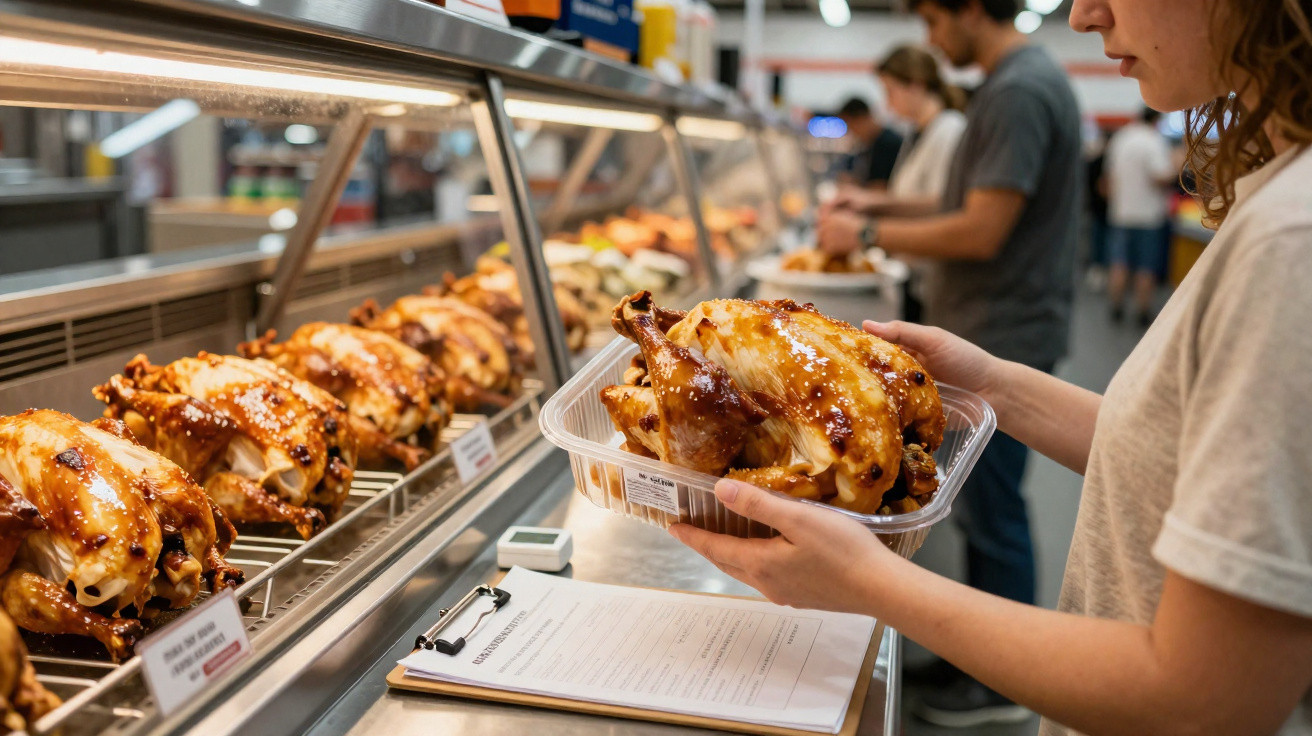
Costco’s rotisserie chicken is among the warehouse chain’s best-known and most budget-friendly purchases, alongside the $1.50 hot dog sold in its food courts.
A Kirkland Signature rotisserie chicken is priced at only $4.99, a figure Costco has not changed since 2009. During its January 2026 shareholder meeting, the company said it had sold 157.4 million chickens globally over the previous year alone. Costco can maintain such a low, consistent price because it does something many other supermarkets will not: it loses money on every rotisserie chicken it sells.
In marketing, this attractively priced chicken is known as a “loss leader”: an item sold below cost to encourage customers into the shop. The strategy has been effective. Chicken has become so important to the Costco brand that the business opened its own $450 million poultry-processing complex in Nebraska in 2019, both to meet demand and safeguard the $5 price point.
Costco’s rotisserie chicken has a substantial following, yet its popularity and reputation are already under significant pressure in 2026. Two separate proposed class-action lawsuits, both lodged this year, are scrutinising the $5 chicken and questioning both its ingredients and how it is produced.
Lawsuit says Costco labelled rotisserie chickens incorrectly as preservative-free
A class-action lawsuit submitted on 22 January to the U.S. District Court for the Southern District of California alleges that Costco deceived customers by promoting its Kirkland Signature rotisserie chicken as containing "no preservatives." Filed by two Californian consumers, the case states that the chicken contains sodium phosphate and carrageenan. Both ingredients can serve as preservatives that prolong shelf life and retain texture, the claim says, conflicting with Costco’s in-store signs and online product listings.
Costco has since taken references to preservatives off its rotisserie-chicken signage and online listings. In a statement to KTLA 5 News, the retailer said the two ingredients at issue are FDA-approved and are used to help retain moisture, support texture and ensure product consistency.
According to Jessica Williams, senior regulatory specialist at Registrar Corp, a consultancy that assists food and drink businesses with FDA compliance, neither ingredient is formally categorised as a preservative under federal rules. Both are also approved under the GRAS (“generally recognized as safe”) rule.
Unlike a claim such as "low fat," "no preservatives" has no specific regulatory definition. As Williams explains, "The issue arises when consumer perception interprets these functions as being preservative in nature, even if the additive is not technically classified as a preservative."
Legal claim says Costco’s poultry plant risks Salmonella contamination
A second class-action lawsuit, filed on 12 February in the U.S. District Court in Seattle, concerns the way Costco’s chicken is produced. The case was brought by Missouri resident Lisa Taylor and targets Lincoln Premium Poultry in Fremont, Nebraska. Costco built the plant to control its chicken supply chain from hatchery to shelf, but the lawsuit alleges that the retailer has not controlled Salmonella contamination at the site.
USDA inspection records indicate that, since opening in 2019, the facility has received a category three rating - the lowest food-safety designation - in 92% of reporting periods. Court documents show that the plant did not pass any monthly Salmonella test from late 2023 to mid-2025.
A December 2025 Farm Forward report states that the plant “consistently fails USDA salmonella safety standards”, while a Consumer Reports investigation published in October 2025 identified it as one of the country’s most contaminated poultry plants.
This information may be particularly important for customers because the site processes more than 100 million chickens each year. In her lawsuit, Taylor seeks compensatory and treble damages - three times the actual damages - for shoppers who have bought rotisserie chicken or other applicable Costco chicken products since 1 January 2019.
Fast facts: Two lawsuits filed over Costco’s rotisserie chicken
Johnston et al., vs. Costco Wholesale Corporation, et al.
- Filed on 22 January in the U.S. District Court for the Southern District of California.
- Alleges that Costco misled shoppers by describing its rotisserie chickens as "preservative free" despite the product containing sodium phosphate and carrageenan.
Lisa Taylor v. Costco Wholesale Corporation
- Filed on 12 February in the U.S. District Court in Seattle.
- Alleges that Costco exposed consumers to health risks because of Salmonella contamination at its chicken-processing plant.
Current status of both Costco rotisserie chicken lawsuits
Both cases are proposed class actions. Neither has received court certification, and trial dates have not been scheduled for either matter. In response to the preservatives case, Costco removed the "no preservatives" wording from its in-store signs and marketing, and said the ingredients are allowed by food-safety authorities. The company has not commented publicly on the Salmonella lawsuit or announced changes to its chicken products or processing practices following its filing.
For consumers, the question is whether sodium phosphate and carrageenan being used to maintain texture and shelf life matters to them if Costco rotisserie chickens are a regular household purchase. Although these additives are generally recognised as safe, some customers may choose to avoid them.
For anyone concerned about foodborne illness, the risk from this product is low. Costco’s rotisserie chickens are fully cooked to an internal temperature of 74°C (165°F), the USDA standard for eliminating Salmonella in poultry. However, shoppers buying raw chicken from Costco - some of which could also be processed at the same facility - should look out for recalls and ensure that poultry is cooked to the proper temperature.















Comments
No comments yet. Be the first to comment!
Leave a Comment