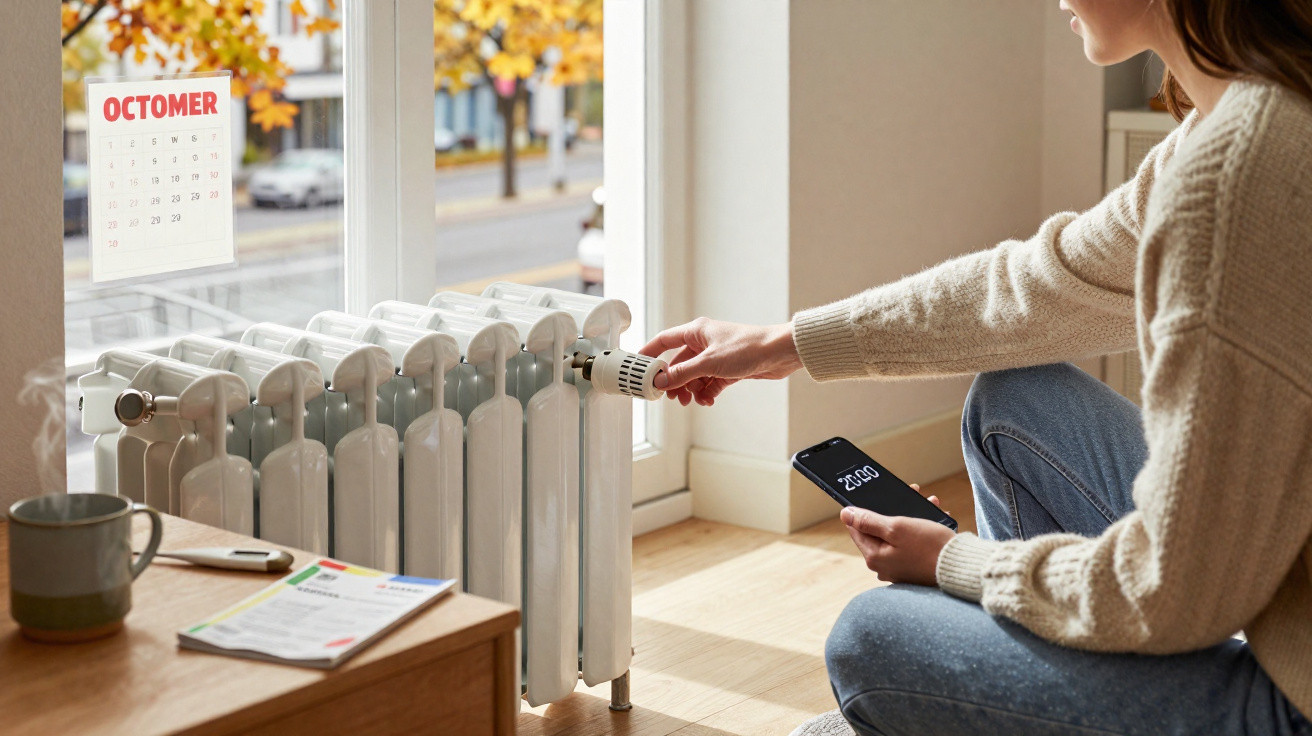
With 15 October approaching-the official start of the heating season in several European countries-a straightforward adjustment to your radiators could noticeably cut your heating costs.
Drawing on detailed advice reported by the German online outlet behind this article, heating specialists explain how changing radiator schedules by twenty minutes can lower energy use without sacrificing comfort. The suggestion is particularly relevant to French households, at a time when energy prices remain under close watch.
Why 15 October is a key date for heating
Across several central and northern European countries, including Germany, the communal heating period is often set by building regulations or tenancy agreements, generally beginning around 15 October. Landlords and district-heating operators then gradually bring homes up to temperature.
For residents, the date is a useful prompt to prepare their systems: bleeding radiators, checking thermostats and revising heating schedules. The source article highlights one specific recommendation: use a twenty-minute time window to shorten daily active heating periods without reducing comfort in living areas.
“The principle is to slightly reduce the amount of time radiators run at full output by adjusting the schedule, rather than sharply lowering the target temperature.”
The message to occupants is straightforward: plan ahead, fine-tune settings and avoid needless bursts of heat when the heating season begins.
The ‘twenty-minute setting’: what this tip actually involves
The method is based on a simple idea: cut around twenty minutes from the intensive heating phase during a key part of the day, when the home has already stored heat. The German outlet cites energy-efficiency experts who advise people to:
- delay the automatic switch-on of radiators slightly in the morning;
- bring forward the switch-off time a little in the evening; or
- combine a small morning delay with another adjustment in the evening.
In practical terms, if a radiator had been scheduled to enter comfort mode at 6.30 am, it would instead be set for 6.50 am. Alternatively, it could switch to reduced mode earlier at the end of the day. The aim is not to make the home cold, but to limit periods when the system runs even though the building’s thermal mass is still sufficient to keep the temperature pleasant.
“Twenty fewer minutes of continuous heating, repeated every day throughout the season, add up to several hours of saved operation over a month.”
The specialists quoted point out that many homes are heated too early or for too long “out of habit”. This twenty-minute setting is intended to correct that pattern without making a drastic change to the temperature setpoint-for instance, maintaining 19 or 20 °C, but spending less time at that maximum setting.
Why such a short delay can still reduce the bill
From a technical perspective, electric radiators, convector heaters and boilers supplying wet radiators use more energy while raising the temperature and maintaining high output. Every avoided or shortened heating period therefore translates directly into kilowatt-hours that are not used.
Over a heating season lasting several months, cutting fifteen or twenty minutes in the morning and/or evening can mean:
- dozens of operating hours avoided over the full period;
- slower wear on equipment; and
- a noticeable reduction in overall consumption, particularly in poorly insulated homes.
The article also notes that comfort is not perceived according to a strictly mathematical rule. A room heated for several hours can remain comfortable for several tens of minutes after heating stops, especially where the radiators and walls have retained warmth.
How to apply the setting to different radiator types
In the countries where this article applies most directly, many homes have centrally programmable thermostats or electronic thermostatic radiator valves on individual radiators. The advice can still be adapted to equipment commonly found in France, with a few differences.
Individual electric radiators
For convector heaters, radiant panels or storage radiators with a built-in programmer or energy-management system, the change simply involves altering the ‘comfort’ and ‘eco’ time slots:
- Identify the current time at which comfort mode starts in the morning and reduced mode begins in the evening.
- Shift these times by twenty minutes, or by ten minutes in the morning plus ten minutes in the evening.
- Keep the same temperature setpoint-for example, 19 °C in the living room.
- Monitor the effect on perceived comfort for a few days.
If the home remains comfortably warm, those saved twenty minutes can become the new standard. If the drop in temperature feels too pronounced, the specialists recommend moving back in five-minute stages until the right balance is found.
Wet radiators with a central thermostat
In buildings served by a shared or individual boiler, the principle remains the same. A room thermostat or weekly programmer can be used to adjust heating periods:
- lower the temperature setpoint earlier in the evening;
- delay the morning start slightly; and
- retain a ‘reduced’ temperature rather than switching the heating off completely, which helps prevent excessively large temperature swings.
Experts stress that a wide variation in temperature during the day can instead increase consumption, as the system has to work harder to recover the lost heat. The twenty-minute setting is therefore a precise optimisation, not an abrupt shut-off.
What this means for a French household
In France, the position is similar in several respects: higher energy costs, homes that are sometimes poorly insulated and significant scope for changing how heating is used. Although 15 October is not an official nationwide date, it often marks the practical start of the heating season in many households.
The recommendations promoted by the German outlet can be applied while taking French circumstances into account:
| Element | Context described in the source | Equivalent in France |
|---|---|---|
| Heating start date | Around 15 October, often set by building rules | Varies, but heating commonly starts in mid-October depending on the weather |
| Type of installation | Communal heating, thermostatic valves, programmable thermostats | A mix of electric convector heaters, storage radiators, gas boilers and communal networks |
| Scope for adjustment | Centralised scheduling or individual radiator control | Built-in programmers, pilot-wire controllers and smart thermostats |
In France, the Agency for Ecological Transition (Ademe) and other bodies emphasise that a controlled reduction in temperature, together with optimised heating periods, is among the main ways to lower bills without giving up basic comfort.
“French households, like their European neighbours, have considerable potential for savings simply by adjusting heating switch-on and switch-off times.”
The twenty-minute setting fits this approach: it reduces unnecessary heating periods, especially in homes where warmth remains stable for a while after radiators are turned off.
Combining this setting with other useful habits
Energy experts consulted by the outlet that published this recommendation stress that the setting is only one measure among several. They underline the value of combining it with:
- closing shutters and curtains at night to reduce heat loss;
- bleeding wet radiators regularly to improve their efficiency;
- servicing boilers annually, as required in France for certain equipment; and
- checking that nothing obstructs radiators, such as furniture or heavy curtains.
By pairing better time scheduling with these straightforward actions, a household can reduce both its energy consumption and the sensation of cold surfaces that causes discomfort.
A practical example over a typical day
To show the potential impact, the article’s specialists use the example of a household that heats mainly in the morning and evening:
- Before: heating from 6 am to 8.30 am and from 5.30 pm to 10 pm.
- After adjustment: heating from 6.20 am to 8.30 am and from 5.30 pm to 9.40 pm.
On paper, the difference may seem small. Yet over a six-month heating period, those forty fewer minutes each day accumulate. Without changing the temperature setpoint, the consumption curve gradually levels off.
In a well-insulated flat, most occupants will not notice a clear difference in warmth in the evening or on waking. Greater care is needed in older properties to prevent rooms becoming too cool, particularly for vulnerable people.
Limitations and precautions to consider
The twenty-minute setting remains a general recommendation. The experts cited by the German outlet emphasise that the approach must be adapted to:
- the quality of the home’s insulation;
- the local climate and outside temperatures; and
- the presence of young children, older people or those who are unwell and more sensitive to cold.
In some situations-especially in very poorly insulated or wind-exposed homes-reducing heating periods too much may lead to an excessive fall in indoor temperature. Professionals then advise making only a moderate reduction and supporting it with insulation measures, such as door draught excluders, window seals and double curtains.
They also point out that air that is too cold and too damp can encourage mould growth and worsen indoor air quality. Radiator settings must therefore remain compatible with airing rooms properly each day, including in winter.
A simple measure to try at the start of the heating season
For a French reader, the main takeaway from this German media article is how easy the action is: spending a few minutes adjusting radiator schedules, around 15 October or when the first cold spell arrives, may deliver savings without major investment.
Combined with a sensible setpoint in living rooms, a slightly cooler bedroom and effective management of heat loss, the twenty-minute setting is a practical tool for keeping heating bills under control. Households already monitoring their usage may see it as an additional refinement, while those who have never altered their radiator schedules have an accessible first step available to them.

















Comments
No comments yet. Be the first to comment!
Leave a Comment