If you only open your freezer to grab something quickly, it is easy to miss the thick layer of ice gradually building up inside. At some point, drawers start to stick, the appliance hums more loudly and your electricity bill rises. One simple, almost unremarkable trick can greatly reduce this ice problem, helping the freezer stay clean and efficient for longer.
Why too much ice builds up in many freezers
A freezer is no longer a luxury appliance; it is standard in most homes. It helps prevent food waste because bread, meat, vegetables and leftovers do not spoil straight away. The issue develops quietly: ice does not appear overnight, but accumulates layer by layer.
Whenever the door is opened, humid room air enters the appliance. That moisture freezes onto the cold inner walls. Putting away very warm food or leaving the door open for too long encourages even more ice to form.
The more ice collects in the freezer, the less efficiently it works – it uses more energy and loses storage space.
The effects become noticeable in everyday use:
- Drawers become more difficult to pull out.
- Food freezes onto the walls or sticks to other items.
- The appliance runs more often and for longer, increasing electricity use.
- The set temperature is distributed unevenly.
There is another consideration: many people underestimate how delicate the internal components are. Poking at ice with knives or screwdrivers can cause a leak in the refrigeration circuit. If that happens, the freezer is often beyond economic repair.
The simple trick that quickly loosens ice in the freezer
You do not need specialist products to remove existing ice. An ordinary household item is enough, and it does most of the work by itself.
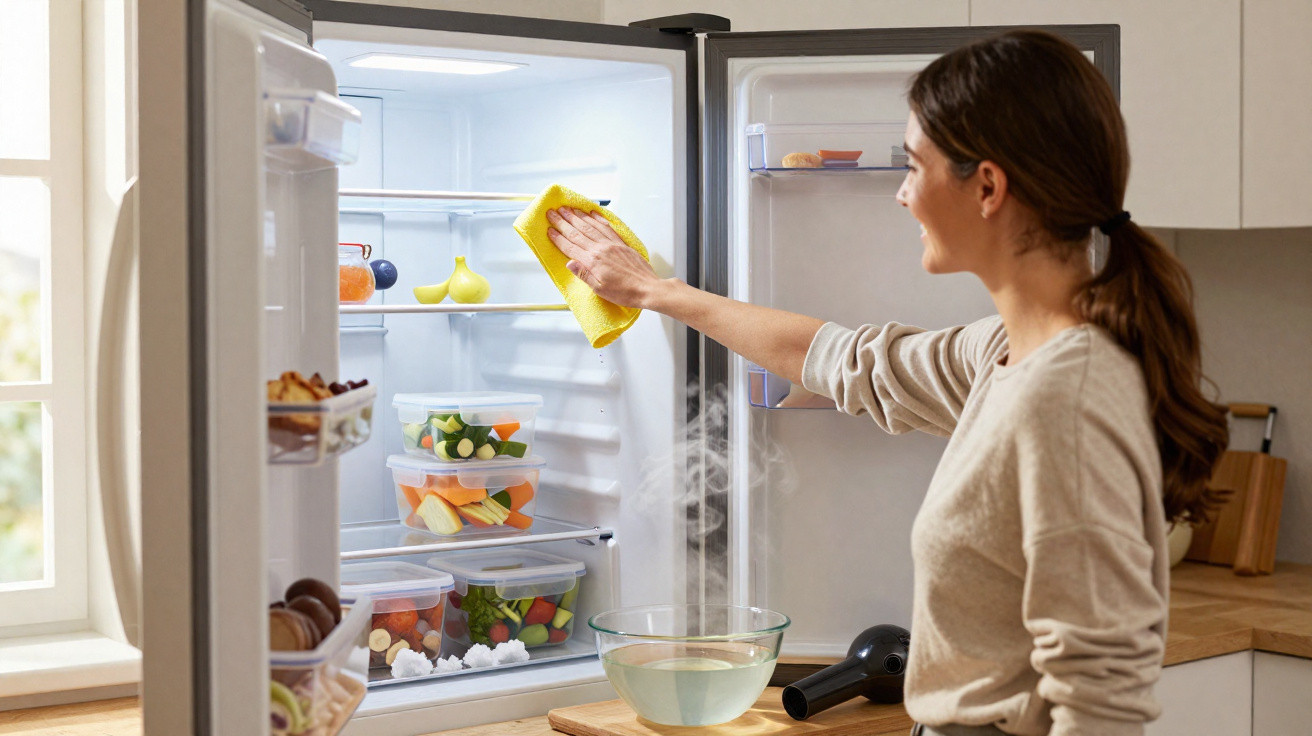
Defrost quickly with hot water
The method may sound basic, but hot water and steam work remarkably well.
- Switch off the freezer and unplug it.
- Remove all food and, where possible, keep it in a cool bag.
- Fill a heat-resistant bowl or pan with very hot water.
- Put the container inside the empty freezer and close the door.
The hot steam breaks the bond between the ice and the inner wall. Before long, whole sheets of ice will begin to fall away. Rather than scraping laboriously, you simply collect the loosened pieces and dispose of them in the sink or bath.
Steam acts like a natural “ice remover”: it softens the surface without damaging plastic or seals.
Drying the freezer: the frequently forgotten step
Once the ice has gone, residual water remains on the walls and in crevices. Switching the appliance straight back on at this point practically invites the next round of ice to form.
- Thoroughly wipe every surface with an absorbent cloth.
- Leave the door open for several minutes to let the interior dry further.
- Only then plug the appliance back in and restart it.
These few minutes can keep the freezer ice-free for months longer, as far less remaining moisture is left inside.
Alternative method: a hairdryer instead of a bowl
If you want an even faster option, use a hairdryer. Set it to warm rather than hot air. An overly powerful blast of heat can warp plastic or make seals brittle.
Method:
- Turn off and unplug the appliance.
- Blow warm air onto the iced-up areas from a safe distance.
- Continuously soak up melting ice with a cloth so that water does not run into gaps.
This approach is particularly suitable for smaller ice deposits around the door or in hard-to-reach places. However, it is not a substitute for regular defrosting when the ice layer is thicker.
What you should never do
The classic risk is using pointed or sharp objects.
Anyone using a knife, screwdriver or ice scraper in a freezer risks irreparable damage to the refrigeration circuit.
A network of thin pipes runs behind the plastic wall. Even a small puncture can release refrigerant. The appliance will then lose its cooling capacity, and repairs are usually no longer worthwhile.
Harsh cleaners and scouring pads with a metal side can also damage the interior. They scratch the surface, making it easier for moisture and dirt to cling to it afterwards – which can actually encourage fresh ice build-up.
How to slow down new ice formation for good
Using the freezer properly every day
Many causes of ice formation come down to everyday use of the appliance. A few habits can substantially reduce the tendency for ice to build up.
- Always allow food to cool completely before freezing it.
- Open the door only for as long as necessary and do not leave it open while deciding what you need.
- Do not pack the freezer completely full; leave space for air to circulate.
- Use packaging that seals tightly and contains as little air as possible.
Warm food in particular acts as a moisture booster: it brings heat and water vapour into the freezer, which immediately settles as ice. A better approach is to cool leftovers in the fridge first, then freeze them.
Airtight containers as a hidden defence against ice
Tightly sealed boxes or freezer bags reduce the contact between food and the air inside the appliance. Less air means less moisture, so less water ends up as frost on the walls.
There is a useful additional benefit: properly packaged food is better protected from freezer burn. Its surface and flavour stay intact for longer, and meat does not dry out as quickly.
| Type of packaging | Protection against ice formation | Protection against freezer burn |
|---|---|---|
| Open dish | very low | very low |
| Loosely sealed bag | medium | medium |
| Airtight container or vacuum bag | high | high |
Location and settings: the often-overlooked cause
Where the freezer is positioned also has a major effect on ice formation and electricity consumption. If it stands directly next to an oven or radiator, it must constantly work against additional heat. The appliance runs more frequently, more moisture condenses inside and then freezes.
A cool, dry location is ideal, such as a utility room or a kitchen corner away from direct sunlight. Leaving a gap of a few centimetres from the wall is sufficient to allow warm air behind the appliance to escape.
For most households, a setting of around –18 degrees Celsius is enough. Colder does not automatically mean better; it often simply costs more. Excessively low temperatures are more likely to promote icing without offering any real benefit.
How often you should really defrost the freezer
Many manufacturers recommend fully defrosting a freezer at least once a year. In damp homes or with appliances that do not have No Frost technology, doing it every six months may make sense.
Once the ice layer reaches around one centimetre, it is time to take action – otherwise electricity consumption rises noticeably.
If you already intend to make space or sort through frozen food, you can combine that task with defrosting. This turns an annoying chore into a reasonably useful routine.
What “No Frost” really means – and what it does not
Modern freezers often advertise “No Frost”. This does not mean that ice can never form anywhere in the appliance. It mainly means that the technology automatically reduces icing on the cooling elements. Fans distribute cold air more effectively and direct moisture away in a targeted way.
Frost can still develop in these appliances, for example on seals or packaging. Anyone who frequently leaves the door open or puts in lots of warm food will eventually have problems even with No Frost models.
Practical scenario: what an efficient defrosting day looks like
A realistic process might look like this: the evening before, you deliberately avoid buying much frozen food. The following morning, prepare cool bags, switch off the appliance and empty it. While the steam does its job, wash the drawers and compartments in the sink.
After drying the inside and outside, arrange the food again: put older products at the front and newer ones at the back. This also reduces the risk of throwing food away. In many homes, defrosting takes no more than one to two hours, including cleaning and sorting.
Why the effort pays off in the long term
An ice-free freezer runs more quietly, reliably and economically. By following the steps described, you not only reduce electricity consumption but also gain a clearer view of your supplies. This helps prevent duplicate purchases and forgotten leftovers at the very back.
The combination of hot water for defrosting, airtight containers, a cool location and short door-opening times works together like a shield against further ice formation. The freezer therefore stays closer to the condition you want: unremarkable in everyday life, yet dependable, clean and predictable in its energy use.
















Comments
No comments yet. Be the first to comment!
Leave a Comment