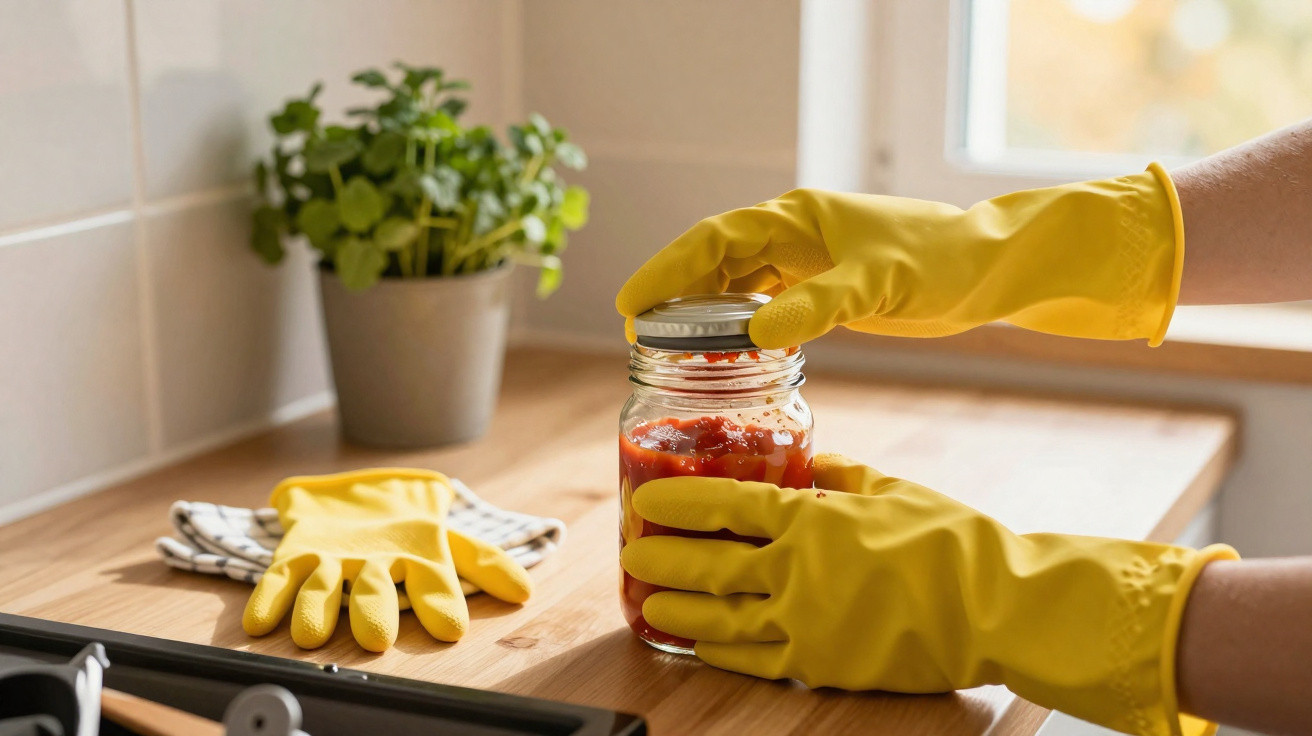
Picture the scene: you are in the kitchen, hungry, gripping a pasta-sauce jar whose lid simply will not shift. The harder you turn it, the more your fingers redden. Glass becomes harder to hold as a thin layer of sweat develops between your palm and the label. You reach for the hem of your T-shirt, a tea towel, even that odd rubber coaster that sits beneath your coffee mug. Still nothing. Once again, the jar has won.
Then your eye catches a bright yellow rubber glove draped over the sink – the sort used for cleaning, when you remember to use it. You pull it on, close your hand around the lid and make one more rather unenthusiastic turn. The lid releases with almost embarrassing ease.
The jar was never the powerful one in this contest.
Why a simple rubber glove beats raw strength
Seeing the rubber glove trick for the first time can feel almost unfair. You have not become stronger within three seconds, and the lid has not suddenly weakened. Only one small, unseen factor has changed: your grip.
Human skin is not especially good at gripping smooth metal. Add condensation, natural oils from your hands or a sticky crust of dried sauce, and an otherwise determined twist becomes a slippery contest. This is where the glove makes all the difference. Between your hand and the lid, it creates more friction, meaning that the effort you apply finally does some useful work.
Nothing about the jar itself has changed. What has improved is your leverage.
Think of the last unopened jar of pickles you tried to tackle. It had just come from the fridge, its lid slightly frosty, while your fingers were already cold from lifting it out. Perhaps you tried three times before handing it to somebody else, quietly hoping they would open it while you claimed you had “loosened it already.”
Now imagine exactly the same situation with a rubber glove. Put it over your dominant hand, with your thumb on one side of the lid and your fingers spread across the other. Turn once, steadily and with control. The glove catches every small ridge in the metal. There is a gentle vacuum sigh as the lid pops, and the whole episode is immediately finished.
There is no magic involved. You have simply stopped allowing slippery skin to undermine the effort you are making.
A little physics sits behind this modest kitchen triumph. Jar lids usually resist opening for two reasons: the vacuum seal and friction in the threads. With an uncovered hand, you have to overcome both while also preventing your hand from slipping. If your grip moves by even a millimetre, part of the force you produce is lost.
The glove raises friction, so the lid turns rather than your palm. Added traction also helps you distribute force consistently around the lid instead of concentrating it at a handful of pressure points. It may feel like a strength upgrade, but it is really a grip upgrade.
That is why climbers use chalk and mechanics choose textured gloves. Strength matters, but grip is what allows it to work.
How to use a rubber glove so the lid pops instantly
The technique could hardly be simpler. Take a clean rubber cleaning glove with a lightly textured palm. Put it on your dominant hand, and leave the other hand uncovered to hold the jar steady.
Keep the jar close to your body, preferably braced against your hip or the worktop edge. Use your bare hand to stabilise the glass. Put the gloved palm flat over the lid, with your fingers curving around its edges. Rather than shaking and wrenching at it, turn the lid in one smooth movement.
In many cases, it will release immediately. Should it remain tight, turn, relax and turn again. The glove continues doing its unobtrusive work: providing pure traction.
A few common details can spoil the method. An old glove covered in grease, for instance, merely puts another slippery surface between your hand and the lid. A glove that is cracked or coated in powder will not grip particularly well either. A quick rinse followed by thorough drying can make a genuine difference.
Another usual error is trying to open the jar while holding it out at arm’s length. That leaves your wrist doing all the work while your grip also has to contend with gravity. Instead, bring the jar towards your centre, brace your elbows and allow your shoulders and forearm to share the strain. Let’s be honest: nobody really does this every single day, we all just improvise until something works.
Yet after experiencing that immediate release with a good glove and a secure position, it is difficult to return to the frustration of using bare hands.
Sometimes the smartest kitchen hacks aren’t about being stronger or braver, but about quietly changing the surface of contact so life stops slipping out of your hands.
- Choose the right glove: Pick a rubber glove with a textured palm rather than a smooth disposable version. Texture catches the lid’s ridges more effectively, turning a weak twist into an efficient one.
- Steady the jar: Set the jar on a solid surface or brace it against your hip. A firm base directs your effort into rotating the lid instead of controlling wobbly glass.
- Make sure everything is dry: Keep the lid, glove and hands dry. Even a very light film of moisture can remove much of the glove’s advantage and cause slipping again.
- Turn using your whole arm: Rotate from the shoulder and forearm instead of relying solely on your wrist. Larger muscles provide the steady force that an unsteady wrist may not.
- Do not over-twist: If the lid stays put on the first attempt, stop briefly. Reposition your hand, adjust your stance and try once more. Short, firm turns are more effective than frantic pulling.
The small kitchen victory that changes how you see “strength”
Opening a stubborn jar with a rubber glove tends to stay in your mind. It is a tiny everyday difficulty, yet its answer overturns a familiar assumption. We often believe we need extra force, more muscle or to “ask someone stronger.” Then a thin piece of rubber casually shows that what was needed was more intelligent friction.
The idea reaches beyond the kitchen. You begin to notice how often apparent “strength problems” are actually concealed grip problems. A tool that will not move until you hold it another way. An exercise that becomes manageable after one minor adjustment. A conversation that shifts when you discover the right approach.
It is oddly reassuring to realise that the jar was never impossible to open; it was simply being handled poorly. The next time you hear that small vacuum “pop” beneath a rubber glove, you may feel a little pride rooted not in biceps, but in technique.
| Key point | Detail | Value for the reader |
|---|---|---|
| Rubber increases friction | Textured rubber holds metal more effectively than bare skin, particularly on smooth or slightly damp lids | Opens stuck jars quickly without depending on brute strength |
| Body position is important | Bracing the jar against a worktop or hip directs force into the lid rather than into keeping the jar still | Lessens wrist strain and avoids the feeling of “I’m weak” |
| A straightforward, inexpensive hack | Relies on a standard cleaning glove already found in most kitchens, with no gadgets or tools required | An immediate, practical solution that anyone can test and pass on |












Comments
No comments yet. Be the first to comment!
Leave a Comment