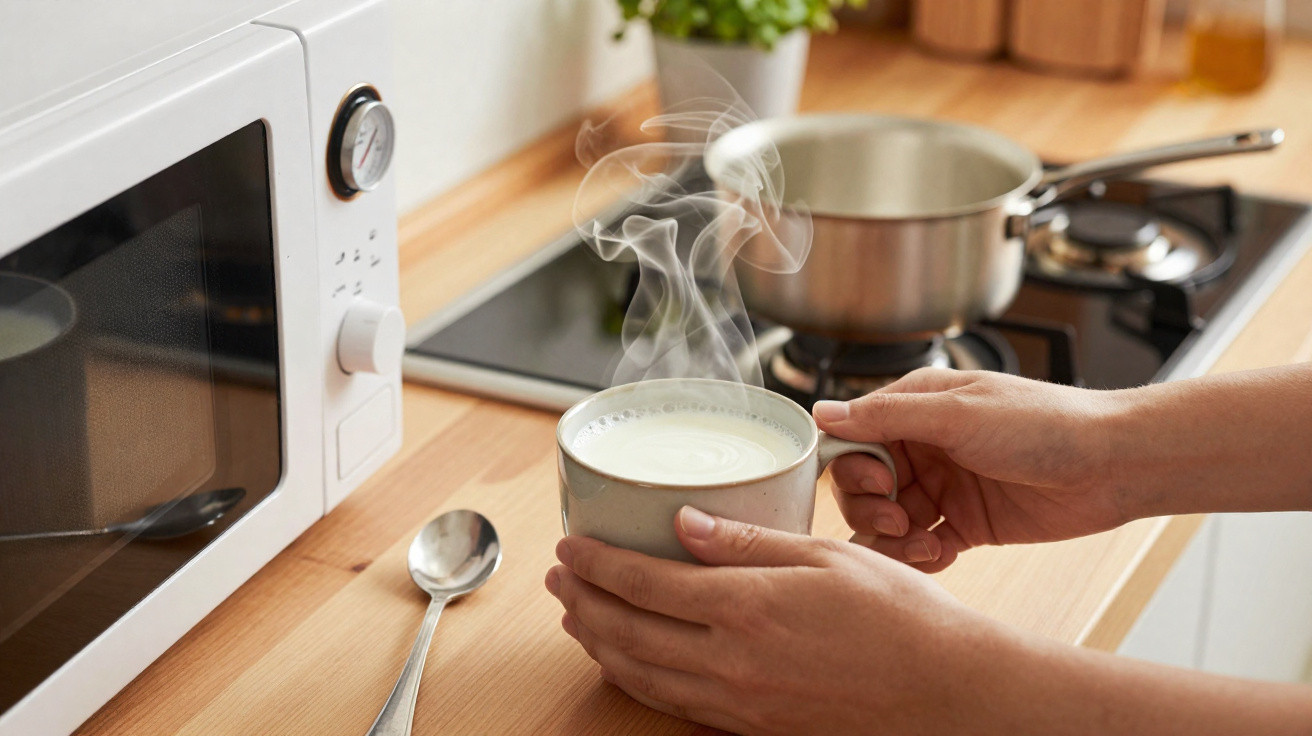
You place the mug in the microwave, push the door closed with your elbow, press 1:30 and step away. The morning is frantic: your laptop is half open, toast is flying about, and somebody is calling out for the car keys. When the ping sounds, you take hold of the handle and sip what you assumed was “just warm” milk or water… only for your tongue to feel as though it has met lava.
The mug is only lukewarm. The surface appears still. Inside, however, the situation can be completely different.
Most of us barely give it a second thought. A microwave is quick, convenient and always within reach. Heat it, drink it, carry on.
But this everyday habit can involve a series of surprising risks that are seldom discussed.
The hazard is not necessarily where you would expect to find it.
Why heating water or milk in the microwave is a hidden risk
In theory, the microwave is the saviour of hectic mornings. Press one button and your tea water is hot, your cocoa is ready, or your baby’s bottle is no longer fridge-cold. We tend to do it automatically, often still sleepy, with one eye on a notification and the other on the time.
The difficulty is that a microwave heats differently from a hob. Its energy warms liquid unevenly, producing hot spots while leaving cooler areas elsewhere. Your eyes may see a peaceful-looking mug, but your tongue, throat or a child’s small mouth may experience something else entirely.
You may believe you are saving time, when in fact you could be taking part in a temperature lottery.
There is a phenomenon that sounds like science fiction but can occur in ordinary kitchens: superheating. Water or milk in a perfectly smooth mug can be heated in the microwave beyond its usual boiling point without producing a warning bubble. It remains still and misleading, as though nothing unusual is happening.
Then you put in a spoon, add instant coffee or shift the mug towards the worktop edge. Boom. The liquid can burst upwards like a small geyser, splashing your hand, face or the arm of a child standing nearby. These burns are not merely hypothetical; emergency doctors treat them.
From the outside, the mug may have seemed “not even that hot”. Yet inside, it could have been seconds from erupting upwards.
Water is not the only concern. Milk brings its own microwave problems. It can warm unevenly, creating scalding pockets while other parts remain only slightly warm. If you shake a bottle without testing it properly, the first mouthful may hit a baby’s tongue like fire.
There is also a nutritional aspect that nobody wants to consider at 7 a.m. Frequent intense and uneven heating may slightly affect certain delicate nutrients in milk, particularly if you use high power and allow it to splatter. Losing nutrients once or twice is not disastrous, but it does not match the reassuring idea of a “nourishing warm drink”.
Put simply, the microwave is speedy, but it is not especially gentle.
Safer ways to warm water and milk without unpleasant surprises
There is a slower and more relaxed approach to warming water or milk. It requires no extra expertise, only a little more care. A small saucepan over low to medium heat, a kettle or even an electric milk frother warms liquids more evenly. You can see the small bubbles, feel the handle and stop heating before the liquid becomes too hot.
For milk, the traditional approach remains the best option. Warm it slowly, stir now and then, and listen for the soft, almost-whistling sound that tells you “I’m warm enough.” It takes a few minutes, and those minutes are precisely what your tongue and skin need.
Naturally, we both know what often happens instead. You are running late, a meeting begins in six minutes, and using the kettle seems like a luxury from a different life. You put the mug in the microwave and promise yourself that you will take care.
When you do use one, a few routines can lower the risk. Heat the liquid in short intervals of 20–30 seconds. Stir after every interval, even if it seems unnecessary. Leave the mug to stand briefly before lifting it. Do not wait impatiently at the microwave door with your face close to it. Never give a freshly microwaved bottle or mug straight to a child without first testing several drops on your wrist.
To be honest, hardly anybody follows these steps every single day. But the one time you do not may be the time something goes wrong.
We’ve all been there, that moment when you think, “It’s just water, what could possibly happen?” That’s exactly when a harmless gesture can turn into a small kitchen accident that you remember for weeks.
- Use a kettle or saucepan whenever possible: This provides gentler, more even heating and visible signs before boiling.
- Never heat water or milk at maximum power: Choose medium power and use several short cycles instead.
- Always stir before tasting: Even a quick swirl with a spoon helps break up hot pockets.
- Leave the drink for 20–30 seconds after microwaving: This brief pause lowers the chance of sudden eruptions.
- Test baby bottles with care: Shake them thoroughly and place a few drops on the inside of your wrist, rather than on your palm.
The everyday decisions that quietly keep us safer
It is striking how readily we put our trust in household appliances. If the microwave door shuts and the turntable rotates, we assume that everything inside is behaving as it should. Water and milk, however, do not follow our routines; they follow physics rather than schedules.
That is why so many people are caught off guard when an ordinary mug becomes a risk. It is not a dramatic enough danger to stick in the mind-until it becomes far too memorable. Pausing for a moment of doubt before pressing Start may be the most helpful safety feature available to you.
| Key point | Detail | Value for the reader |
|---|---|---|
| Microwaves heat unevenly | Hot spots and superheating can occur in water and milk | Understand why a drink may burn you even when the mug feels warm rather than hot |
| Gentle methods are safer | A kettle, saucepan or frother provides gradual, visible heating | Lower the risk of burns and retain better control over temperature and texture |
| Simple habits reduce danger | Short bursts, stirring, resting time and wrist testing for bottles | Practical actions that keep a daily routine quick while making it much safer |










Comments
No comments yet. Be the first to comment!
Leave a Comment