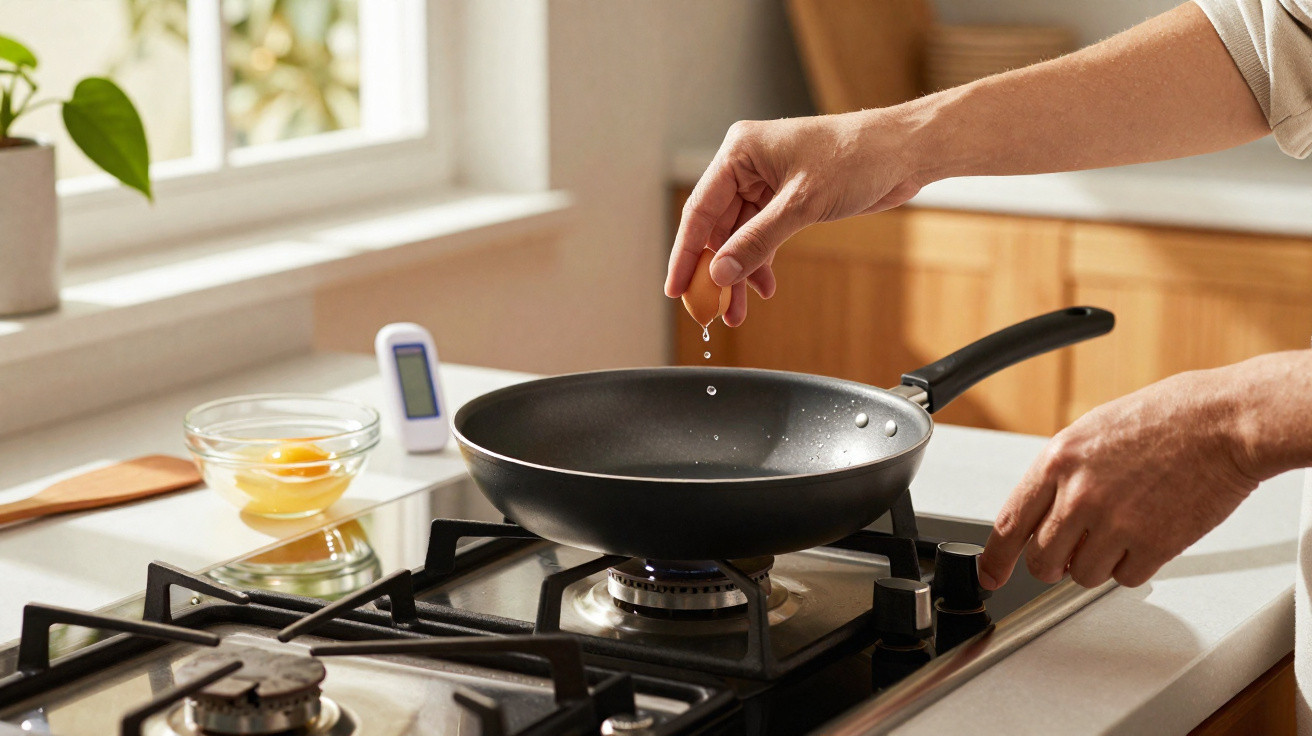
The kitchen was already hot when the smoke alarm gave its first chirp.
An empty nonstick pan had been left on the hob, gleaming with heat, after being forgotten for “just a minute” - a minute that had silently become five. When someone finally dashed back with eggs in hand, its surface had slightly darkened, the smell had become acrid, and the pan - previously smooth and perfect - suddenly seemed far older than it was. The eggs caught in uneven clumps. A rubber spatula left a light melted mark around the edge. There was no blaze or spectacle, merely an unseen threshold being passed: the point at which a utensil designed for ease starts to deteriorate. Most people never realise they have crossed it.
What really happens when your nonstick pan “preheats” too long
Many home cooks follow the same little routine without a second thought: switch on the hob, put the pan on it, then step away “for a second”. With nonstick cookware, it seems harmless. Low to medium heat - what could possibly happen?
At first glance, nothing appears wrong. You may notice a little shimmer or a mild haze hovering above the coating. You return, pour in some oil and carry on cooking. At a microscopic level, however, the coating has just been put through an intense burst of stress.
Nonstick coatings are not magic. They are slender layers of engineered polymers, sprayed or bonded on in several delicate coats. When an empty pan is left over high heat, its temperature can rise by hundreds of degrees within minutes. The coating expands and contracts as a result, beginning to tire. You will not necessarily spot the effect that day; you notice it weeks later, when pancakes cling rather than glide.
One cookware engineer I spoke to explained how rapidly an empty nonstick pan gains heat. In laboratory testing, an inexpensive flat pan on a powerful gas hob can rise from room temperature to above 260°C (500°F) in less than three minutes. That is approximately the point at which many nonstick coatings can begin quietly degrading.
Social media is full of clips celebrating a pan made “ripping hot” before a steak goes in. It may look good on screen, but it is dreadful for nonstick cookware. Everyday kitchens tell a different story. A student in a small flat uses one pan for everything: pasta, stir-fries and pancakes. Following three months of routinely preheating it on high, the middle becomes dull and food suddenly cooks differently. He assumes he has purchased a “bad brand”. The reality is less exciting and more irritating: each empty high-heat preheat has gradually cooked away the coating.
There is evidence behind this. Research on conventional PTFE-based coatings indicates that repeated heating beyond certain limits greatly accelerates the loss of nonstick performance. An overheating episode does not simply make that day’s eggs stick; it alters the surface chemistry in minute stages. The tiny cracks and rough areas visible after a year often began on the occasions when the pan was warming while you looked at your phone.
To see why extended preheating is so punishing, picture the pan as a layered sandwich, with each layer having its own limits. The base is metal - aluminium or stainless steel - which transfers heat quickly and expands as it warms. Above it sits the nonstick coating, which does not expand at precisely the same rate or in the same manner.
When food or oil is in the pan and it heats gradually, these layers tend to warm fairly evenly. Put an empty pan over a powerful burner, though, and the metal races ahead. The coating is pulled along, repeatedly stretching and relaxing. This mechanical strain, coupled with temperatures creeping towards the breakdown range, begins to create weak points that cannot be seen.
After the structure has been compromised, deterioration speeds up. Oil stops spreading as an even film. Hot spots develop. Discolouration starts in the centre of the coating before gradually becoming patchy. Certain modern pans use strengthened ceramic coatings or multilayer systems that tolerate mistreatment somewhat better, but none benefits from intense bare heat. Even the most durable nonstick pan has a quiet adversary: the time it spends empty on an overly hot hob.
How to heat nonstick pans the right way without damaging the coating
The solution is straightforward. It is less about learning a set of rules than changing a few small habits. Treat warming a nonstick pan rather like warming up before a run: do it steadily and gradually, with something present to take the strain. Rather than putting a cold, dry pan straight over full power, use medium heat and add a little fat early on.
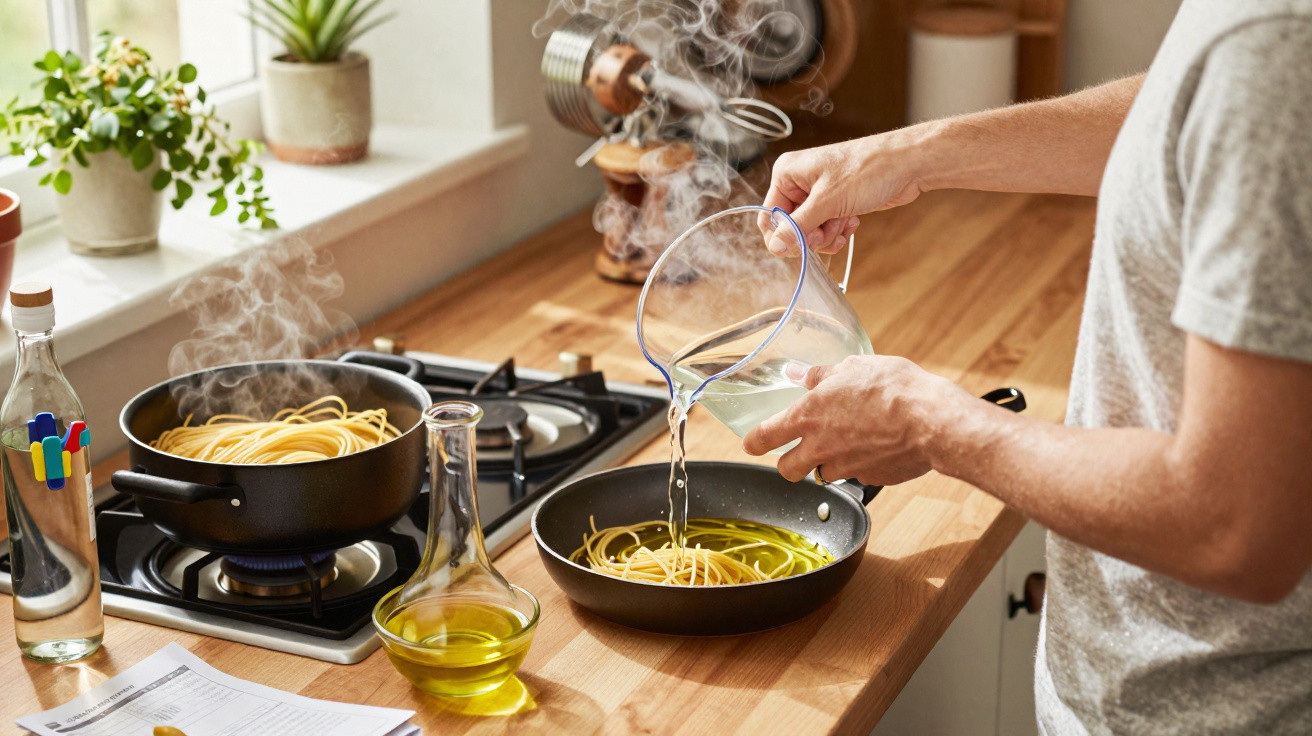
Oil, butter or even a splash of water provides a temperature buffer. While there is something in the pan, energy goes into warming and evaporating it instead of simply rushing into the bare coating. A practical routine is to set the hob to medium, add a teaspoon of oil, then prepare the remaining ingredients within easy reach. Once the oil has a gentle shimmer - rather than smoking - the pan is ready.
For delicate foods such as eggs and pancakes, remain at the lower end of medium heat. Nonstick cookware does not require fierce heat to work properly. It needs steadiness. Aim for a soft sizzle, not an aggressive sear.
On a hectic weekday evening, it is all too easy to repeat the same mistake. You arrive home hungry, throw down your bag and turn the control to high almost automatically. High heat feels like a shortcut, but it is actually the slower route to a ruined pan. So how can you manage real life rather than an idealised kitchen?
First, learn your hob’s character. Gas burners on older cookers may be surprisingly fierce, even when set to medium. Induction hobs can rise in temperature faster than you can react. Look out for early warnings: smoking oil, unusual smells from an empty pan, or a slight rainbow discolouration that was not there the previous month. These are signs that the coating is under distress.
Secondly, observe the limits stated in the instruction manual or on the packaging, even if they appear cautious. Many brands set recommended maximum temperatures at around 260°C (500°F), while some advise lower limits for prolonged cooking. To be honest, nobody reads a cookware manual from cover to cover or reaches for an infrared thermometer at 7 p.m. on a Tuesday. Instead, rely on small, repeatable signs: shimmer, minimal smoke and a gentle sizzle.
There is a quiet truth that many professionals will acknowledge privately:
“Every time you forget an empty nonstick pan on high, you’re trading months of its life for a few minutes of convenience.”
It may sound severe, yet accepting it can be unexpectedly freeing. You can then choose deliberately how to use your pan’s “lifespan budget”. Want to use one inexpensive pan hard for crisp smash burgers, then replace it? Fine. Would you rather save a higher-quality pan for eggs and crêpes, warming it gently and treating it carefully? That is fine too. What matters is making the choice instead of drifting into it.
- Use medium heat with nonstick cookware, and keep high heat for stainless steel or cast iron.
- Add oil or food within 1–2 minutes of switching on the hob.
- If an empty pan produces sharp fumes or smoke, turn off the heat and allow it to cool.
- Rotate your pans: retain a “workhorse” for tougher jobs and a “pampered” pan for delicate cooking.
- If unsure, begin on low heat and increase it only if the food is not cooking.
A different way to think about nonstick pans
Nonstick cookware occupies an unusual place between convenience and fragility. It offers effortless mornings - neatly formed fried eggs slipping on to a plate - while quietly demanding a level of care that does not always suit rushed days. On a busy morning, with children half dressed and toast nearly burning, nobody is measuring how long the pan has been warming. That is precisely when small, invisible damage occurs.
There is also a familiar emotional sting: you buy a smart new pan, look after it reasonably well, and within a year it is sticking and looking miserable. You feel slightly misled, slightly guilty, then move on to another one, assuming that is simply what happens. We seldom discuss how kitchen tools grow old, or how our own habits shape their lifespan. We do not think about them as we do shoes or phones, where wear and tear seems ordinary and expected. Perhaps we should.
Once you recognise this pattern, nonstick becomes easier to understand: it is a specialist rather than an all-rounder. Excellent for certain jobs, vulnerable in others. It’s not a pan that “can’t handle real cooking”; it’s a pan that shines when you meet it halfway. Mention that to a friend and you will probably hear their own tale of a “mysteriously ruined” frying pan. Reflection begins in those small frustrations we share.
| Key point | Detail | Why it matters to the reader |
|---|---|---|
| Critical temperatures | An empty nonstick pan can exceed 260°C (500°F) within a few minutes | Understand when coating degradation truly begins |
| Preheating habits | Heating an empty pan hard weakens the layers of the coating | Identify the everyday action most likely to ruin the pan |
| Best practice | Heat over medium with fat or food in the pan from the beginning | Extend the coating’s lifespan and retain a genuinely nonstick surface |







Comments
No comments yet. Be the first to comment!
Leave a Comment