There is a point on almost every weekday evening when time seems to vanish. You peer into the fridge and find a wilted bag of spinach, rice left over from two days earlier, and perhaps chicken that needs cooking before it starts looking questionable. You are exhausted, your thoughts have turned to mush, and only one thing is stopping you ordering Deliveroo: the forlorn little box humming on the worktop, the microwave. You know it will make the food hot, yet also a bit rubbery, oddly soggy, and somehow dry and wet in precisely the wrong places. Still, at 8.47pm on a Tuesday, you press “Start” because what else can you realistically do?
A new appliance is now fighting for that valuable bit of worktop space. It is discussed in group chats and loudly promoted on TikTok as “the microwave killer”. It claims to deliver speed, crunch, proper flavour and a little more self-respect for your leftovers. Once the hype and hashtags are stripped away, though, how can you tell whether one of these countertop cookers is genuinely worth buying?
The rise of the “microwave killer” on our countertops
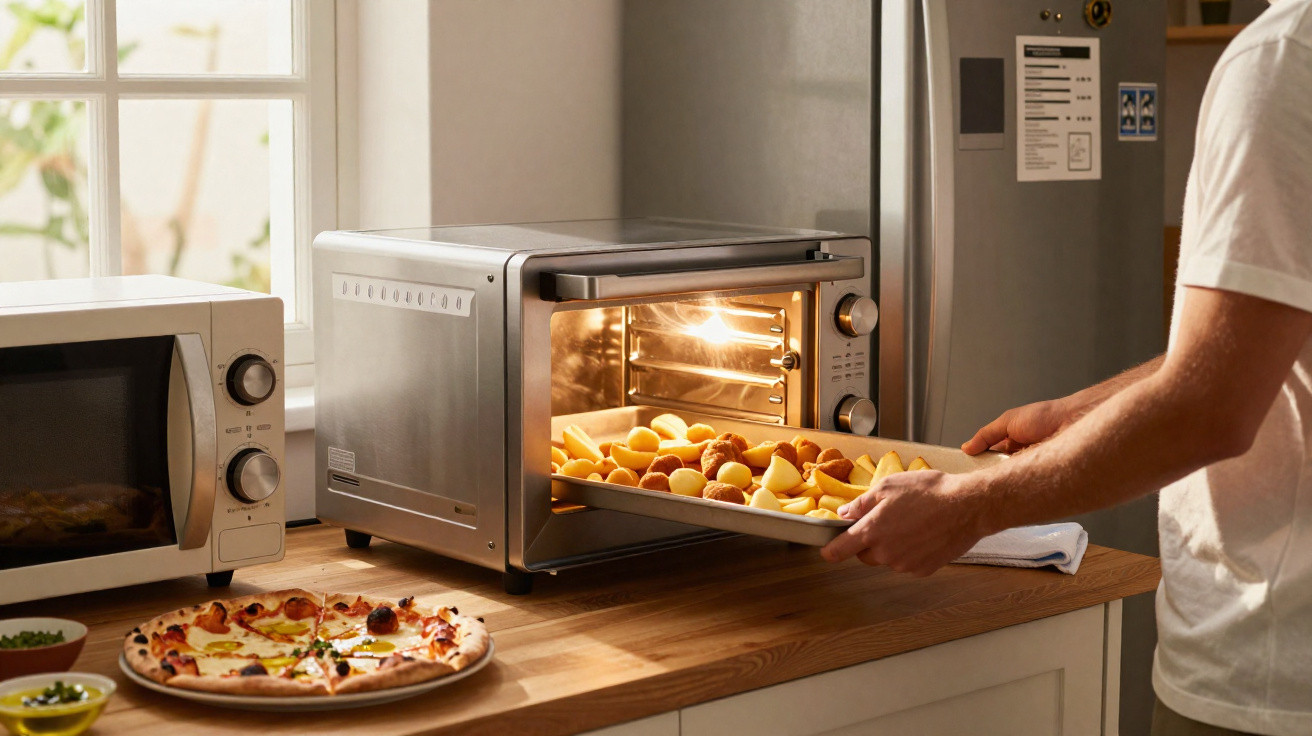
You may have seen one already without quite registering it: a short, box-shaped oven with a glass door, polished dials or a touchscreen, while influencers remove trays of beautifully browned chicken thighs after only 14 minutes. Air fryers began the trend, followed by combination toaster ovens, rapid cookers and even compact “smart ovens” said to use algorithms to cook fish better than you can. All of a sudden, the microwave resembles the ageing uncle at a wedding: still included, but largely ignored.
Calling them a “microwave killer” is clearly dramatic, but the phrase touches a nerve. People have had enough of meals that taste as though they have endured a laboratory experiment. Energy bills have risen, attention spans have shortened and kitchens have become smaller. The modest, rather desperate ambition is one appliance that heats, crisps, roasts, reheats and perhaps grills, without making the kitchen feel like a sauna or turning dinner into a beige disappointment.
Manufacturers understand that appeal. This is why a fresh countertop cooker appears almost weekly, promising restaurant-standard food faster than it takes to locate the end of the cling film. A few really are smartly designed; others are simply microwaves in elaborate disguise. The important part is recognising the difference before spending £200 on a glossy machine that ends up being used only for warming coffee.
What people actually want from the “microwave killer”
In truth, nobody wakes up thinking, “What I really need is a multi-stage convection-cyclonic precision cooker.” The requirements are much more basic: warm food quickly, make it enjoyable, avoid taking over the kitchen and do not demand a 40-minute YouTube investigation before you can prepare a fish finger. That is all. Microwaves never quite solved the emotional divide between convenience and satisfaction.
Most of us know the experience of lifting out a microwaved plate that is scorching around the edges but still cold from the fridge in the centre, accompanied by a strange plastic-like smell despite no plastic having been used. It can feel as though you have short-changed yourself. New countertop cookers are appealing to that quiet frustration, offering an end to limp pizza, roast potatoes reduced to mush and chicken with the flavour of something prepared inside a wet sock.
The excitement grows because the successes are easy to see. Chips can be crisp in 10 minutes with very little oil. Leftover roast dinner can be revived rather than merely tolerated. Frozen salmon can go straight into the appliance and emerge somehow edible 12 minutes later. The first few uses can feel magical, which is how people become converts. Before being won over by the next viral reel, however, there are some simple questions worth asking.
First filter: What kind of cooker is it, really?
Air fryer, hybrid oven or smart box?
Not every “microwave killer” is the same type of appliance. The three main categories are air fryers, air-fryer ovens - compact convection ovens with trays - and sophisticated “smart ovens” combining several technologies. Air fryers excel at crisping food and handling smaller amounts, although many baskets are so compact they barely accommodate one portion of chips. Air-fryer ovens offer more room and operate more like a miniature conventional oven, but can claim a larger share of the worktop.
At the premium end are smart ovens marketed as the genuine microwave killer. They use powerful convection heat, sometimes radiant heating elements and occasionally concealed microwave technology, to cook food remarkably quickly. Many include presets such as “reheat pizza” or “cook salmon”. That is useful until you remember you must still establish whether the salmon is thick or thin, and whether the pizza is frozen or yesterday evening’s regret.
First, consider which format suits the way you truly cook, rather than the version of yourself you picture inhabiting an organised new life. If your usual routine is reheating leftovers and preparing frozen odds and ends, a simple air fryer or combination oven is likely to improve weeknights more than an expensive smart box offering 200 modes. The right machine is the one you don’t have to psych yourself up to use on a Wednesday.
Size, shape and the brutal reality of British kitchens
A large 15-litre appliance with three shelves can appear brilliant on paper. In a London flat with roughly one and a half useful surfaces, it is effectively another housemate. Before becoming attached to an online model, take two unexciting but crucial measurements: the amount of worktop you can afford to give up and the size of food you genuinely need to fit inside. Product photographs can be deceptive, and the chicken on display is often suspiciously small.
Put some direct questions to yourself. Do you really cook whole chickens, or are your more likely meals chips, two fillets, a tray of vegetables and reheated pasta bake? Are you feeding one person, two people, or an entire family arriving in the kitchen simultaneously like a swarm? A 4–5 litre air-fryer basket will generally suit one or two people. Families may need 7 litres or a tray-style oven capable of cooking a full meal on a single shelf.
Height matters too. Some newer cookers are tall, which seems harmless until you discover that you must pull the appliance out from beneath cupboards every time because its lid or door cannot open completely. Measure the available space, then measure the cooker, and imagine using it on a real Tuesday night rather than during an aspirationally organised Sunday food-prep session that you definitely will not do.
What actually makes food taste better?
The magic word: crisping
The central improvement that makes people bold enough to use the term “microwave killer” is browning: crisp edges and genuine texture. A microwave agitates water molecules, making it excellent for speed but dreadful for food that was originally crunchy. Steam becomes trapped, food sweats, and previously splendid roast potatoes turn into hot, moist pebbles. Circulating hot air - convection - is what changes this.
When comparing appliances, seek powerful fan-assisted convection with respectable wattage. At least 1400–1700W will usually provide the intense rush of heat needed to brown food quickly. Certain models refer to “dual heating elements” or “top and bottom heat”; both can prevent chips cooking on one side while remaining pale and underwhelming on the other. Engineering knowledge is unnecessary: look for robust wattage and effective airflow.
It is also important that food can be arranged in one layer. The moment you anxiously pile chips on top of one another, cooking becomes uneven. Basket air fryers work well for smaller portions, while tray-style appliances with shallow pans are generally more suitable for feeding several people. The greater the surface exposed to hot air, the better the chance of biting into something that actually crunches rather than droops sadly through the middle.
The controls you’ll genuinely use (and the ones you won’t)
A shiny touchscreen and 15 cheerful pre-set modes can be alluring. In practice, most people repeatedly use only two or three settings while the rest accumulate virtual dust. The relevant question is not “How many functions does it have?” but “How quickly can I get it going when I’m hungry and grumpy?” That is the meaningful test for any supposed microwave replacement.
Choose an appliance that allows you to alter cooking time and temperature without a struggle. Physical dials remain underappreciated, as they are faster than prodding a touchscreen with slightly greasy fingers. An uncomplicated control panel that gets you to “go” within seconds is more valuable than menus resembling the set-up process for a new phone. If looking at the product photographs already makes you feel weary, take that as a warning.
Pre-sets can help when they fit your everyday habits. “Chips”, “reheat”, “chicken”, “veg” - those are sensible options. On encountering more specialised programmes such as “shrimp”, “muffins” and “dehydrate”, consider how frequently you will honestly dehydrate mango slices on a school night. Choose usability over bragging rights. An oven’s “yoghurt” mode is irrelevant if the microwave still feels easier to use.
Reheating leftovers: the real battleground
Leftovers have always been the microwave’s strongest territory: put food in a bowl, press one button and it is done. These countertop appliances are attempting to take that title by achieving the thing microwaves rarely manage: making yesterday’s meal seem fresh. This is a reason to be selective, because their performance on routine reheating varies considerably.
If curries, stews and pasta with sauce are your usual leftovers, you may still want a microwave close by. The “microwave killers” perform best with dry, solid food such as pizza, chips, breaded chicken and roasted vegetables. Read reviews that discuss reheating as well as cooking meals from scratch. Does rice dry out? Do the edges burn while the middle remains cold? People tend to be notably candid about this, particularly after their leftover lasagne has suffered a second death.
A specific “reheat” or “leftovers” setting is encouraging, but it should not become an obsession. Control over time and temperature is more significant. Being able to reduce the heat to 150–160°C and warm food gradually is much better than attacking everything at maximum power. A good microwave killer should be kind to yesterday’s food, not just brutal and fast.
Cleaning: the deal-breaker no one wants to talk about
The honeymoon period ends when you open the door and see that chicken fat from the night before has covered the interior in a shiny, sticky layer. This is where many expensive gadgets discreetly disappoint. Deep baskets, inconvenient corners and odd mesh inserts that cling to crumbs for dear life all create work. When cleaning is a hassle, the appliance can shift from “game-changer” to “dust collector” in around three weeks.
Prioritise removable, dishwasher-safe trays and baskets without excessive crevices. Non-stick finishes are useful, although it is worth checking the small print about approved sponges and detergents. Smooth internal surfaces that can be wiped clean will beat clever shapes every time. Ideally, you should be able to wipe around the interior in less than a minute, rather than mount a major kitchen operation involving toothpicks and despair.
Consider the door as well. Does it open without obstruction? Are there spaces where crumbs will collect and torment you? It may sound overly particular, but you only appreciate the issue when you are trying to remove burnt cheese from an impossible angle and wondering why you did not stay with the microwave, which never demanded so much effort.
The emotional bit: does it actually fit your life?
Beyond the specifications, wattage and fan arrangements lies a more subdued question: do you genuinely want to cook more, or simply want life to seem a little less chaotic? Much of the “microwave killer” enthusiasm is about lifestyle as well as meals. The promise is that the appliance could encourage healthier eating, reduce waste and lessen reliance on takeaway food. Occasionally it does; sometimes it does not.
There is nothing embarrassing about wanting improved chips and a way to make leftover pizza taste less like cardboard. That alone is a perfectly good reason to buy one. The trick is not to buy into the fantasy version of yourself who batch cooks, roasts vegetables every night and reads the entire manual before bed. That person is delightful, but for most people, also fictional.
As you decide whether to enter the “microwave killer” club, imagine yourself in three months’ time. You are tired, it is late, and the fridge contains a cold slice of pizza and half a tray of Sunday roast potatoes. Which button will you honestly press? If the new cooker is as straightforward and instinctive as the microwave, but produces food that quietly makes you happier, it is probably the right choice. Otherwise, the old humming box may remain safe on your worktop for a few more years.











Comments
No comments yet. Be the first to comment!
Leave a Comment