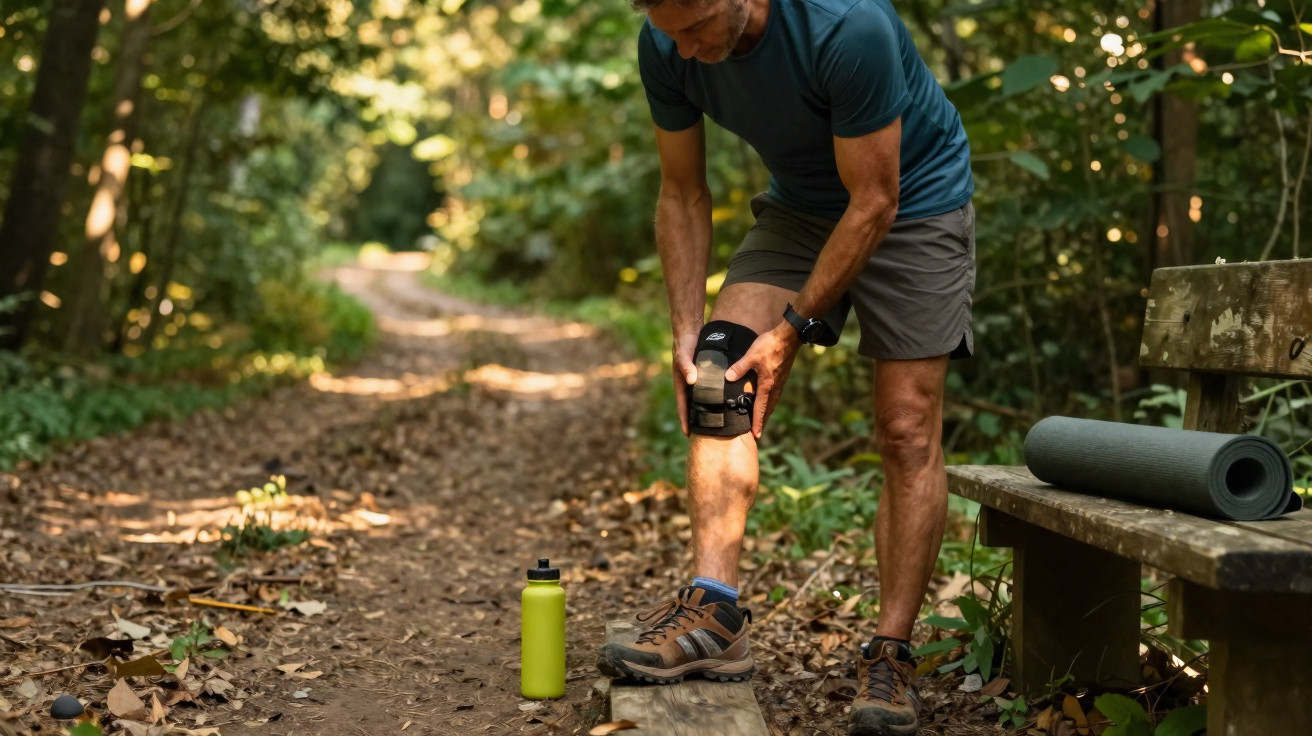
Ten minutes before reaching the car, a sudden stab shoots through your knee. At first it happens only every third step, then on every stair. You start walking lopsidedly, trying to protect the leg while muttering under your breath. Later, when you get up from the sofa, the knee makes itself known again. Climbing stairs feels as though there is a rusty nail beneath your kneecap.
The following morning, you search for “knee pain after hiking” and find every possible explanation: meniscus damage, osteoarthritis, overuse, and alarming worst-case scenarios. You wonder whether you weigh too much, are insufficiently fit, are getting too old, or were simply unlucky. One line repeatedly appears in forums: “You need to stretch more.” It sounds simplistic. Yet what if that is precisely where the answer lies?
Why your knee suddenly gives up after a hike
It is a familiar experience: the hike itself was excellent, the running route felt comfortable and your heart rate stayed under control - yet your knee hurts afterwards. The pain may not arrive immediately, instead emerging as a gradual pull at the front of the knee or beside the kneecap. You cannot recall a misstep, a fall or anything dramatic. There is only the sense that the joint is protesting because it had to keep going for too long. That can feel particularly unfair when you were “only trying to do something good” for your body.
Physiotherapists hear versions of this story almost every day. There is the 32-year-old training for her first half marathon, sitting on the sofa with an ice pack on her knee after every long run. There is the 55-year-old mountain enthusiast who can barely get out of the car after an easy but lengthy hut-to-hut walk. Then there are all the weekend hikers who sit in an office and do virtually no exercise from Tuesday to Thursday, before trying to make up four hours of ascent on Saturday. Their knees have to absorb both everyday life and ambition.
From an anatomical perspective, the knee is a remarkably straightforward but brutally honest joint. It sits exactly where load, direction and speed come together. When the hips and ankles are stiff, the thigh muscles are shortened, or the glutes and core are tired, the extra workload ends up at the knee. Let us be honest: nobody does 15 minutes of mobility work for their hips and hamstrings every day. Most people only realise how immobile they are when pain forces them to kneel down - quite literally. In many cases, knee pain after hiking is not caused by irreversible damage, but by a muscle and fascia issue that can be addressed quite specifically.
The stretching routine many physiotherapists swear by for knee pain after hiking
Physiotherapists rarely rely on “miracle exercises”; instead, they use straightforward routines repeated consistently. One such routine appears in many clinics when dealing with knee pain after running or hiking. It targets three areas: the front of the thighs, the backs of the legs, and the glutes/IT band. The routine takes around ten to fifteen minutes and is done after exercise - ideally as soon as you arrive home, before sinking into the sofa.
The first component is a traditional quadriceps stretch, either standing or lying on your side: bring the heel towards the buttock, actively push the hip forwards, and hold for 30–40 seconds on each side. The second is a hamstring stretch performed lying down with a strap or towel: lift one straight leg upwards until you feel a clear pull at the back of the leg, rather than in the knee itself. The third is a glute and IT-band stretch, for example by placing the ankle over the opposite thigh while seated and leaning the upper body gently forwards. Ease gradually into every stretch; do not bounce or pull sharply, but settle calmly into the position.
Here is the less exciting part: this stretching routine only works when it is performed regularly, not as an emergency response once a month. Yes, that sounds dull. Many physiotherapists suggest spending five to ten minutes on it immediately after a hike or run, plus doing a “maintenance session” on one pain-free day each week. One additional technique that surprisingly few people use is to shake out and gently stretch the front of the thighs before a long descent, rather than simply refilling a water bottle. Treating muscles as something other than rigid ropes reduces pressure on the joint.
The most common mistake is seeing stretching as punishment. You come off the trail sweaty and hungry, perhaps already picturing a burger, and now you are meant to hold dull positions while the clock seems to stand still. Many people also stop as soon as the knee pain has “gone away”, then wonder why it returns after the next hike. This is exactly where good physiotherapists step in with a very human approach:
“I do not expect my patients to do half an hour of yoga every day,” says sports physiotherapist Lisa K., who regularly works with trail runners. “But three targeted stretches after running, which genuinely become routine, often make more difference than expensive shoe insoles or a fifth knee brace.”
- Keep it brief and consistent: 3–4 stretches, each held for 30–40 seconds per side, immediately after running or hiking.
- Respect the pain scale: a mild pulling sensation is acceptable; sharp knee pain is a sign to stop.
- Consider the context: persistent swelling, a feeling of locking or pain at night mean the knee needs medical assessment.
What matters once the trail is behind you
Anyone who has limped down a staircase with knee pain is unlikely to forget the sensation quickly. It is a quiet shock: the mobility you had always considered a given suddenly feels fragile. At that point, a small, unassuming stretching routine can make a difference - not as a miracle cure, but as a daily reminder that your knee does not work alone. The hips, thighs, glutes and calves all influence how much pressure reaches this joint.
Perhaps the real value of this routine is not limited to the ten minutes after a hike. Perhaps it lies in the moment when you deliberately sit on the floor, take off your shoes, put your phone aside for a while and ask yourself: how does my body truly feel right now? If the front of your thighs feels as hard as concrete, or your hamstrings pull like an old elastic band, that is not failure. It is an invitation to judge your next hike or run not only by distance and ascent, but by how easily you can push yourself back up from the floor afterwards.
You may eventually share this routine with the friend who always wants to “just jog quickly downhill” before complaining about knee pain. Or perhaps with the colleague who says she is “too inflexible” to stretch. It could become something very ordinary and, at the same time, highly valuable: a small culture of taking care before something breaks down. Your knees will carry you for longer than you think - if you give them a few minutes of attention now and then.
| Key point | Detail | Benefit for the reader |
|---|---|---|
| Stretching routine after exercise | Focus on the front of the thighs, backs of the legs, glutes/IT band, 30–40 seconds each | A specific, easy-to-follow plan to relieve pressure on the knee after hiking or running |
| Consistency rather than perfection | 2–3 times per week, especially on exercise days; short sessions are better than none | A realistic approach that fits into ordinary life and works over the long term |
| Take warning signs seriously | Swelling, a locking sensation and pain at night are reasons to seek medical assessment | Helps prevent misjudgements and avoids serious problems being overlooked |















Comments
No comments yet. Be the first to comment!
Leave a Comment