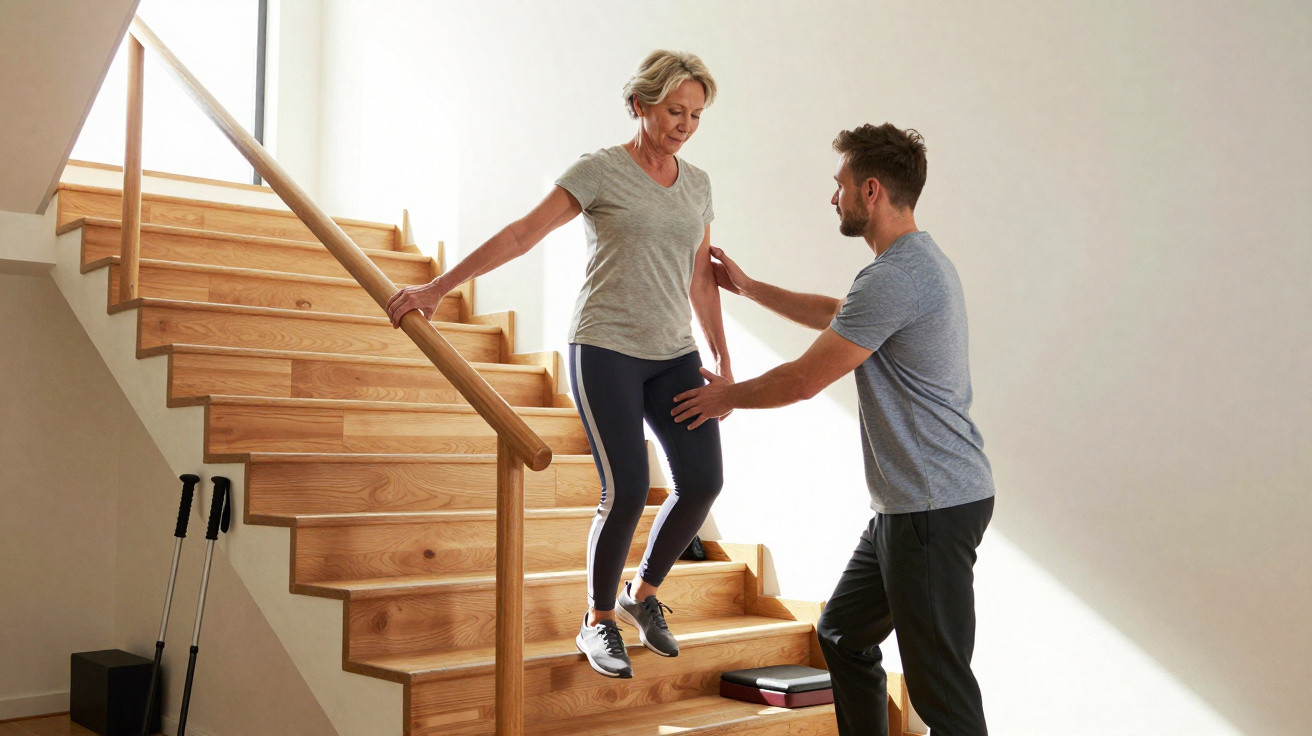
Six steps. Once a joke, now a brief inner conversation: “Will this still be all right?” Mrs M, 72, takes a deeper breath, grips the handrail more firmly and places her foot with care. No rushing, no phone in her hand, no laundry basket under her arm. Just her, the staircase and that quiet moment between confidence and caution. We know it: the instant when you suddenly realise that your body responds differently from how it did at 40. That is exactly where the decision is made-whether stairs remain part of everyday life or become a risk. Falls on stairs among people over 65 are far from a marginal issue. They happen in ordinary life, on entirely ordinary days. Yet three simple movements can prevent them surprisingly often. One starts before a foot even touches the first step.
Three movements that rewire stair climbing
The first movement is almost imperceptible: deliberately engaging your core before lifting a foot. From the outside, it simply looks as though someone pauses to collect their breath and gently draws in their abdomen. Inside, however, something crucial is happening. The spine lengthens, the pelvis becomes steadier and balance suddenly has support behind it. It seems unremarkable, almost obvious. Perhaps that is why so few people use this small ritual.
A geriatrician from Cologne told me about a 79-year-old patient who nearly lost his independence after falling on the stairs. The man was mentally sharp and had once been active, but his core muscles had simply “gone to sleep”. After six weeks of a basic exercise-consciously tightening his abdomen three times a day before taking a step-he no longer needed a second handrail. No joke: he started to view his staircase as a “training route” again. Rehabilitation clinic statistics point in the same direction. People with greater core stability fall on stairs far less often. This is not because their legs are stronger, but because the whole body works as one team.
The logic soon becomes clear. When the torso wobbles, each leg has to manage every minor correction alone. The foot searches for support, the gaze drops downwards and the shoulders tighten. The staircase becomes a test. When the core is stable, the legs can “simply” lift and lower. The mind remains clear, and the eyes can look one or two steps ahead rather than being anxiously fixed on the toes. This subtle micro-movement before the first step works like an internal switch: from passive to active, from exposed to prepared. Once people have felt the difference, they rarely want to return to the old habit of just setting off quickly.
The three specific movements that make the difference
The first movement is: “navel towards the spine”. Before stepping onto the stairs, while standing still, stand tall, breathe out and gently draw your navel inwards, as though you were fastening your waistband. Do not brace hard; simply create a light tension. Hold it for two seconds, then take the first step. On every step, give yourself a brief reminder: back long, abdomen gently engaged. This small routine quickly becomes embedded, much like automatically fastening a seat belt in a car. After a few weeks, you no longer need to think much about it-the body takes over.
The second movement is: “nose over toes”. Whether going up or down, mentally move your nose over your toes instead of leaning your upper body backwards. Many older people do precisely the opposite, leaning back because they are afraid. It may feel safer, but it moves the centre of gravity backwards and makes the next step less steady. A gentle forward lean keeps your body weight over your feet. It sounds counterintuitive, yet after a few attempts it feels calmer. There is nothing dramatic about it, only a minimal forward position of the upper body.
The third movement is: “place the whole foot down”. Each step should take the entire sole, rather than just the forefoot. When going up, this means placing the foot far enough forward for the heel to fit on the step. When descending, consciously notice the heel and ball of the foot landing together. This seemingly slower method reduces strain on the knees and hips, gives the brain clearer feedback and lessens the notorious “ladder effect”, when feet are left hanging too far over the edge. Let us be honest: nobody truly does this on every single step, but on challenging stairs-steep, poorly lit or in an unfamiliar building-it can make exactly the difference that matters.
Avoiding common pitfalls without becoming anxious
Many people over 65 use their own stairs for years without ever falling. That is precisely the trap: familiarity creates an illusion of safety. You do still quickly carry the laundry basket upstairs, balance shopping bags, or fail to hold the handrail “just for a moment” because your phone is in your hand. People who use the three movements do not need to panic; they simply need a new agreement with themselves: I no longer take stairs as an afterthought. They deserve a moment of their own. One or two seconds of preparation, no multitasking and no heroics.
The most common mistake after a fall is excessive caution. Some people begin avoiding stairs “so as not to risk anything”. Muscles then weaken further, confidence fades and fear grows. Others head in the opposite direction and feel they need to “prove it to themselves”. They deliberately climb faster, without using the handrail, almost defiantly. Both responses lead the same way. A more sensible middle path is to regard the staircase as an everyday training space-not an enemy and not a stage for showing off. It is simply a neutral place where you practise a little stability every day, as routinely as brushing your teeth.
“When my patient says, ‘I now avoid all stairs’, I know that the stairs are not the problem, but rather the lost confidence in their own body,” says a physiotherapist from a rehabilitation clinic in Baden-Württemberg. “We restore that confidence through very small movements-and the staircase often becomes the first place where they truly notice their new bodily awareness.”
- Deliberately use one staircase a day as “training”, rather than avoiding all of them.
- Keep at least one hand free-laundry baskets, bags and phones can wait.
- Practise the three movements (abdomen, nose, foot) on a familiar staircase.
- If uncertainty arises, slow down slightly rather than speeding up.
- Once a week, use the stairs with someone else-four eyes see more than two.
What stairs have to do with dignity-and small choices
When you speak to people over 65 about stairs, it quickly becomes clear that the subject is rarely just steps. It is about independence: whether they can still sleep upstairs in their own bedroom, whether the balcony remains accessible, and whether they can accompany their grandchildren through the house. A fall on the stairs carries this additional, unspoken weight. Suddenly, there are discussions about whether a stairlift is needed or whether the house still suits them. The three movements do not solve this at the push of a button. But they shift the perspective-from feeling helpless to taking an active role.
Nobody needs to become a fitness enthusiast to manage their stairs more safely. Simply noticing how you stand before the first step can change daily life: Are you holding your breath or breathing out? Where is your weight? How does your foot land? Small routines create the safety net that remains invisible until it is needed. Something else also happens quietly: children and grandchildren who observe this unconsciously adopt these movements themselves. Suddenly, the staircase is no longer an intimidating place but a shared learning space across generations. Once a day, one staircase, one conscious moment. That is often all it takes to keep walking the steps of your own life independently for a little longer.
| Key point | Detail | Benefit for the reader |
|---|---|---|
| Engaged core | Gently draw the navel inwards before your foot reaches the first step | Greater torso stability, less wobbling and clearer balance on every step |
| Centre of gravity forwards | Mentally move your nose over your toes instead of leaning backwards | Lower risk of falling when going up and down, with a steadier sense of each step |
| Full-foot contact with the step | Place the entire sole on the step rather than leaving only the forefoot on the edge | Less strain on knees and hips, better sensory feedback and greater safety on every step |











Comments
No comments yet. Be the first to comment!
Leave a Comment