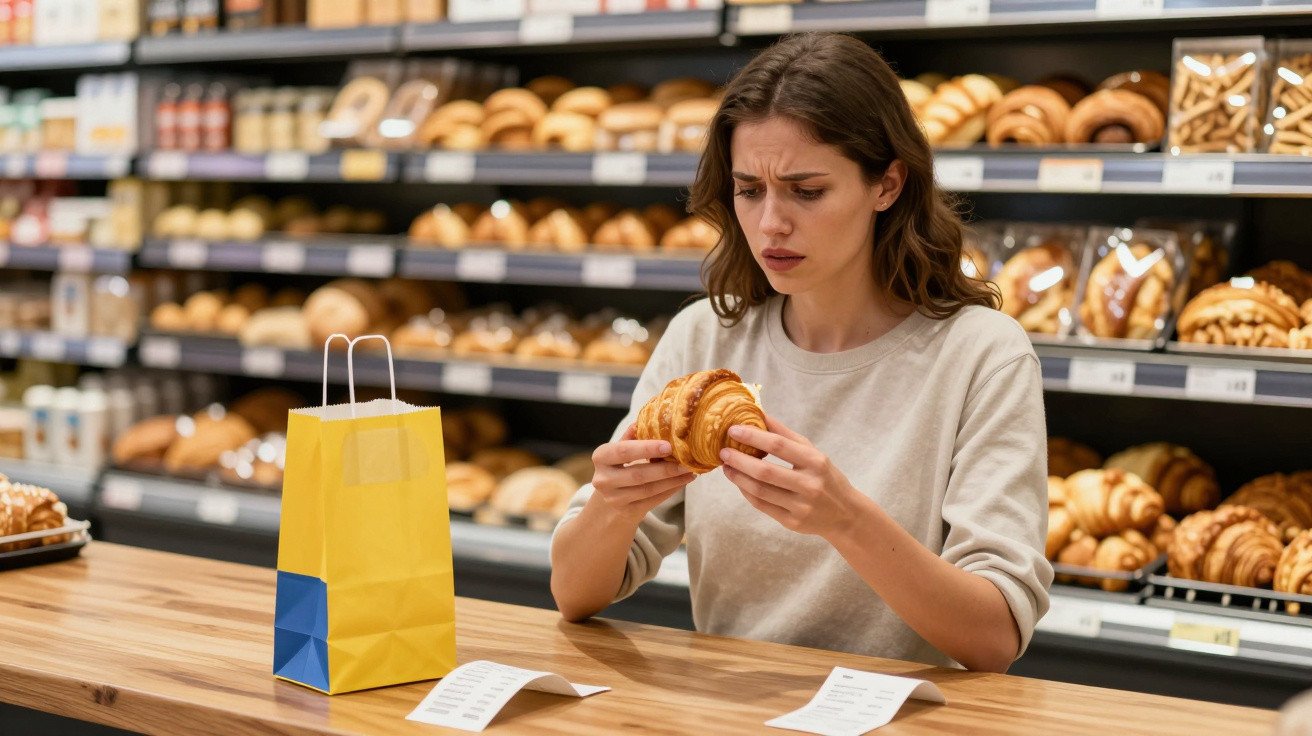
A popular puff-pastry classic has suddenly come under scrutiny: a consumer in the United Kingdom explains why she has drawn the line over Lidl’s best-selling croissant of all things – and which alternative from the same shop she now much prefers to put in the oven.
How a Lidl croissant became a regular weekend ritual
For this shopper, it began in a fairly ordinary way. Low prices, the familiar slogan “Quality guaranteed, Lidl price” and a quick visit to the bakery section were all it took to win her over. A croissant from the self-service counter became part of every weekend, often alongside an offer from the Lidl Plus app.
At home, she would serve the pastry with Greek yoghurt, fresh fruit and a few seeds. It was a small yet established ritual: a crisp, buttery, airy croissant that seemed ideal for a Sunday morning. Later, however, this apparently harmless everyday pleasure began to lose its appeal.
The problem: when a croissant is no longer oven-fresh
Over time, her shopping routine changed. Rather than buying a croissant immediately before eating it, she started picking one up one or two days in advance. She soon noticed the difference: the crumb appeared duller, the texture was no longer as light or flaky, and the crust became less appealing.
She therefore tried to solve the issue with an appliance. The air fryer was supposed to bring the pastry back to life. Convenient, quick and supposedly healthier than deep-frying, it seemed like the perfect answer.
After several attempts, she was convinced that the air fryer could not return the Lidl croissant to the standard of a freshly baked pastry.
The pastry tended to turn hard on the outside, while the middle became denser and less fluffy. She adjusted the temperature and cooking time, tested different settings, turned the croissant over, placed it directly in the basket and then tried baking paper – but the outcome remained disappointing.
The air fryer as an apparent miracle solution – with drawbacks
In the customer’s view, an air fryer is essentially no more than a small fan oven. That is precisely where the difficulty lies: puff pastry that has already been baked and allowed to cool can only be revived to a limited extent. Its fat layers have set, moisture is distributed differently through the dough, and the flavour seems flatter.
There are also health concerns around reheating baked goods repeatedly at high temperatures. Depending on the product and preparation method, unwanted substances such as acrylamide may, in extreme cases, develop – particularly if the pastry becomes very brown or burns. This is not a direct scandal, but the trend for trying to “upgrade” everything in an air fryer clearly has its limits.
The Lidl croissant alternative comes from the freezer aisle
The turning point came in a completely different aisle: the frozen food section. There, the shopper found unbaked croissants that could be finished in the oven at home. The packet promised a longer shelf life, straightforward preparation instructions and a notably lower price per croissant.
She decided to try them and was surprised by the result. The frozen dough pieces rose considerably in the oven, turned golden brown on the outside and remained light inside. Visually, they looked more like traditional bakery goods than a self-service croissant reheated the day after purchase.
According to her account, the aroma of the frozen croissants comes remarkably close to the smell from the in-store bakery – without a trip around the supermarket.
She detected very little difference in taste, too. In her opinion, the fresh self-service croissant and the frozen version were extremely similar when both were prepared in the oven. The major difference was the price.
Price comparison: bakery counter versus frozen pack
- Croissant from the self-service bakery: about €0.69 per item
- Frozen croissant for home baking: around €0.41 per item
For someone who buys croissants regularly, that gap makes a substantial difference. There is also a practical benefit: the frozen option stays in the freezer, can be baked as required and arrives warm on the plate – without the pressure of having to eat it while it is fresh.
Loyal to Lidl, but rejecting one product
Despite being disappointed by her favourite croissant, the customer is not turning her back on Lidl at all. On the contrary, she says she still enjoys shopping there and considers the discounter particularly competitive on price compared with other chains in the United Kingdom. In her experience, individually sold products – especially own-brand lines – often perform better than comparable items at rivals such as Tesco or Sainsbury’s.
There is just one product where she now draws a firm boundary: Lidl’s most popular bakery-shop croissant will no longer go into her trolley. Instead, she consistently chooses the frozen pack – the same brand, but a different department and a different shopping experience.
Her conclusion: her favourite shop remains the same, but her favourite croissant does not – the frozen version has won.
What other shoppers can take from this
The example demonstrates how minor everyday observations can change purchasing habits. Few people examine the full ingredients list or study every label in detail whenever they buy a croissant. Yet anyone who compares products carefully will quickly spot differences in:
- Price per item or per kilogram
- Shelf life and day-to-day flexibility
- Texture after one or two days of storage
- Preparation method: fresh, reheated or frozen
Bakery items in particular can depend heavily on timing. Fresh from the oven, they can be impressive; after a few hours in a bag or after reheating, their quality can decline noticeably. Frozen products, where the real baking process begins only at home, can partly avoid that issue.
Why bakery labels deserve a closer look
Checking the label can make it easier to assess quality. Anyone who overlooks details on a self-service croissant, such as its baking date, where the dough was produced or its fat content, may miss relevant information. Not every branch bakes at the same time, and not every item comes from the same production source.
Many discounters use ready-made dough pieces that are delivered blast-frozen and baked in store. In some cases, this system closely resembles what shoppers later do themselves at home – except that they have less control over the timing and temperature.
| Aspect | Bakery-shop croissant | Frozen croissant at home |
|---|---|---|
| Baking time | determined by the shop | freely chosen |
| Freshness when eaten | dependent on the shopping time | directly from your own oven |
| Price | higher per item | usually cheaper |
| Flexibility | available straight away | stock kept in the freezer |
What air fryers, ovens and frozen food mean for health
Air fryers are often presented as an all-purpose answer for crispy snacks. Even so, it is worth taking a critical view when using them for industrially produced baked goods. High temperatures, repeated reheating and rich doughs are not an ideal combination for anyone trying to maintain a balanced diet.
People who use croissants from the freezer aisle at least have the advantage of controlling only the final baking stage. This lowers the risk of heating the pastry for unnecessarily long periods or at an excessively high temperature. At the same time, the enjoyment remains high because the result comes fresh from the oven.
Naturally, this does not change the actual calorie or fat content. A croissant remains an indulgent food, not a healthy snack. However, planning more consciously may mean buying them less often on impulse and choosing them deliberately for particular occasions – such as Sunday brunch.
Practical advice for anyone who loves croissants
Anyone who recognises themselves in the Lidl customer’s experience can use a few straightforward strategies:
- Read the label: check the unit price, ingredients and shelf life.
- Watch the baking times in store: when does the bakery counter appear at its freshest?
- Try frozen alternatives: take home a pack and compare it directly.
- Store croissants properly: eat them preferably on the same day or package them very well.
- Choose the reheating method carefully: a conventional oven often produces more even results than a small hot-air basket.
The story shows that a single close observation of product performance – in this case, texture, smell and price – can be enough for even a long-standing regular shopper to question her routine. Lidl remains her first choice for the weekly shop, but when it comes to the “star” of the bakery counter, she has chosen another route: fewer impulse purchases and more control in her own oven.

















Comments
No comments yet. Be the first to comment!
Leave a Comment