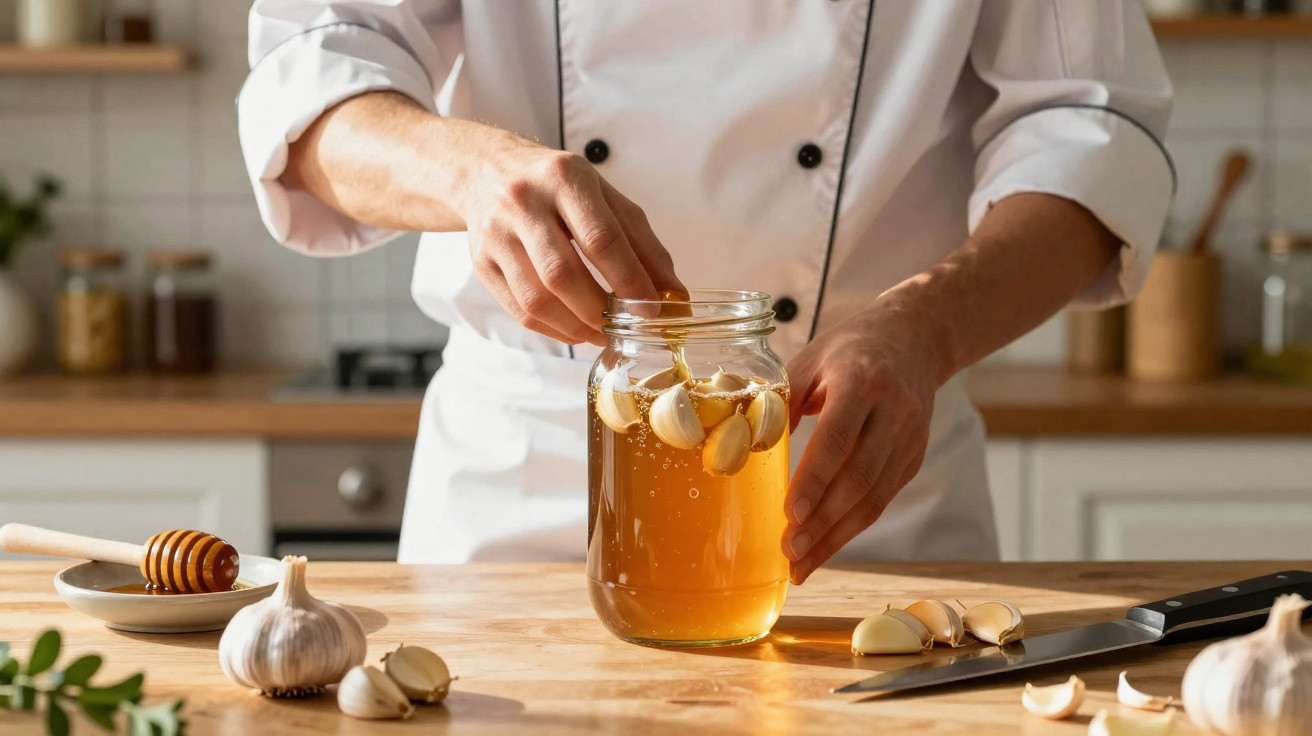
Pharmacies dispense remedies, yet kitchens can feel strangely silent. A chef I met insists that a quiet comfort is already waiting in the cupboard: garlic gradually settling into honey, transforming sticky gold into something now spoken of with near-folkloric reverence.
It was a Tuesday evening service, with steamed-up windows and pans clattering like rain against corrugated metal. The chef placed a jar on the counter: pale cloves suspended in amber honey, with tiny bubbles clinging to them like fireflies. He eased the lid open and bent towards it as though meeting an old friend. “Listen,” he said. “It’s alive.”
The tale emerged between incoming orders. One sous-chef had developed a harsh cough halfway through a shift. The chef fetched this jar, drizzled some over toast, then later whisked more into a vinaigrette. The team called it sorcery. It tasted of warmth and smelt like a field after rain. The jar achieved what no staff notice could: it made everyone slow down. The jar was breathing.
What is really happening in a garlic and honey jar
Put simply, when crushed garlic comes into contact with honey, the chemistry becomes active. Crushing garlic activates an enzyme that changes alliin into allicin, the sulphur compound responsible for its sharp, distinctive aroma. Raw honey has its own understated properties: low water activity, natural acidity and an enzyme that gradually releases a small amount of hydrogen peroxide. Together, they do not make a dramatic display. They gently influence one another.
A chef I spoke to keeps this mixture on the prep shelf throughout winter. When a sore throat begins to tingle, he coats a spoon, leaves it on his tongue and waits for the sensation. Laboratory research supports parts of the folklore, cautiously: garlic extracts can inhibit common microbes such as E. coli and Staph in Petri dishes, while honey has demonstrated broad antimicrobial activity, including against certain persistent strains. In a kitchen, that can mean fewer shared sniffles and a dressing that feels like a hug.
Language is important here. Pharmaceutical antibiotics are targeted medicines for diagnosed infections. This jar is food science from the kitchen: antimicrobial, soothing and supportive. The sugars in honey draw moisture from the garlic, making the honey thinner, encouraging wild yeasts and creating a mild, self-balancing environment. Its logic is closer to preserved lemons than a pharmacy blister pack. Even so, there is a reason it has earned its nickname.
How to ferment garlic in honey like a chef
Choose a small, clean glass jar with some space left at the top. Peel fresh, firm garlic cloves and gently crush each one to activate the enzymes. Pour in raw honey in a slow stream until the cloves are covered, stir to free trapped air, then fit the lid loosely so gas can escape. For the first week, tip the jar each day to ensure every clove is coated in honey. After 2 to 4 weeks, the mixture becomes darker and runnier, with an almost citrus-like fragrance.
Everyone has experienced the moment when a lid hisses and you fear something has gone wrong. That is simply the jar greeting you. Store it somewhere cool and dim, and “burp” it daily at first, then once a week. Do not add water. Never give honey to babies under one year old. If it develops mould or smells genuinely unpleasant, throw it away. Honestly, nobody keeps up this routine every day. A minute now and then is enough to let the jar do its work.
Treat it as a pantry Swiss Army knife: add a spoonful to lemon tea, brush it over roasted carrots, or spread it across hot buttered toast. Some chefs finely chop a clove into yoghurt with salt and olive oil for a quick sauce. Others take a little before service as singers might sip honeyed ginger. Call it comfort, or call it a natural antibiotic for the home cook. Either way, the ritual alters the atmosphere of a kitchen.
“Garlic brings the fire, honey brings the kindness,” the chef told me. “Together they make something you actually want to take.”
- Ratio sweet spot: roughly 1 part garlic to 2 parts honey by weight.
- Fermentation cues: gentle bubbles, thinner honey, cloves that slowly sink.
- Timing: pleasant at 7 days, round and mellow after 3 to 4 weeks, great for months.
- Storage: cool, dark shelf; tighten the lid once bubbling settles.
- Safety note: honey is not for infants under 1; for any illness that worsens, talk to a clinician.
Why this small ritual means more than a recipe
There is a reason this jar appears on social feeds every winter. It is food as a small act of agency: not a cure-all, and not a trend forgotten by spring. You crush garlic, pour in honey and watch bubbles rise like a subdued celebration. Someone you care about wakes with a scratchy throat; you stir a spoonful into tea, and the kitchen begins to smell like hope. I watched the cloves exhale, and the room felt less tired.
It also connects the old with the new. Science accounts for the individual elements, while tradition explains the purpose. First comes sweetness, followed by heat, then that lifted scent at the back of the nose. The jar rests on the worktop like a lighthouse, reminding you that worthwhile habits need not be loud. You may give half to a neighbour. The remainder will see you through to spring.
| Key point | Detail | Benefit for the reader |
|---|---|---|
| Synergy in the jar | Allicin from garlic plus honey’s enzymes, acidity, and low water activity | Understand why the combination has antimicrobial effects |
| Simple method | Lightly crushed cloves submerged in honey, burped for 1–2 weeks | Repeat it at home with a chef’s rhythm |
| Sensible safety | No honey for infants; discard if mouldy or unpleasant-smelling; not a prescription | Use it confidently without taking risks |













Comments
No comments yet. Be the first to comment!
Leave a Comment