The first burst of steam arrived before anyone had even removed their coats.
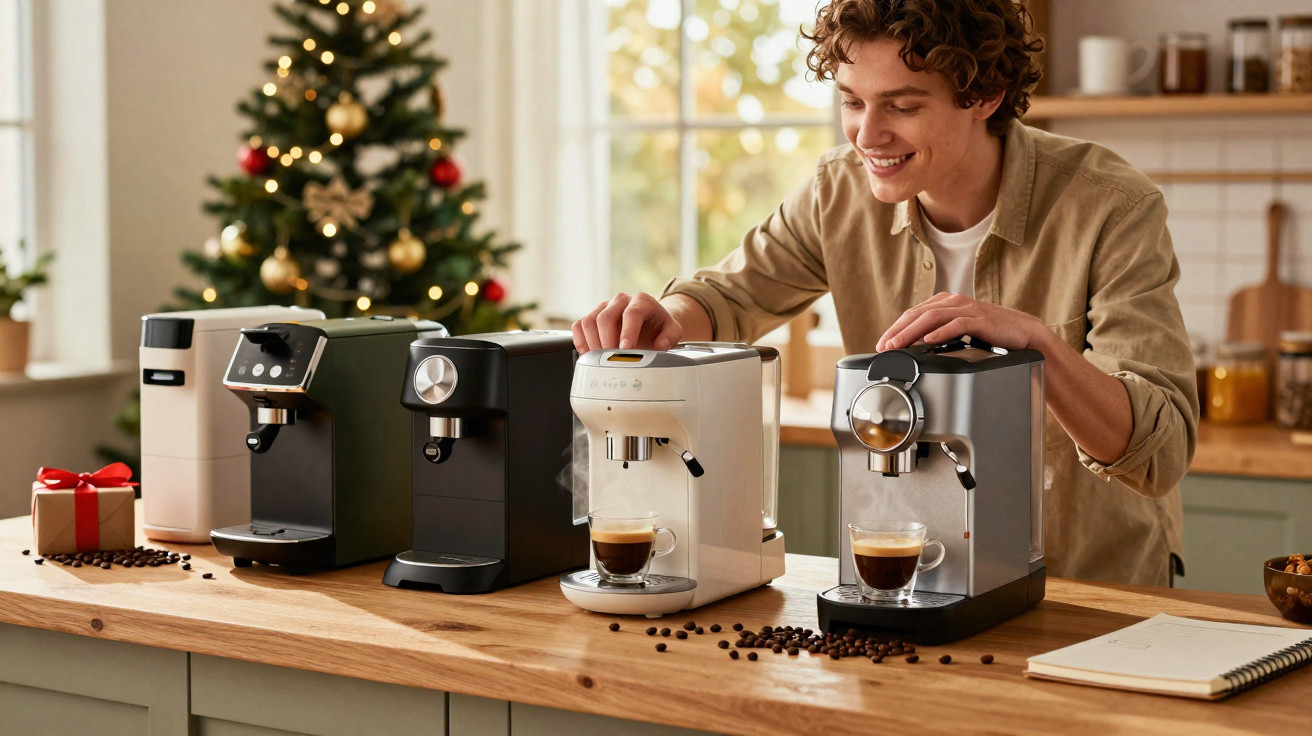
It was followed by a piercing hiss and the warm, nutty aroma that can make a lounge feel like a tiny café. Four bean-to-cup coffee machines were lined up on the table, resembling nervous robots at a talent contest awaiting their verdict. Half the editorial team stood nearby with mugs in hand, while the rest recorded Instagram Stories. A spoon hit the floor. Another person announced, “If the latte’s good, I’m buying this for my dad.”
In less than ten minutes, the room had become a subdued, coffee-fuelled frenzy. Controls beeped, grinders thundered and milk frothers sent up little puffs of vapour. The tastings quickly became arguments: too bitter, too weak, too loud, too slow. No one saw eye to eye on every point. By the third round of espressos, however, some clear trends were emerging. One machine repeatedly won the “just one more sip” test.
What began as a straightforward Christmas gift idea had become a small-scale coffee revolution. One obvious favourite caught us all off guard.
What we discovered when testing 4 bean-to-cup coffee machines
Our first realisation was that a coffee machine is never merely a coffee machine. As soon as these four models were on the table, they exposed everyone’s personality. One person cared only about the crema. Another listened to each grinder as though assessing a car engine. Someone else timed extraction on their phone, as if we were competing in a barista championship.
Each machine came with its own small ceremony. One required careful adjustments but rewarded patience with a smooth, silky espresso. Another tore through beans with all the restraint of a jet engine, while producing a cappuccino you would gladly pay for in a café. The supposedly easy option really was exactly that: three taps, no thought required, then drink. The fourth aimed to handle everything and came close to succeeding.
We put them through their paces with different beans and grind settings, milky coffees and short ristrettos. After an entire afternoon, the differences were much easier to see. Certain brands have essentially mastered the user experience, though at the expense of some depth in the coffee. Others are designed for coffee enthusiasts who enjoy spending five minutes fine-tuning strength and temperature. That difference matters enormously when buying for Christmas.
The numbers helped us look beyond the caffeine buzz. Seven out of 10 team members said they buy takeaway coffee at least three times a week. Once we worked out the annual spend, the room became oddly silent. Against a £900 yearly latte habit, a £500 machine suddenly seemed far less extravagant.
We noticed another factor too: the “wow” moment. One machine created that silence after the first sip, when people close their eyes. Another featured a touchscreen that made everyone grin, even though its coffee was merely “good enough”. One colleague, who is normally unmoved by gadgets, murmured, “I’d actually wake up for this.” That showed us which machines had genuine Christmas gift appeal rather than simply impressive specifications on paper.
From a practical perspective, we prioritised three things above all else: consistency of grinding, milk texture and everyday cleaning. A machine may offer every programme imaginable, but if cleaning its milk system feels like surgery, it will be in a cupboard by February. Let’s be honest: nobody really does that every day.
One mid-range model struck the right balance of flavour, simplicity and maintenance in a way that felt achievable in everyday life. A different high-end machine delivered barista-standard drinks, but required more attention and more worktop room. The remaining two belonged firmly in the “ideal for busy parents / remote workers” camp: quick, dependable and forgiving. Ultimately, the best machine depended on the person using it.
Choosing the right bean-to-cup machine as a Christmas gift
Put the technical terminology aside for a moment. The first, very simple question is this: how does the recipient genuinely drink their coffee? For someone devoted to flat whites and lattes, the milk system takes centre stage. For a black-coffee drinker, grinder performance and extraction quality are the real battleground.
We began by asking every tester to describe a typical morning. Was it rushed or relaxed? Were children charging about? The answers changed everything. In hectic homes, a straightforward interface and rapid heat-up time were essential. For people who savour a slower morning, the ability to alter strength, temperature and pre-infusion was enjoyable rather than burdensome.
One small approach proved particularly useful: we asked everyone to score each machine not only for taste, but also for “Would I actually use this every day?” That question immediately pushed one highly sophisticated machine down the list. It was undeniably beautiful, and its espresso was close to perfect. Yet people hesitated over the daily tasks of topping up the water, cleaning the milk system and emptying the coffee grounds. The best machine to give is one that will not become an expensive, unused monument on the worktop.
Buying a bean-to-cup machine can feel daunting on a personal level. There is the price, the pressure to “get it right” and the concern that the gadget will simply gather dust. We have all experienced the moment when a slightly expensive gift ends up in a cupboard. This is why it is more useful to consider three daily realities than the specifications printed on the box.
First comes noise. One machine in our test had a grinder that shrieked like a hairdryer at 6 am. It was amusing once, but much less so in a shared flat or with a sleeping baby nearby. Another was unexpectedly quiet, which immediately made it more family-friendly. Second is size. One model seemed compact in our test kitchen, but in a real flat it would take over half the worktop. Third is cleaning: a removable brew unit, an easy-rinse milk system and an accessible water tank. These are small details with a huge effect on long-term satisfaction.
We also identified some familiar errors. People overestimate how often they will alter settings, then pay for functions they never use. They underestimate how irritating a poor interface can be at 7:12 am when they are barely awake. And they seldom consider the beans: even the costliest machine cannot rescue low-quality coffee. The gift is not only the hardware; it is the promise of a better everyday ritual.
One remark from the tasting panel stayed with me:
“I don’t need the best espresso on earth. I just want that first coffee of the day to feel like a tiny moment that’s mine.”
That line became our quiet guide. We were no longer assessing crema and mouthfeel alone, but also the way each machine shaped that private pause before emails and notifications.
To clarify our thinking, this is the mental checklist we used before selecting the winners:
- Daily rhythm: rushed commuter, remote worker or weekend barista?
- Favourite drinks: mainly espresso, or milk-based coffees throughout the day?
- Kitchen space: a compact corner or a statement piece on a large worktop?
- Noise tolerance: shared flat, family home or quiet studio?
- Maintenance style: “quick rinse and go” or happy to deep-clean each week?
Once these questions are answered, the perfect Christmas machine almost picks itself. The trick is not to pursue the most expensive model, but to match one simple device to one very particular lifestyle.
The verdict: 4 machines, 4 types of coffee lover
Our final order bore little resemblance to the press releases. The luxury flagship took first place for coffee quality alone, particularly with straight espressos and ristrettos. Its shots were deep and layered, with attractive crema and almost no bitterness. Still, half the team quietly said they would be intimidated by its full range of features after Christmas. It is the perfect present for someone who already discusses “extraction time” without irony.
The biggest surprise was the mid-range all-rounder, which kept appearing in comments such as “I’d actually buy this”. Its controls were uncomplicated, its grinder reliably consistent and its milk system good enough to create a café-quality cappuccino. It was not flawless, but it slotted into real life without fuss. This became our top Christmas choice: generous, approachable and not so costly that the recipient feels uncomfortable.
The cheaper compact machine earned plenty of praise from younger renters and those with small kitchens. It started quickly, had a smaller water tank and lighter body, and occupied a footprint that did not consume the worktop. Its coffee lacked some complexity, particularly with lighter roasts, but was still far superior to capsule machines. The final model, a technology-heavy touchscreen beauty, split the group: gadget fans loved it, while those wanting one reliable button before work ignored it.
What was most striking was the way each machine affected the atmosphere in the room. With the mid-range favourite, people instinctively began offering one another coffees. “Want a latte? It’s easy.” With the premium powerhouse, everyone watched like an audience while one colleague took control. The compact machine, initially almost unassuming, became a discreet ally for anyone wanting a respectable flat white between Zoom calls.
Our verdict, then, is not one gold medal but four distinct personalities. The barista’s toy. The everyday hero. The small-space saviour. The touchscreen show-off. Each can work as a gift, provided it suits the pace and rituals of the person opening the box beneath the tree.
Perhaps that is the true appeal of a bean-to-cup machine as a Christmas present. You are not simply giving someone a large, gleaming appliance. You are introducing a new kind of morning into their life: a sound, a scent and a first sip they will experience for years. Some presents are forgotten by January. This one quietly hums in the corner day after day, transforming a half-awake routine into something that almost feels like care.
There is something unexpectedly intimate about choosing coffee for another person. You are saying, “I see how you start your day, and I want it to feel kinder.” It could mean a fast button for a busy parent at 6 am, or an exacting espresso routine for a detail-loving friend. The machines we tested taught us one thing: the right choice is less about pressure bars than it is about paying attention.
The next time you pass those shiny coffee machines in a shop, picture their kitchen rather than your reflection in the chrome. Imagine the grinder early on a Monday, or the first wisp of steam on a lazy Sunday. That is where the real verdict is made, long after the wrapping paper has disappeared.
| Key point | Detail | Benefit for the reader |
|---|---|---|
| Choose according to the ritual | Match the machine to the person’s lifestyle and favourite drinks | Avoids a costly gift sitting unused after two months |
| Do not overlook maintenance | Prioritise easy cleaning, water access and access to the brew unit | Ensures realistic, lasting everyday use |
| Mid-range is a sensible choice | A good versatile model is enough for most uses | Maximises enjoyment and value for money in a Christmas gift |












Comments
No comments yet. Be the first to comment!
Leave a Comment