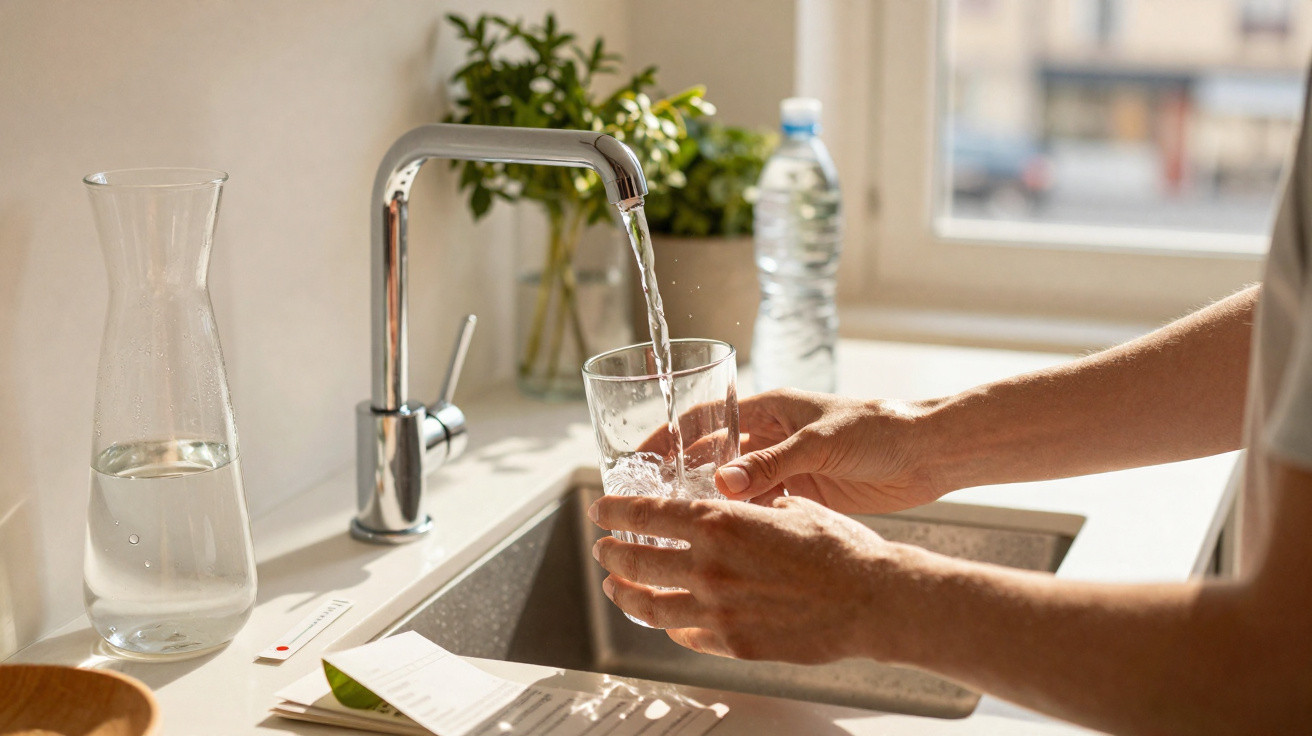
France has a notably robust nationwide water distribution network, although it is not flawless. But does that alone justify choosing bottled water instead?
Since 2001, particularly following Decree No. 2001-1220, almost everyone in France has had access at home to water regarded as safe to drink. Using tap water to quench thirst or prepare food has become such an everyday habit that we barely give it a thought.
It is subject to close monitoring and stringent standards, yet it has repeatedly come under scrutiny. This was the case with a Karolinska Institute study published earlier this year, which examined its trihalomethane (THM) levels. Tap water is not perfect, but certain bottled waters perform even less well, particularly because PFAS, known as ‘forever chemicals’, can migrate from plastic packaging into the water. If neither option deserves complete confidence, which one should be preferred? Fortunately, UFC-Que Choisir offers some guidance.
Tap water: safe, but not pure
Olivier Andrault, food policy officer at UFC-Que Choisir, was asked about the issue by our colleagues at Kombini, who shared his comments on Instagram (see the video below). A former engineer and scientific director at CLCV (Consumer Affairs, Housing and Living Environment), he joined the consumer protection organisation in 2005.
View this post on Instagram
There is therefore little reason to question his expertise in this field. In his words: “For the vast majority of people in France, tap water complies with all European regulatory criteria.” Regional Health Agencies (ARS) continually assess the safety of supply networks by testing dozens of indicators, including nitrates, pesticides, solvents, heavy metals and bacteria. This monitoring system is, in itself, a safeguard for consumers.
Tap water monitoring and local exceptions
Exceptions do nevertheless remain. “In some supply networks in northern France, there has been a very sharp rise in pesticide levels exceeding the standards,” he acknowledges. On a national scale, these situations are extremely uncommon and, according to him, affect no more than 1,200 people. Whenever temporary restrictions are required, local residents are informed, while the data can be viewed on the ARS website.
The example below comes from UFC-Que Choisir’s interactive water-compliance map. Consider Amiens, a city in northern France: water in the city centre is rated “good”, while several outlying networks show lower compliance levels.
For Andrault, it is no longer possible to claim that tap water is completely untouched, even though it remains entirely drinkable. Drinking it cannot cause acute poisoning in the strict sense, but he says: “We may have to let go of the idea of water that is completely pure and entirely free from contamination. It does not exist.” UFC-Que Choisir has, in fact, identified PFAS, residues of pesticide molecules and other pollutants, including in major cities, though only in very small quantities. Every result was below the limits set by the European Union, and France is known to have one of the best water distribution networks in Europe.
Bottled water: not necessarily cleaner or greener
As mentioned above, the reputation of bottled water has declined in recent years because of PFAS and certain plastic compounds, “although their precise impact on health is not yet fully understood,” Andrault notes.
Beyond the toxicological issues that will need more thorough investigation one day, the specialist highlights two further considerations: cost and environmental impact. Bottled water is far more expensive, while water from the tap is on average “60 times cheaper”. According to UFC-Que Choisir, it costs “€0.003 per litre on average”, compared with “€0.20 per litre for spring water, €0.40 per litre for mineral water”.
The carbon footprint of bottled water is also markedly disproportionate: on average, a bottle travels 300 km before reaching your home. Mostly transported by lorry, it creates CO₂ emissions that could readily be avoided, while also making a substantial contribution to global plastic pollution. An entirely unnecessary luxury in the present context of inflation and climate pressures.
When tap water is the most rational choice
Unless you need to follow medical advice recommending particular waters, such as magnesium-rich varieties, the rational choice in the overwhelming majority of cases is to drink water from your tap. It may contain certain residues, but their concentrations remain within current health standards and you are at no risk whatsoever. For additional peace of mind, you can also filter it at home using a filter jug, under-sink filters or similar systems, which will retain some heavy metals and toxic residues. If you are unsure about the quality of your local supply, consult UFC-Que Choisir’s interactive map on this page. Enter your local authority area to see immediately whether your water is rated as having good compliance.









Comments
No comments yet. Be the first to comment!
Leave a Comment