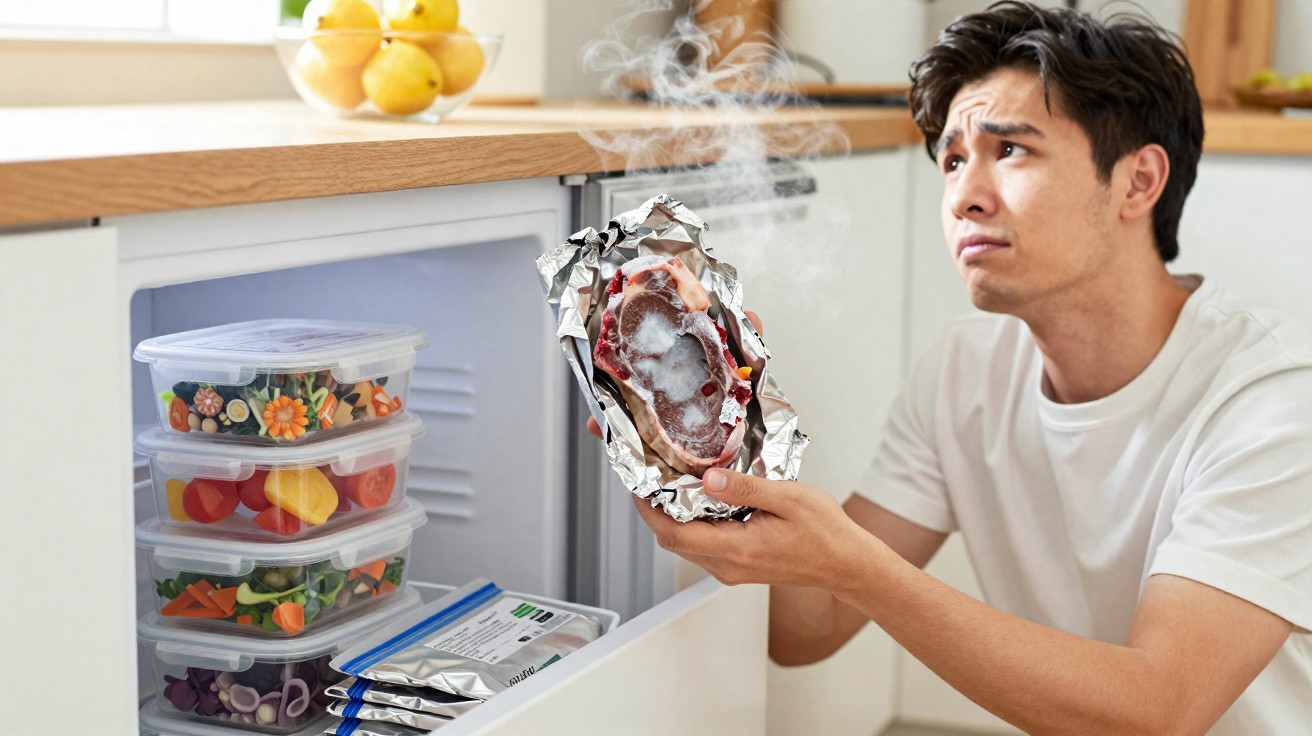
Leftover bake, some bread or a piece of salmon bought on offer: in the rush, these often end up wrapped in aluminium foil and put straight into the freezer. It feels practical. Yet the disappointment comes at defrosting time: ice crystals, dry edges, unfamiliar smells and an altered texture. This apparently clever shortcut is actually one of the most common freezing mistakes.
Why aluminium foil alone secretly dries out frozen food
At first glance, aluminium foil seems like a professional-grade material: inexpensive, quick to tear off, easy to press tightly around food, and apparently well sealed. It may often be adequate in the fridge, but the situation is different in the freezer.
Foil creases, develops tiny gaps and tears more easily than expected. These flaws create minute openings through which air reaches the food. That air is precisely what causes the problem: moisture moves outwards, freezes there and forms ice crystals.
The real enemy in the freezer is not the cold – it is the air that reaches your food.
The effects are clear once food is defrosted:
- dry surfaces, with pale or greyish patches
- watery pools around meat, fish or a bake
- an uneven texture: mushy or crumbly rather than succulent
A pasta bake can suddenly seem grainy, meat becomes soft and stringy, while bread breaks when cut or develops a strangely rubbery crust. This has less to do with the food's original quality than with its air-permeable aluminium covering.
Freezer burn, ice and foreign odours: common effects of poor packaging
As soon as air reaches food, a process known technically as freezer burn begins. Certain areas effectively dry out. The surface looks lighter, slightly grey or whitish, and can sometimes appear almost leathery.
The following foods are particularly sensitive:
- Bread: quickly absorbs moisture and odours, becoming crumbly
- Fish: its delicate structure rapidly loses liquid and flavour
- Meat: dries around the edges and then cooks unevenly
- Prepared meals in sauce: fat and water separate noticeably during defrosting
There is also a second problem that few people consider: odour transfer. A freezer usually holds very different products close together. If packaging is not genuinely airtight, aromas can pass from one item to another.
The result: chocolate cake from the freezer can unexpectedly take on a faint garlic or fish note, while vegetable lasagne may taste slightly of chips and old ice. Aluminium foil on its own cannot block these odours sufficiently.
Risky combination: aluminium foil with acidic or very salty foods
One little-known point is that some foods should ideally not come into direct contact with aluminium at all, especially not for extended periods in the freezer. The reason lies in the food's composition.
Three categories in particular are more critical:
- acidic foods, for example those containing tomato, lemon or vinegar
- very salty foods
- foods that are liquid or wet on the surface
This includes, for instance:
- tomato sauces, Bolognese and lasagne
- dishes with lemon juice, such as fish marinades
- salad with a vinegar dressing and pickled vegetables
- strongly seasoned stews or chilli
In unfavourable circumstances, acid and salt can react with aluminium. This is not always immediately visible, but quality can suffer over time. For the safest approach, consistently use a protective layer between food and metal.
Double packaging: a simple method for better defrosting
The good news is that you do not need to reorganise the entire freezer to achieve noticeably better results. In most cases, one straightforward technique is enough: packaging in two stages.
The “double barrier” for everyday use
The ideal approach combines a contact layer with an outer covering. In practice, it works like this:
- Inner layer: cling film or baking paper placed directly against the food
- Outer layer: a zip freezer bag or a tightly sealing container
The inner layer prevents direct contact with aluminium or plastic and protects the food's surface. The outer layer provides a proper seal and prevents air exchange.
Anyone who consistently presses out the air and seals freezer containers properly gains more quality than with any expensive “premium freezer”.
Which packaging suits which food?
| Food | Recommended packaging |
|---|---|
| Meat & fish | Cling film directly against the piece, then a freezer bag; press out the air thoroughly |
| Bread & rolls | Freezer bag, sealed well; ideally sliced or cut into halves |
| Sauces & stews | Freeze flat in freezer bags or use a container, sealing the lid tightly |
| Acidic / salty dishes | Use baking paper or cling film as a separating layer, then a container or bag |
| Cakes & pastries | Wrap first in film, then place in a container to prevent freezer odours getting in |
Small freezing tricks with a big effect
Many issues arise not during storage but in the first few minutes, when food is still warm or is simply put into a bag without any order.
- Never freeze food while hot: allow dishes to cool completely first; otherwise, a great deal of condensation forms and later creates more ice.
- Portion food: freeze several smaller portions rather than one large block that cannot all be used later.
- Freeze flat: press sauces or soups flat in bags, so they freeze faster and defrost more evenly.
- Press out the air: close the bag almost fully, force out the air with your hand or by using a water bath, then seal it.
- Label everything: write down the date and contents so that nothing disappears at the back of the freezer for too long.
How long can food stay in the freezer?
Even perfect packaging cannot stop time. Many foods keep for several months, but gradually lose flavour and texture. A rough guide for the freezer is:
- Lean fish: around 3 months
- Oily fish (salmon, mackerel): around 2–3 months
- Poultry: 6–9 months
- Beef and pork in pieces: up to 10–12 months
- Bread and rolls: 1–3 months
- Cooked dishes: usually best for 2–3 months
Anyone who regularly notes the freezing date will also quickly see which quantities make sense in everyday life – and which are more likely to become an “eternal block of ice”.
Defrosting properly: the second crucial step
Even the best packaging has limited benefits if defrosting goes wrong. Delicate foods in particular react strongly to changes in temperature.
- Defrost in the fridge: a gentler rise in temperature, less liquid loss and greater safety for meat and fish.
- Use a frying pan or oven: for bakes or gratins, cooking straight from the freezer can work if the dish is suitable.
- Use the microwave carefully: otherwise the outside starts cooking while the middle still contains an icy core.
Patience is particularly worthwhile with bread: ideally, let it defrost slowly at room temperature or refresh it briefly in the oven. This keeps the crumb lighter and prevents it from drying out as much.
Why using aluminium foil thoughtfully is genuinely worthwhile
Aluminium foil still has a place in the kitchen, such as for covering food while it cooks in the oven or shielding it from heat on the barbecue. In the freezer, however, it should play only a supporting role. It can be useful as an outer reinforcement over baking paper or film, but as the sole material it is more likely to cause harm.
Replacing the automatic reach for the foil roll with a moment's thought brings a noticeable improvement in quality: after defrosting, food tastes much closer to the original, freezer burn is less common, and oddly mixed odours are easier to avoid. Before every trip to the freezer, the key question is therefore: does my packaging method really block the air – or does it merely look as though it does?












Comments
No comments yet. Be the first to comment!
Leave a Comment