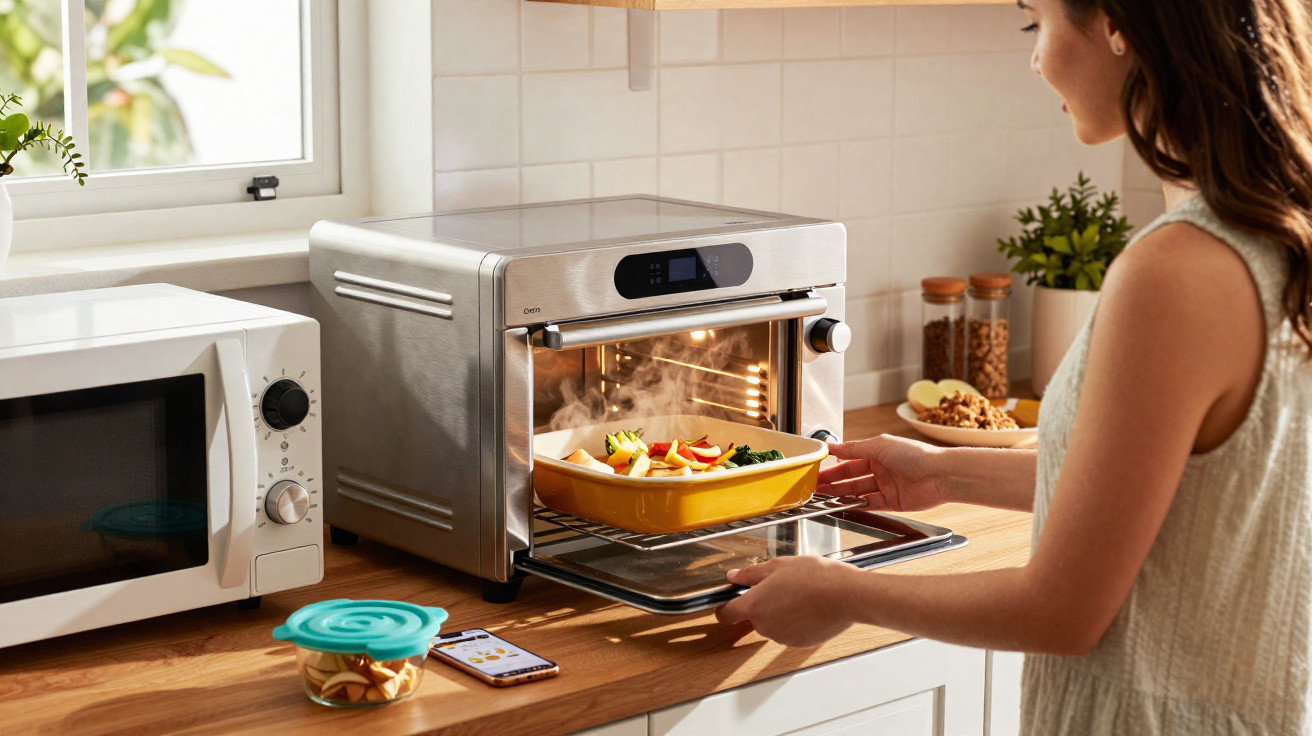
It is Tuesday evening, you arrive home late, and supper is whatever can be warmed through in fewer than five minutes. Almost without thinking, you reach for the microwave door. The familiar beeping, rotating turntable and slightly rubbery leftovers are a ritual that most kitchens know well.
Now picture the alternative: quiet. No hum, no dried-out edges and no cold patch in the centre of the meal. Instead, there is a small appliance on the worktop that heats, bakes, grills and crisps more quickly than a microwave while apparently consuming less energy.
A growing number of experts are placing their bets on precisely that kind of box.
The “microwave killer” experts are watching
Visit a fashionable appliance retailer today and a notable change becomes clear. The microwave display has shrunk, while another category is gradually claiming more space, its gleaming doors marked with terms such as “smart oven”, “inverter” and “air fry”. Tell a salesperson that you are updating your kitchen, and they are likely to steer you towards one particular type of appliance.
It is a streamlined, toaster-oven-sized device known as a high-efficiency countertop smart oven, usually combining air-fry and convection functions. Certain models rely on powerful heating coils and fans, while others incorporate infrared or inverter technology. Their shared promise is simple: microwave-like speed with results worthy of a proper oven.
Consider appliances such as the Breville Smart Oven, Ninja Foodi ovens or Panasonic’s inverter countertop ovens. A London retail group reported that sales of compact convection / air-fry ovens rose by more than 40% year on year, whereas conventional microwave sales barely changed. In one consumer panel, 3 out of 5 younger households said they would “happily live without a microwave” if they owned a quick, energy-smart oven.
One couple in Berlin went further still. After moving into a small flat without a built-in oven, they relied on one smart air-fry oven on the worktop. “We heat baby food, reheat pasta, bake fish, everything,” they told me. Their old microwave remained boxed up in the cellar.
Why do experts believe this type of appliance could unseat the microwave? The answer lies in efficiency at several levels. Microwaves excite water molecules within food, making them quick but often uneven and restrictive when it comes to texture. High-efficiency countertop ovens circulate hot air around the food - sometimes enhanced by infrared heat and smart sensors - directing warmth where it is required.
They heat up in a fraction of the time needed by a traditional oven and draw considerably less power than a large built-in model. Unlike microwaves, they can also roast, brown and crisp. Energy analysts note that replacing daily microwave reheating and regular oven use with one compact, efficient appliance can noticeably reduce your total kitchen energy footprint. This is the understated worktop revolution happening in plain view.
How smart ovens can replace the microwave
The meaningful test is not the specification sheet; it is the weary 8 p.m. routine of warming dinner. A modern high-efficiency countertop oven can be used in much the same way: open the door, put in the plate, choose a preset and leave it to work. Many current models offer “reheat”, “pizza”, “leftovers” or “meal” settings, using sensors and fan patterns designed for chilled food.
Warming food takes a little longer than in the quickest microwaves - typically 4–6 minutes rather than 2–3 for a full plate - but the result looks and tastes more like a freshly prepared meal. There is no soggy pastry, nor parched edges surrounding an icy middle. Hot air circulates around the plate, while intelligent temperature controls reduce or stop the power when the food reaches its target range.
Frozen pizza, a classic microwave let-down, illustrates the difference. Heat it on a microwave-safe plate and the base becomes limp while molten cheese slides about. Put the same pizza in a compact smart oven with air-fry or convection, and the outcome changes considerably. One Boston food technology laboratory compared the two methods: the smart oven needed 3 minutes more, consumed 20% less energy than a full-size oven, and testers repeatedly described the texture as “restaurant-like” rather than “microwaved”.
Meal preparation offers another example. A family in Paris swapped their microwave for a 26-litre smart oven. During a hectic week, they place two glass containers from the fridge into it at once, using separate shelves. As the children complete their homework, dinner heats evenly and develops a little browning on top. The mother said that she no longer called it “We’re just microwaving something” and instead said “We’re finishing it in the oven”. It is a subtle linguistic change, but one that has a substantial effect on how the evening meal feels.
The energy case is more intriguing still. A standard microwave commonly operates at 700–1200 watts, running at full output until its timer stops, with little subtlety. A high-efficiency countertop oven may be rated at 1500–1800 watts, which appears less favourable on paper, but practical testing suggests otherwise. It warms up quickly, then manages power in cycles, using insulated walls and a fan; as a result, the total energy required for each task may be lower, particularly for foods that need crisping.
Experts identify three layers of efficiency. First, one appliance takes the place of both a microwave and a large oven. Second, multiple items can be cooked together on trays rather than reheating one plate at a time. Third, programmable modes mean food is less likely to be overcooked “just to be safe”. In truth, almost nobody manages that every day with a traditional oven. Instant heat and smart presets encourage better routines without demanding much thought.
Switching at home without losing your mind
If you are considering abandoning - or simply using less - your microwave, begin gradually. Experts recommend making the high-efficiency smart oven your default appliance and keeping the microwave as a reserve. For a week, use only the new oven for coffee, leftovers and frozen snacks. Make a point of using its reheat and air-fry modes.
Watch your timings closely. The first two or three days may feel like trial and error. By the fourth day, it tends to become automatic: a pizza slice needs 4 minutes on air-fry; lasagne takes 8–10 minutes on reheat with a small cover; vegetables require 5–6 minutes on a tray. The aim is not flawless results, but recognising which microwave habits are purely automatic and where the new appliance performs better.
One frequent concern is: “Will my mornings fall apart?” There is the frantic 45 seconds for warming milk, or the two-minute porridge blast. Everyone knows the moment of watching the clock and thinking, “I don’t have time for real cooking.” Experts who test these ovens maintain that breakfast can remain quick, provided the routine is adjusted slightly.
Choose oven-safe mugs or small dishes, leave one shelf permanently in the middle position, and keep the appliance plugged in and ready. Many models feature rapid preheating that reaches 180–200°C in under 2 minutes. Put the dish inside, select the preset and go and brush your teeth. When you return, breakfast is ready, with more consistent warmth and less splatter. It is not magic; it simply means working with the appliance’s power curve rather than against it.
There is one early mistake that nearly everyone makes: using the smart oven only as an upgraded toaster. That is when frustration starts, because none of the functions that could replace both the microwave and the large oven are being used.
“People underestimate these appliances,” says a Barcelona-based appliance engineer who works with several European brands. “They’re designed to handle 80% of daily cooking and reheating. The problem is, we still mentally reserve ‘serious’ tasks for the big oven and ‘fast’ tasks for the microwave. The countertop oven lives in a weird middle zone, when it should be the main stage.”
- Try the reheat preset with three meals over one week.
- Use trays or shelves that allow air to circulate beneath food rather than only above it.
- Keep a small oven-safe glass or ceramic dish specifically for sauces and soups.
- Test batch reheating by warming two portions at the same time instead of one.
- Identify foods that taste better than they do from the microwave, then write them on a sticky note beside the oven.
A kitchen future where the microwave is optional
Consider this scenario: your microwave fails tomorrow. Would you immediately replace it, or would you look at the high-efficiency countertop oven and think, “Maybe you’re enough”? For an increasing number of homes, particularly small urban flats, the answer is quietly moving towards the latter.
Energy costs are increasing in many countries, people prepare more meals at home than they did five years ago, and there is genuine weariness with limp, zapped food. A compact smart oven that reheats, crisps, bakes and roasts within one small footprint seems like the appropriate sort of improvement: not showy, merely better suited to the way people actually live and eat.
For experts tracking the trend, the issue is not whether this appliance can technically take over from the microwave. For most everyday jobs, it already can. The real issue is psychological: when will we stop treating the microwave as essential and begin seeing it as one choice among several - perhaps even the “old tech” in the corner?
Some households will never abandon it, and that is perfectly fine. Others are finding that, once the smart oven becomes the worktop’s main appliance, the microwave door is opened less and less. Eventually it gathers dust. By then, the revolution has already taken place - quietly, somewhere between reheated lasagne and a perfectly crisp piece of leftover chicken.
| Key point | Detail | Value for the reader |
|---|---|---|
| High-efficiency smart ovens can take over most microwave tasks | They reheat, cook and crisp using convection, air-fry and smart sensors | Fewer appliances on the worktop and better-tasting everyday meals |
| Real-world efficiency is greater than the label may suggest | Rapid preheating, intelligent power cycling and multi-shelf cooking | Lower overall energy consumption than a microwave + full oven routine |
| The transition is behavioural, not merely technical | Use presets, adjust breakfast and leftover habits, and batch tasks | Smoother daily routines without feeling as though you have “given something up” |
FAQ:
- Question 1 Can a countertop smart oven really heat food as fast as a microwave?
- Question 2 Is it safe to put my usual microwave containers in a smart oven?
- Question 3 Will my electricity bill actually go down if I switch?
- Question 4 What size should I choose for a small kitchen?
- Question 5 Do I still need a traditional oven if I buy one of these?












Comments
No comments yet. Be the first to comment!
Leave a Comment