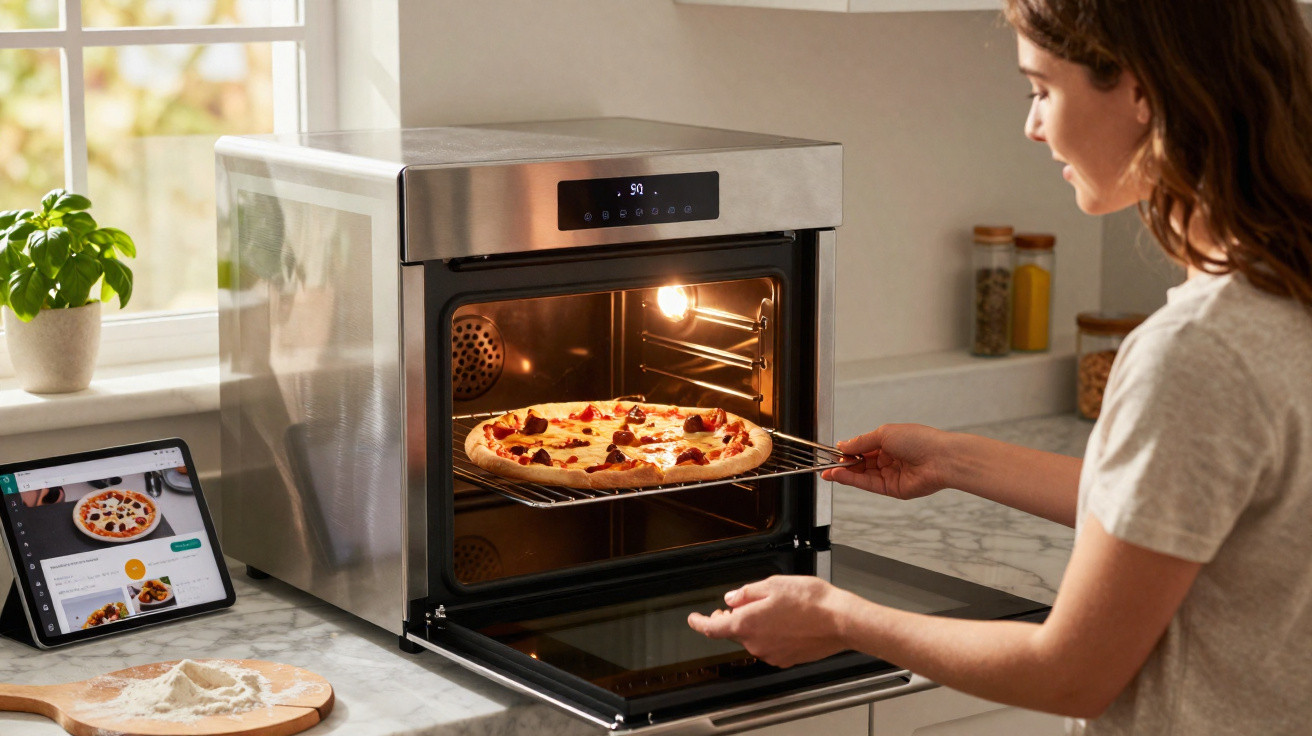
A notification flashes the instant the cheese begins to blister, promising perfect pizza without having to hover around the kitchen. The advert claims it “knows” when dinner is ready. But is that really the case, or is the appliance simply highly convincing as it counts seconds and monitors changing pixel colours? It is an ambitious promise for something with such modest, delicious consequences.
The other evening, I watched a pizza bubble away on my phone via a stream from a tiny camera inside a sleek black oven. Steam misted the lens, the crust rose, and the app delivered a bright alert: “Your pizza is ready.” Opening the door released a deep, salty aroma. The topping looked magnificent, but the base was slightly soft, as though the oven had assessed the surface while overlooking the essential part. The oven blinked like it knew a secret. I put it back for another 90 seconds and heard the crust begin to firm up. It pinged once more. Had it actually known?
How a smart oven “knows”
In brief, it observes, measures and makes predictions. Tiny cameras follow colour changes as cheese shifts from glossy to speckled and the crust turns from pale to caramelised. Temperature sensors chart heat movement and moisture loss. Smart ovens don’t taste; they guess. Their predictions can be remarkably accurate with familiar, consistent foods, but become less reliable as more variables enter the mix.
I cooked two pizzas one after the other: they used dough from the same batch but had different shapes, and one was piled with mushrooms. The oven declared the lightly topped pizza “done” at 8:42, then judged the mushroom pizza ready at 10:03. The first was spot on, with a crisp, dry base. The second had a bronzed top but a faintly steamed underside. Identical algorithm, different physics. Moisture from the mushrooms delayed browning and disrupted the humidity pattern the oven anticipates. It had not malfunctioned; it followed its model. The model had simply encountered a real-world curveball.
Machine vision thrives on patterns, and pizza provides plenty of them: Maillard browning, bubbling cheese, evaporating steam and even fat rendering. Cameras analyse colour histograms, software monitors the point at which gloss becomes matte, and heat sensors detect when the rate of temperature increase levels out. This is how the appliance defines “done”. What it cannot genuinely observe is the crunch underneath, the texture of the inner crumb or the precise pull of perfectly melted cheese. A pizza stone that has not fully absorbed heat, a thick outer rim or a scattering of semolina can alter the outcome. The algorithm judges readiness using the evidence available to it; your palate determines whether that evidence was sufficient.
Make the smart oven algorithm work for you
Begin by calibrating your approach. Preheat the stone or steel for longer than the oven’s beep suggests, waiting until the material itself has properly absorbed the heat - 20 to 30 minutes after it says “ready”, and occasionally longer. Lower the rack by one position to intensify heat beneath the pizza. Where the oven offers a “finish level” or “browning target”, raise it by one setting for thicker pizzas. When the app pings, select “add 90 seconds” and make a note of the result you preferred. Preheat longer than you think. It solves more complaints about soggy bases than any AI adjustment can.
Keep the camera lens clean and leave the door shut. Repeatedly opening it releases heat and disrupts the curve the model is tracking. Frozen pizzas contain ice crystals that raise humidity, so the oven may judge them ready later than expected; meanwhile, fresh dough containing a little sugar browns quickly and may be called early. Everyone has experienced a beep that sounded certain while instinct said otherwise. Rely on your eyes and inspect the underside of the crust. Though, honestly, hardly anyone does that every day.
The aim is to adapt a one-size-fits-most algorithm to suit your own household style. Record the settings from one pizza night and save separate profiles for thin-crust and pan pizzas. If the oven includes a “bottom heat boost”, activate it for the last minute. Then use your own judgement as the software approaches its estimate, rather than waiting until the moment has passed.
“The oven isn’t omniscient; it’s doing probability, not prophecy.”
- Thin crust on steel: add 60–90 sec beyond the first ping.
- Heavy toppings: begin on a lower rack, then finish on the middle rack for colour.
- Fresh mozzarella: anticipate earlier browning and monitor the melt.
- Frozen pizzas: allow the oven to make its call, then inspect the underside once.
- Keep the glass and camera spotless so colour readings remain dependable.
So, smart or just clever marketing?
It is a little of both. Saying an oven “knows” when food is ready reduces a complicated sensory judgement to a neat alert. The technology genuinely helps: it prevents ruined dinners, reduces uncertainty and provides a live view of your food. Marketing takes that useful prompt and presents it as certainty. The truth lies between the two, with machines spotting patterns and people making the final decision in those last two minutes. Exchange settings with friends, refine them and create a household pizza profile that no algorithm can reproduce. The smartest cook in the room is still you. When the ping arrives, stop for a moment, breathe in the aroma and turn over a slice to check the base. That small ritual separates nearly there from exactly right - and is better than debating with an app.
| Key point | Detail | Why it matters to the reader |
|---|---|---|
| How smart ovens detect “done” | They monitor colour, moisture loss and temperature curves using cameras and sensors. | Understand what the appliance can and cannot observe. |
| Why results vary | Toppings, dough hydration, rack height and preheat duration alter the model’s expectations. | Learn which variables to manage for consistent pizza nights. |
| How to achieve better results | Lengthen the preheat, adjust the finish level, use a lower rack and add 60–90 seconds where required. | Practical measures that are better than blindly trusting the ping. |













Comments
No comments yet. Be the first to comment!
Leave a Comment