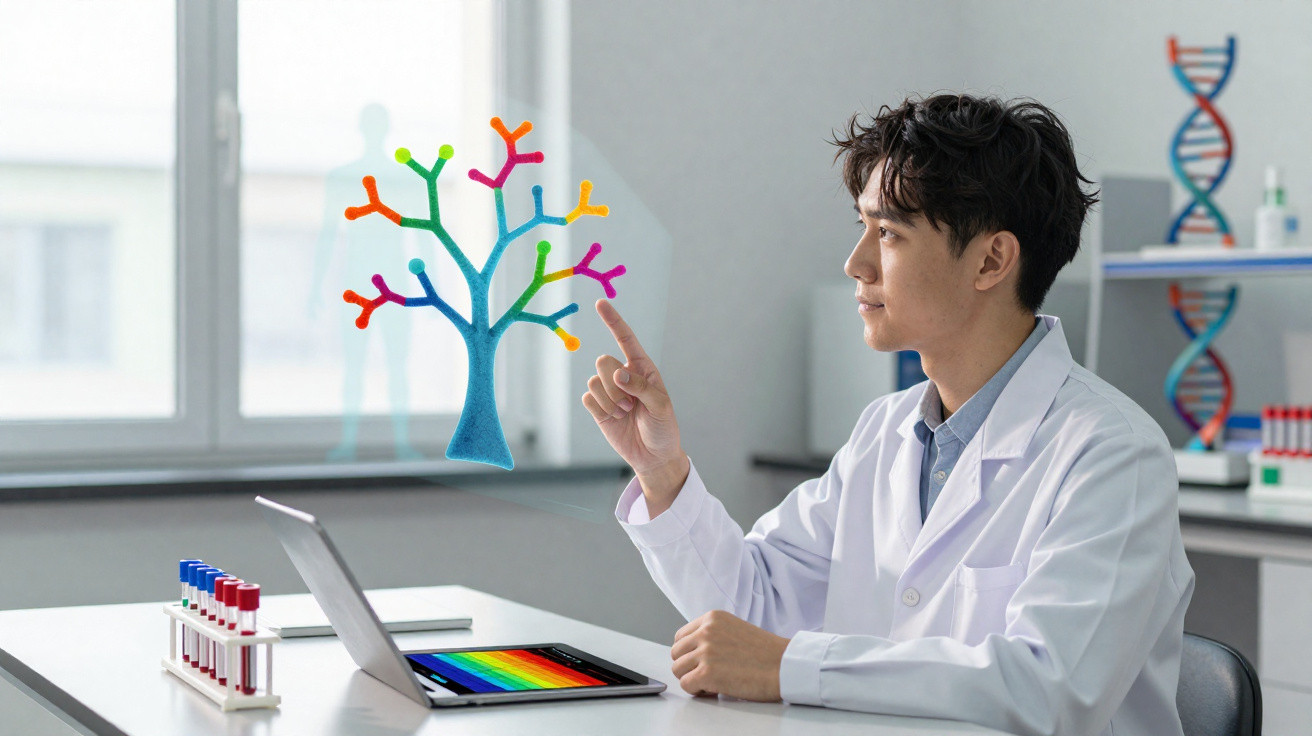
Millions of people have sent away saliva samples to discover what their genes could say about their future health.
These tests examine your DNA: the biological blueprint present at birth, which alters very little during a person’s life.
Researchers are now focusing on something much more changeable.
A second biological code, formed by tiny sugar molecules covering cells, changes continually with your health and could indicate disease years before symptoms develop.
Sugar on your cells
Nearly every cell and protein in the body is covered by a thick layer of sugar chains.
Known to scientists as glycans, these structures attracted little attention for a long time.
Wei Wang, a professor at Edith Cowan University (ECU) in Perth, Australia, has devoted years to drawing meaningful information from this sugary coating.
Professor Wang contributed to a wide-ranging review examining the current state of the science.
DNA changes only minimally throughout life. A cheek swab taken in kindergarten and one collected at retirement would produce almost identical readings.
Glycans are entirely different. Their profiles can shift from one month to the next, reflecting diet, stress and whatever conditions the body may be fighting without obvious signs.
More than cell decoration
Researchers once regarded these sugars as little more than packaging, with no meaningful influence on the body’s workings. That assumption has now unravelled.
Glycans appear on antibodies, the immune proteins that determine how strongly the body responds to an infection.
Alter the sugar coating of one of these antibodies and the immune cells it meets may either become aggressive or refrain from responding. It is the same molecule, but with a different role.
“Glycans aren’t just sitting there. They’re actively controlling how our immune system works and how diseases develop,” said Professor Wang.
He and his colleagues maintain that these molecules perform genuine biological functions rather than simply decorating cell surfaces.
Reading the body’s sugars
Until recently, much of this biology remained out of view for one straightforward reason.
Sugar chains are famously hard to analyse, while testing them in thousands of blood samples was previously slow, technically demanding and frequently unreliable.
Improved laboratory techniques and quicker software have changed the cost equation.
One run can now assess sugar patterns across very large groups of samples simultaneously, an advance used in one recent paper. That ability to work at scale is crucial.
When sufficient numbers of people are measured over long enough periods, subtle sugar signals cease to resemble random noise and instead become dependable biomarkers: measurable indicators that doctors use to monitor health and disease.
Disease leaves early clues
The strongest evidence to date concerns type 2 diabetes. In long-term studies, blood glycan patterns had already shifted towards an unhealthy profile years before people were diagnosed.
The signal was present in stored samples gathered as much as a decade earlier. Blood that appeared healthy on the surface contained a pattern that was not.
This could not be detected until measurement methods became capable enough. The shift does not establish that the sugars cause the disease.
It does, however, indicate that the body may signal risk long before symptoms emerge, using a language doctors are only beginning to understand.
A real-time health snapshot
Genetics explain some of this pattern, while hormones, ageing and the cumulative effects of daily life continually reshape the rest.
No two individuals have exactly the same glycome, meaning the complete collection of sugar patterns carried by their body at any given time.
Part of this uniqueness is inherited. Major genetic projects have identified particular genes that help determine a person’s baseline sugar profile, as detailed in a 2025 study involving more than 10,000 people.
Since the pattern is so individual, it may be well suited to medicine tailored to a person rather than to an average population.
A result from your own blood might eventually identify the risks relevant to you, rather than the average risks associated with a group you merely resemble.
Before it reaches clinics
None of this is prepared for your next routine check-up. Two laboratories testing the same blood sample may still produce different results.
The field now requires standardised measurement methods and robust statistical techniques capable of distinguishing true biological signals from chance observations.
Larger and longer-running studies are also still needed.
Only by tracking the same people for years, in many countries, can researchers determine which sugar patterns genuinely predict disease and which are statistical illusions.
Looking beyond DNA
What has truly changed is this: a biological layer once dismissed as inactive can now be measured across entire populations, and the patterns it shows correspond with real disease, at times years in advance.
“Instead of waiting for people to get sick, we could spot the risk early and step in sooner,” said Wang. This creates a possibility that medicine has not previously possessed.
Your genome describes what you were born with, whereas your glycome reflects how you are faring at this moment.
This continuous picture of the body’s condition could eventually make an ordinary blood test an early-warning tool.

















Comments
No comments yet. Be the first to comment!
Leave a Comment