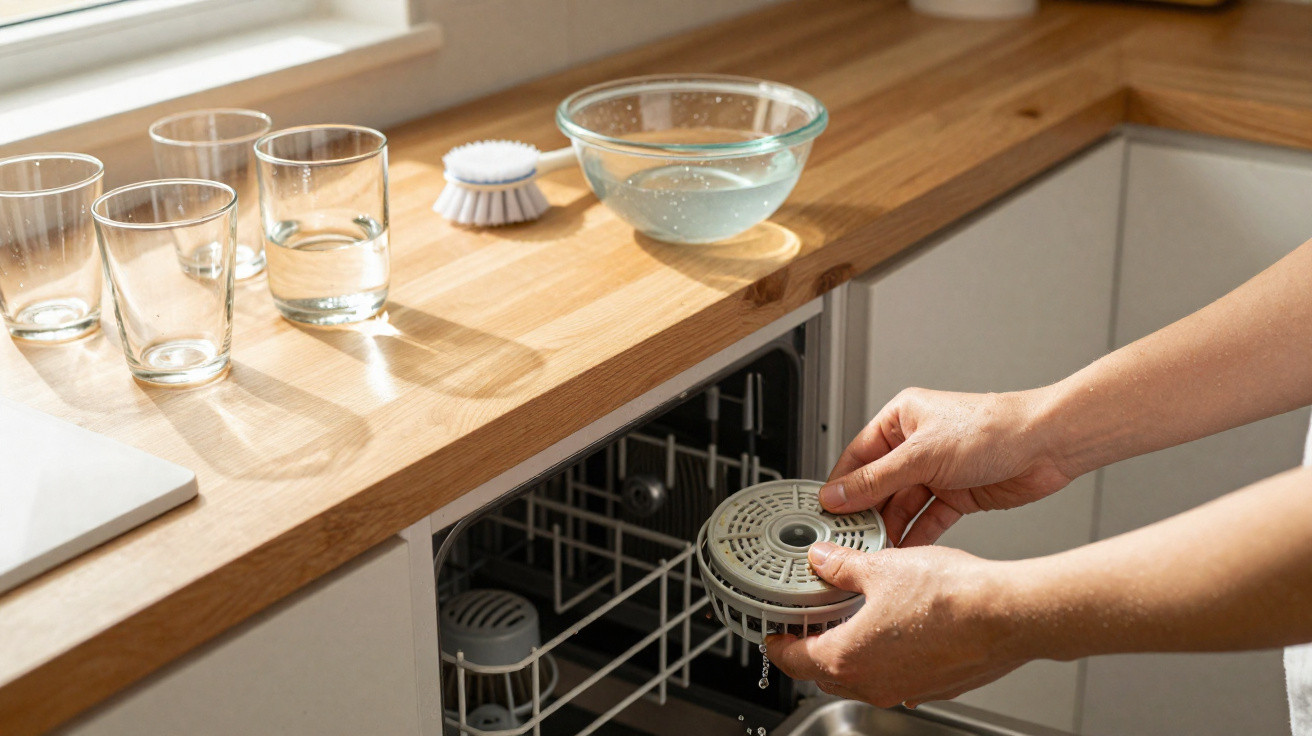
The plates look fine and the cutlery is gleaming, yet the glasses are another matter: dull, streaky and almost greasy-looking. Drying one with a tea towel may improve it slightly, but the cloudy coating never fully disappears. It is easy to blame budget detergent, an eco programme or even hard water. What is less likely to get the blame is a component you hardly ever see, hidden beneath the lower rack and steadily filling with grime every day. That is where the real issue begins.
The hidden dishwasher filter spoiling your glassware
For many people, a dishwasher is simply a sealed box: load it, press the button and leave it to get on with the job. Perhaps you add rinse aid or change tablet brands when an offer comes along. Beneath the lower spray arm, however, sits a small cylindrical or flat mesh component with a decidedly unglamorous role. It traps food scraps, grease and mineral particles before they can circulate around the machine again. Even when this dishwasher filter is clogged with sludge, the appliance will still operate, making it seem as though nothing is wrong. In reality, the trapped debris is being mixed back into the wash water and gradually leaving a stubborn fine layer on your glassware.
On a wet Tuesday in a London suburb, a repair technician called Mark pulled out the lower rack of a family’s dishwasher and unscrewed the filter. The parents looked over his shoulder, then both drew back. The mesh was no longer silver; it had become a felt-like layer of beige grime, with pasta fragments, coffee grounds, egg and a slight greasy sheen. They had been saying that “the glasses never look clean anymore” and were close to replacing the appliance altogether. Mark washed the filter under the tap, refitted it, then ran a hot programme with dishwasher cleaner. Their next load of glasses emerged clear for the first time in months.
There is a straightforward reason a concealed filter can make such a difference to cloudy glasses. A blockage reduces the pressure at which water circulates, meaning detergent may not dissolve properly and can leave deposits behind. Small food particles and limescale can then be sprayed back onto dishes, particularly clear, smooth surfaces where every blemish is obvious. People often assume the problem is “hard water damage” or “etching”, both of which can occur, but the explanation is frequently much simpler: the filter has not been cleaned for months, or even years. The dishwasher is effectively cleaning with dirty water, and glasses reveal the truth most clearly.
Cleaning the dishwasher filter to restore cloudy glasses
The most useful solution is remarkably uncomplicated: remove the filter, clean it thoroughly and allow the dishwasher to work freely again. Empty the appliance first, then pull the bottom rack all the way out. At the base of the tub, close to the lower spray arm, you should find a circular or rectangular mesh section, often marked with a handle or arrows indicating which way to turn it. Carefully rotate it, generally anti-clockwise, and lift it out. If it seems tight, ease it gently rather than forcing it. Once removed, you may find a grey or brown layer of slime that explains far more than the claims on any detergent packet.
Rinse the filter beneath warm running water, rubbing it with your fingers or using a soft brush. Do not use anything overly abrasive, as it could damage the mesh. Where residue will not shift, leave the filter to soak for ten minutes in a bowl of hot water with a splash of white vinegar, before rinsing it once more. Inspect the recess where the filter fits and remove anything lodged there, such as pasta, seeds, broken glass or labels. Put the filter back, ensuring that it sits level and clicks or twists securely into position. Let’s be honest: nobody really does this every day. Cleaning it once a month, though, can dramatically improve dishwasher performance.
“I’d say at least seven out of ten ‘my dishwasher is broken’ callouts I see are just a clogged filter,” Mark the technician told me. “People look embarrassed when they see how bad it is, but honestly, nearly everyone’s looks like that.”
To make the task easier to remember, link it to an existing routine, such as the first weekend of each month or the moment you run out of dishwasher tablets. We have all had that moment when we open the machine, see the mountain of washing-up and think we do not have the energy for one more job. This is why it is useful to make filter cleaning a small, near-automatic habit. Open, twist, rinse and replace. It takes under three minutes. Those cloudy glasses that had you doubting your entire cleaning routine can then begin to resemble the sparkling ones in detergent adverts.
- Remove the filter with a twist once a month, or more regularly if you cook frequently.
- Rinse it under hot water, using a soft brush or an old toothbrush.
- Soak it in diluted white vinegar when a greasy coating remains.
- Remove visible debris from beneath and around the filter.
- Every few months, run a hot empty programme with dishwasher cleaner.
What changes when you pay attention to the dishwasher filter
Once you make the connection between that hidden filter and the appearance of your glasses on the table, something changes. The cloudy layer stops seeming like something that is “just how it is now” and becomes a sign of an appliance gradually choking on its own residue. The next time friends come for dinner, it feels different when they pick up a glass that genuinely sparkles beneath the pendant light, rather than showing streaks in it. You no longer grab a tea towel in silent panic two minutes before your guests arrive.
There is also a low-key satisfaction in solving an issue you thought required new products, miracle tablets or even a replacement dishwasher. Instead of searching for “best detergent for cloudy glasses” at midnight, you can remove the filter with the calm confidence of someone who understands the actual cause. When water can circulate properly again, the dishwasher may sound slightly different: less laboured and more assured. Knowing that it is actually washing with clean water, rather than swirling yesterday’s soup around your wine glasses, brings an unexpectedly reassuring sense of relief.
A discussion about a filter may sound minor, perhaps even too minor to matter. Yet hidden components like this silently keep most homes running. They remain unnoticed year after year until neglect appears in frustrating, hard-to-pinpoint ways: cloudy glassware, unpleasant-smelling programmes, gritty plates and higher water bills. When you finally lift out that mesh section and wash away months of build-up, you are doing more than cleaning an appliance. You are regaining a small amount of control over a daily task that normally just “happens” in the background, and there is something surprisingly motivating about that.
| Key point | Detail | Benefit for the reader |
|---|---|---|
| The hidden filter | Located beneath the lower rack, it traps residue that can ultimately end up on glasses | Understand the real cause of dull, cloudy glasses |
| Monthly cleaning | A quick rinse under hot water, gentle brushing and correct refitting | Immediately improve glass clarity and dishwasher performance |
| A cleaner cycle | Fewer deposits, better water pressure and more effectively dissolved detergent | Less rewashing, clearer glasses and a longer-lasting appliance |

















Comments
No comments yet. Be the first to comment!
Leave a Comment