The smell reaches you before the sound of the door closing.
You head through the kitchen, looking forward to quickly warming up a coffee, and there it is when you pull the microwave handle: the questionable scent of yesterday’s fish mixed with cheese, butter, burnt popcorn and who knows what else. The scene is nearly always the same. A small splash of sauce on the ceiling, the slightly melted rim of a plastic container, a napkin forgotten in a corner. Nobody admits responsibility for the powerful “fragrance” that has taken over the appliance. Everyone acts as though nothing has happened. The microwave, the quiet hero of a hectic routine, ends up becoming a small domestic smell bomb. In a busy household, the disagreement starts as soon as the door opens. And the question hangs in the air, even if no one says it aloud.
Why does the microwave smell so strong?
Anyone who uses a microwave every day knows that it holds on to memories. Not only of packed lunches and late dinners, but also of stubborn smells. Invisible grease builds up on the interior walls, along with tiny droplets rising from a rich sauce or meat reheated in a rush before work. At first glance, everything looks clean: white and free from obvious stains. Yet the smell reveals what the eye misses. Each time it is used, heat reactivates the residue left behind. It is as though the appliance has an olfactory memory. And it is more irritating than most of us admit in everyday conversation.
In many Brazilian kitchens, the microwave is almost a meeting point. It is where a teenager heats a frozen lasagne at midnight, a father revives a cold breakfast at 11 am, and a grandmother improvises a quick sweet treat for the children. In a small flat, the smell released from it travels straight into the living room. One reader told me she stopped using her microwave at night because the fish smell from lunch “came back to life” and permeated even the sofa. Another said she felt embarrassed when a friend came round: she opened the microwave to warm some pão de queijo, only to be met by a blast of reheated food from several days earlier. Neither person said anything, but they both felt the awkwardness.
There is a straightforward reason for this. Grease, moisture and heat are the perfect recipe for lingering odours. The steam you see inside a microwave is not just water; it is a cocktail of food particles. They hit the walls, ceiling and turntable, settling in extremely thin layers. When you heat another dish, this film heats up again too and starts releasing its smell once more. With strongly scented foods, such as fish, garlic, onion and certain cheeses, the aroma is even more pronounced. If nobody cleans the appliance after using it, it becomes a sort of reverse fridge, spreading smells instead of containing them. The good news is that this cycle can be stopped.
Microwave cleaning tricks that really prevent strong smells
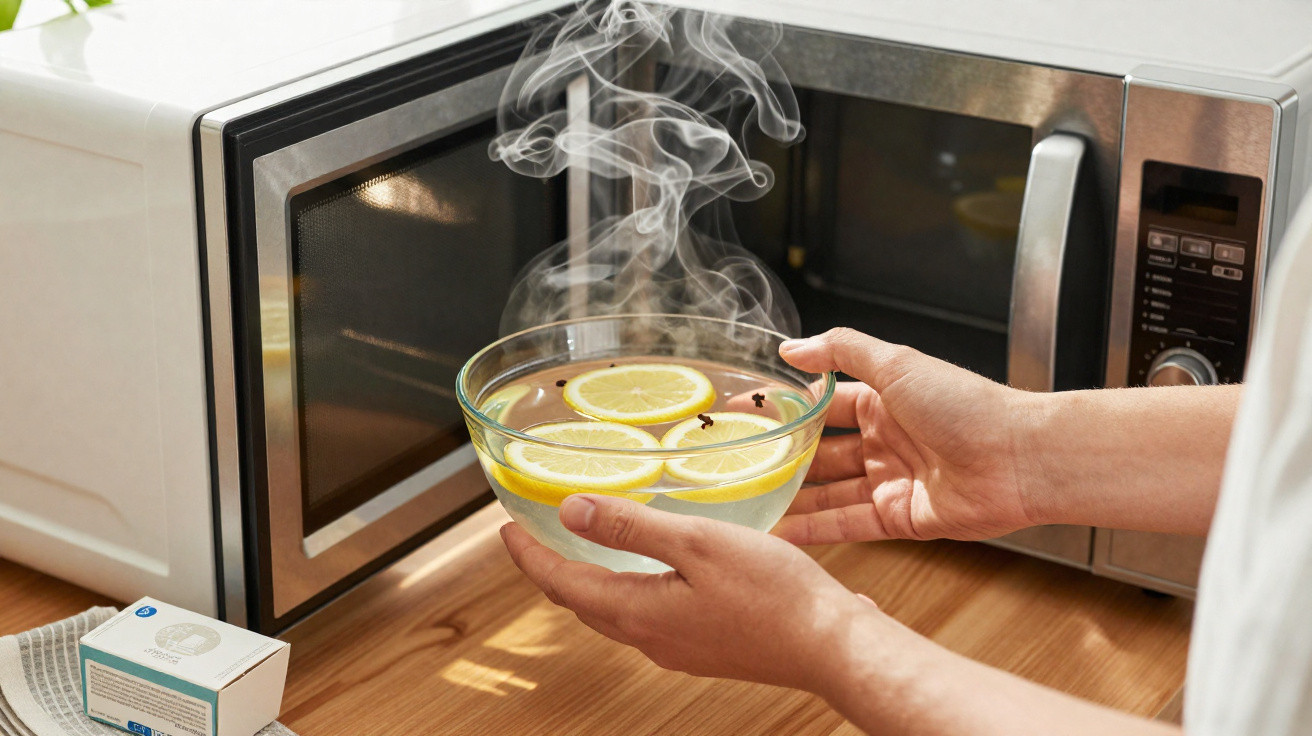
The most effective step is simple and almost always overlooked: clean the microwave while it is still warm. Have you just heated a particularly pungent dish? Put a glass of water with a few lemon slices inside for around 2 to 3 minutes, until steam forms. When the beep sounds, do not open the door straight away. Let the steam work inside for another two minutes, like a mini scented sauna. Then open it and wipe every interior surface with a damp cloth. At this point, the grease has not dried out again, so it comes away more easily. Lemon helps neutralise the smell and leaves behind a light citrus note, which suits a kitchen far better than the aroma of old food.
Another helpful habit is covering food whenever possible. A microwave-safe lid, a plate placed upside down over a bowl, or even cling film pierced in two places can contain much of the splatter and smell. We have all had that moment: you take the dish out in a hurry, a little sauce escapes, and nobody cleans it because “I’ll deal with it later”. Honestly, hardly anyone does it every single day. Life gets in the way. But these small omissions add up, and eventually the smell comes calling. In a shared home, a quick chat about using a cover and giving the interior a fast wipe can change the situation. It does not need to become a lecture; a basic agreement between users is enough.
“The microwave does not ruin food, but it can ruin the atmosphere in the kitchen when it becomes a source of bad smells,” joked a nutritionist I interviewed once. That line stayed with me.
- Use water with lemon or vinegar in a glass to create steam and loosen grease.
- Cover dishes and containers with suitable lids or inverted plates to reduce splashes.
- Wipe the interior while it is still warm, using a damp cloth and mild washing-up liquid.
- Leave the door slightly ajar for a few minutes after use to allow ventilation.
- Avoid heating fish and highly aromatic foods without covering them.
When the smell has taken over: how to turn things around
Sometimes there is no point pretending you are used to it: the smell is there, powerful, persistent and almost with a personality of its own. You open the microwave and know this is not a matter of a “slight aroma”; it feels like an invasion of territory. In these cases, it is worth doing a focused deep clean, almost a detox. Place a glass bowl containing water, two tablespoons of white vinegar and, if you like, a bay leaf or a few lemon slices inside. Run it for 5 minutes, until it fills with steam, then keep the door closed for a further 5 minutes. Once you open it, use a soft sponge with a little washing-up liquid, rinse with a damp cloth and dry with kitchen roll. It may sound lengthy, but it takes less than ten minutes of actual work.
For dramatic cases, such as burnt popcorn or fish left over from before a bank holiday, you can combine methods. After steaming with vinegar, place a small pot of bicarbonate of soda in the switched-off microwave, close the door and leave it overnight. Bicarbonate of soda works as an odour absorber: discreet and inexpensive. Another option is to use coffee beans or activated charcoal on a saucer, which can also help draw odours from the space. Some people worry that a strong smell means the appliance is faulty. Most of the time, that is not the case. It is simply a build-up, something that can be resolved with a minimal routine and a few practical kitchen tricks.
What almost nobody mentions is the indirect effect this small detail has on day-to-day life. When the microwave smells unpleasant, we tend to use it less, resort to the hob when time is short, or let a packed lunch go cold because we cannot face dealing with the odour. Little by little, the appliance that should make the day easier becomes a quiet nuisance. Taking care of the smell is, ultimately, taking care of your relationship with your own kitchen. It is not about magazine-perfect standards. It is about comfort: the pleasure of opening the door, finding neutral air and knowing that the space is working for you rather than against you. It is almost a daily gesture of belonging.
| Key point | Detail | Value for the reader |
|---|---|---|
| Steam cleaning | Water with lemon or vinegar for a few minutes before wiping | Removes hidden grease and prevents persistent odours |
| Daily prevention | Cover dishes, use a lid and clean while warm | Reduces accumulated dirt and saves time on intensive cleaning |
| Odour detox | Bicarbonate of soda, coffee beans or activated charcoal after thorough cleaning | Neutralises strong smells and restores the feeling of a “new” microwave |
FAQ:
Question 1 Can I use any type of vinegar to remove microwave smells?
White distilled vinegar is the best choice because it has a less noticeable smell and a more neutral action. Other types can be used, but their aroma may compete with the smell of food afterwards.Question 2 Will heating lemon in the microwave damage the appliance?
No, provided it is placed in a bowl of water and heated for only a few minutes. The lemon simply scents the steam and helps loosen grease. The problem would be using unsuitable containers, such as plastic that can melt.Question 3 How often should I do this deep clean with vinegar or lemon?
In a home where the microwave is used daily, once a week is enough to keep smells under control. With heavy use, such as in an office or shared house, twice a week makes a difference.Question 4 Does a microwave with a self-cleaning function remove smells on its own?
It helps a great deal, but it is not a miracle solution. You still need to wipe inside, remove the turntable and clean the edges that steam does not reach as effectively.Question 5 Can a strong smell be harmful to health?
The discomfort is more sensory than dangerous. The greater risk is old residue, which can attract insects or become mouldy. Keeping the microwave clean means it remains safe to use.













Comments
No comments yet. Be the first to comment!
Leave a Comment