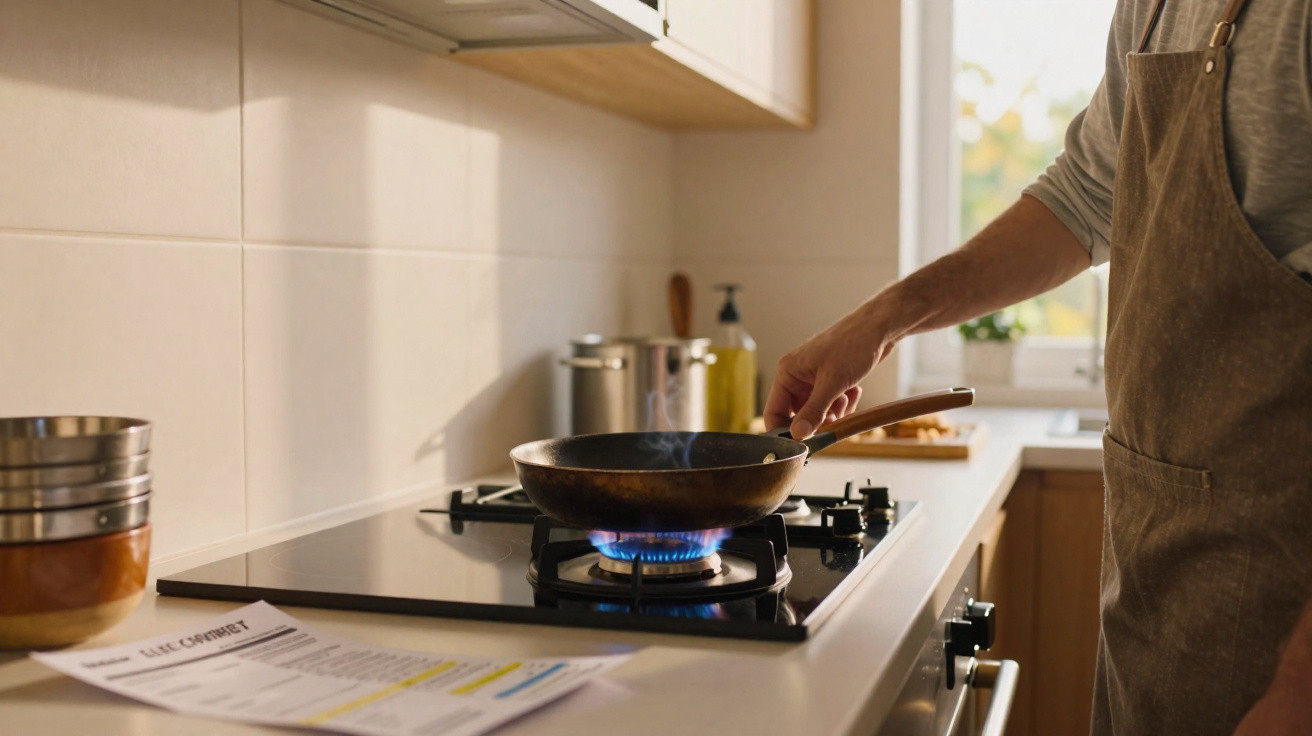
Glossy black glass, clever sensors and touch sliders were once seen as the “future” of cooking.
But a quiet exodus is under way among home cooks.
With its streamlined appearance and claims of efficiency, the induction hob appeared to be the final word in kitchen technology. By 2026, however, more people are reassessing the decision and returning to gas. This is not simply nostalgia: everyday cooking, energy costs and troublesome repairs are leading them elsewhere.
From status symbol to everyday frustration
For years, an induction hob represented the modern kitchen: smooth, minimalist, fast-heating and promoted as energy-efficient. Interior designers valued the way it blended into a worktop, while developers routinely fitted one in new flats. Many people, including me, expected gas to gradually disappear.
Then the practical drawbacks began to show: climbing electricity bills, temperamental electronics, error messages and the unwelcome discovery that a much-loved cast-aluminium pan would never again work on the polished surface.
Induction suits a brochure. Gas often suits how people actually cook, especially when energy costs start to bite.
This change is not a rejection of technology. It arises from the untidy realities of daily life: attempting to simmer sauce while the hob beeps, managing power settings across several zones, or receiving a four-figure estimate to replace cracked glass that still seems “almost new”.
How induction and gas technology differ in the home kitchen
Induction’s concealed complexity
Induction uses coils below the glass to create a magnetic field. This heats the base of compatible cookware directly rather than the hob surface itself. Temperature rises rapidly, water reaches the boil fast, and the glass around the pan remains comparatively cool.
In theory, that sounds perfect. In practice, the system depends on layers of delicate electronics. A surge, moisture or a small fault can trigger an error mode. When that happens, the usual answer is a specialist engineer rather than a screwdriver and a spare from the DIY shop.
Gas’s obvious simplicity
A gas hob can seem almost dated next to induction. You light the flame, it surrounds the pan, and its response is visible the moment you turn the knob. There is little guesswork: an unusual-looking flame makes it clear that something is wrong.
Its basic design has changed very little over decades, and that has proved an advantage. Burners, igniters and pan supports can often be replaced separately and at modest cost. For households watching tight budgets in 2026, this can matter more than an advanced control panel.
Where induction hides its power behind software and sensors, gas shows you everything in that ring of blue flame.
Energy prices alter the calculation
For a long time, induction was presented as the efficient, climate-conscious choice, while gas was treated as yesterday’s fuel. The situation now appears more complicated.
- Electricity prices have become unpredictable in many areas, making cooking costs harder to forecast.
- Although gas is far from environmentally perfect, it can still cost less than electricity per kilowatt-hour.
- Certain suppliers provide biogas or blended gas, modestly improving the carbon picture for consumers unwilling to abandon a burner flame.
Energy-provider comparisons repeatedly indicate that gas cooking can remain cheaper than electric options over the longer term, particularly where electricity tariffs rise in the evening - exactly when most households make dinner.
Cookware compatibility and the hidden cost of replacement
Why a favourite pan can suddenly be unusable
Compatibility is one of induction’s less obvious problems. It only works with ferromagnetic cookware, generally steel or cast iron. Copper, glass, certain aluminium pans and many older items either do not work at all or work badly.
For people who have built up a cookware collection over many years, this can mean an enforced clear-out. The alternative is to retire those pans or retain another heat source. As a result, the supposed “upgrade” can create an expensive sequence of purchases: a new hob, new pans and, in some cases, a redesigned worktop arrangement.
Gas accepts almost anything placed on it
Gas works with nearly every material: stainless steel, enamel, cast iron, aluminium, clay pots and unusual inherited cookware that would never meet an induction test. This supports a broader range of methods, from wok hei above a fierce flame to gently warming yoghurt in a ceramic pot on the smallest burner.
| Aspect | Induction | Gas |
|---|---|---|
| Cookware compatibility | Needs magnetic base | Almost any material |
| Heat control | Fast, via electronics | Instant, via visible flame |
| Lifespan and repair | 10–15 years, repairs costly | Often longer, modular parts |
| Cleaning | Flat surface, easy to wipe | Grates and burners to disassemble |
Maintenance, lifespan and the real cost of failure
Today’s induction hobs seldom endure as long as the heavy enamelled gas cookers many people recall from childhood kitchens. Their usual lifespan is around a decade, sometimes slightly longer, although the glass and electronics are still susceptible to damage.
A falling pan may fracture the surface, while a power surge can destroy a circuit board. Repairs can involve proprietary components and approved technicians, rapidly bringing the cost close to that of a replacement appliance. This prompts some households to replace rather than repair, with clear environmental consequences.
When a glass‑ceramic panel cracks, the decision is often not “should I fix it?” but “do I accept buying a whole new hob again?”
Gas hobs, on the other hand, commonly develop smaller and more manageable faults: a blocked injector, a tired igniter or a warped pan support. Parts are often sufficiently standardised for local engineers to keep them operating without much difficulty.
What cooks feel when using the hob
Speed versus feel
There is no denying induction’s pace. Pasta water can boil remarkably quickly, and power settings react fast. Those saved minutes can be genuinely useful for weekday meals. Provided spillages are wiped up promptly, the glass is also simple to clean.
Even so, many home cooks say induction feels impersonal. There is no flame or gentle burner tick, only numbers on a compact display. Sauces can maintain a consistent simmer, but some users miss the subtle, instinctive signals that come from watching a flame increase or decrease.
Control, instinct and the “real fire” factor
Gas offers an immediate visual signal. A glance at the burner tells you whether the heat is right for searing or a gentle bubble. Moving a pan partly away from the flame makes it possible to manage hot spots without using a control panel. That hands-on understanding of heat, developed over years, does not easily translate to induction’s digital settings.
For many, gas feels like cooking with a living element; induction can feel like managing an appliance.
It may sound romantic, but this distinction influences everyday routines. People who regularly make stir-fries, flatbreads or delicate caramels often return to gas because a flame better suits the pace of those dishes.
Safety, health and ventilation
Health and safety should be considered before changing hob type. Induction eliminates an open flame, reducing the chance of direct burns for children and accidental ignition. Its surface cools sooner and it normally has automatic shut-off functions.
Gas, conversely, burns fuel inside the home and produces nitrogen oxides alongside other by-products. Inadequate ventilation may harm indoor air quality, particularly in small urban flats. Anyone returning to gas should assess their extraction: a properly vented, functioning cooker hood, or at minimum effective window ventilation while cooking.
Many modern gas hobs have flame-failure devices that stop the gas supply if the flame extinguishes. Routine servicing helps maintain clean combustion and stabilise the flame pattern. For homes with asthma sufferers or very young children, this element of the decision requires careful consideration and, where appropriate, professional advice.
Lifehacks, hybrid setups and middle-ground options
The 2026 story is not solely “gas versus induction”. Many kitchens now combine both technologies. One popular arrangement matches a gas hob with a compact portable induction plate: water can boil on induction, while searing and stir-frying happen on gas, leaving options available when energy tariffs change.
Some cooks rely on straightforward methods: lining pans with foil to protect coatings, reserving a heavy cast-iron skillet for high-heat searing on gas, and using induction for low-and-slow cooking, where it functions almost like a precise hotplate.
Manufacturers are also promoting hybrid hobs, which combine a couple of gas burners with induction zones in one appliance. They are intended to provide induction’s speed and easy cleaning while retaining at least one exposed flame for jobs that require it.
Beyond 2026: what changing to gas actually involves
Selecting gas in 2026 is not merely a nostalgic choice. It relates to wider concerns including energy security, repair culture, the cost of living and how frequently people want to replace major appliances. A hob that runs for 20 years with occasional replacement parts may be more attractive than a sleek model requiring replacement after a decade, even if the latter has a slightly better energy-label performance.
Anyone thinking of moving back to gas can carry out a straightforward home calculation: total current cooking hours each week, examine local gas and electricity tariffs, then estimate annual consumption for both choices. Set this alongside an honest assessment of cooking patterns - frequent wok cooking, bread baking on a stone or slow stews - and the result can often be more revealing than any marketing brochure.
There is a cultural dimension too. As more people take up food preservation, batch cooking and home baking, the hob becomes less a lifestyle accessory and more a working tool. In that setting, durable hardware, uncomplicated repairs and a visible flame can seem unexpectedly modern, even when the underlying technology comes from an earlier era.
















Comments
No comments yet. Be the first to comment!
Leave a Comment