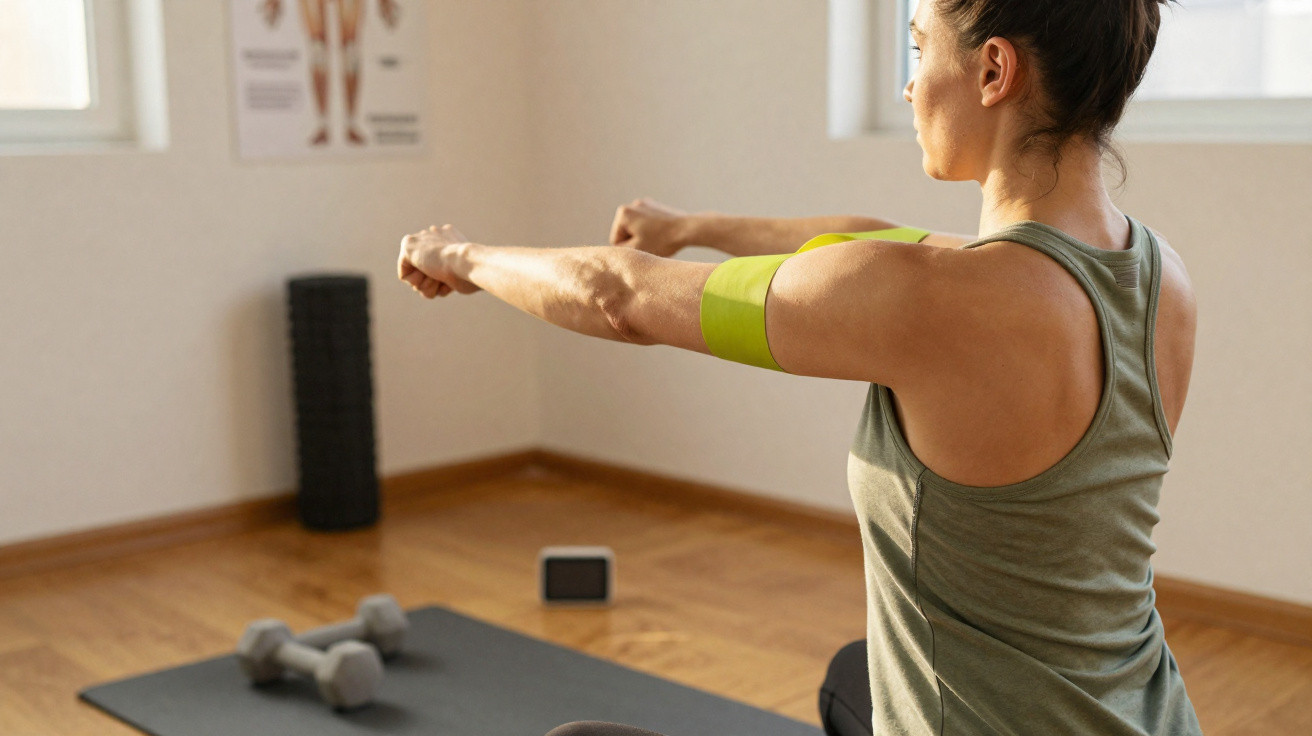
The rotator cuff consists of deep muscles that keep the shoulder stable as the arm rotates, lifts or bears weight. Strengthening this area through gentle, controlled and regular movements can ease overload, improve joint mechanics and help prevent pain associated with weakness, poor posture or repetitive use.
Why does strengthening the shoulder reduce pain and injury risk?
The shoulder has an extensive range of movement, but that mobility requires stability. If the rotator cuff is weak, larger muscles attempt to take over, which may irritate tendons, place extra stress on the joint capsule and make everyday activities more uncomfortable.
Rehabilitation specialists commonly focus first on external rotation exercises, shoulder-blade control and gentle activation before introducing heavy loads. The aim is not to “burn” the muscle, but to train the shoulder to move without pinching, hiking upwards or losing alignment.
How do you perform external rotation with a resistance band?
External rotation using a resistance band mainly works the infraspinatus and teres minor. These muscles help turn the arm outwards and keep the head of the humerus more stable within the joint. It is among the most widely used exercises for protecting the rotator cuff without needing a heavy load.
- Secure a light resistance band at elbow height.
- Stand side-on to the anchor point, with your elbow bent to 90 degrees.
- Place a small towel between your elbow and your torso.
- Rotate your forearm outwards without moving your elbow away from your body.
- Return slowly, maintaining control against the band’s resistance.
Why is lying external rotation useful for beginners?
Lying external rotation is suitable for beginners because it limits compensation from the torso. When lying on your side, the body is steadier and the movement is more focused on the shoulder, making it less likely that you will use the lower back or neck to compensate.
Use a very light dumbbell weighing 500 g to 2 kg, or even a small bottle. Complete 2 to 3 sets of 10 to 15 repetitions, always avoiding sharp pain. If your arm shakes excessively or your shoulder lifts towards your ear, the weight is too heavy.
How do shoulder-blade exercises protect the rotator cuff?
The shoulder blade provides the foundation for the shoulder. When it does not move properly, the rotator cuff has to work from an unfavourable position, especially when raising the arm or carrying weight. This is why shoulder-blade retraction and wall slides are essential supporting exercises.
- For shoulder-blade retraction, sit or stand and gently draw your shoulder blades back and down.
- Hold for 3 to 5 seconds without arching your lower back.
- For a wall slide, rest your forearms against a wall and slide your arms upwards in a controlled manner.
- Keep your ribs down and your neck relaxed throughout the movement.
- Perform 2 sets of 8 to 12 repetitions at a slow pace.
The right frequency matters more than heavy loading
To strengthen the rotator cuff, the best starting point is to train 3 to 4 times a week using a light resistance band, a small dumbbell and slow execution. Mild muscular effort is acceptable; sharp pain, loss of strength, tingling or symptoms that worsen after training require professional assessment.
The shoulder responds well to small, repeated stimuli: external rotation, shoulder-blade control, sufficient rest and gradual progression. After a few weeks, movement will usually feel steadier, the arm will lift with less compensation and overhead tasks will demand less from the joint.















Comments
No comments yet. Be the first to comment!
Leave a Comment