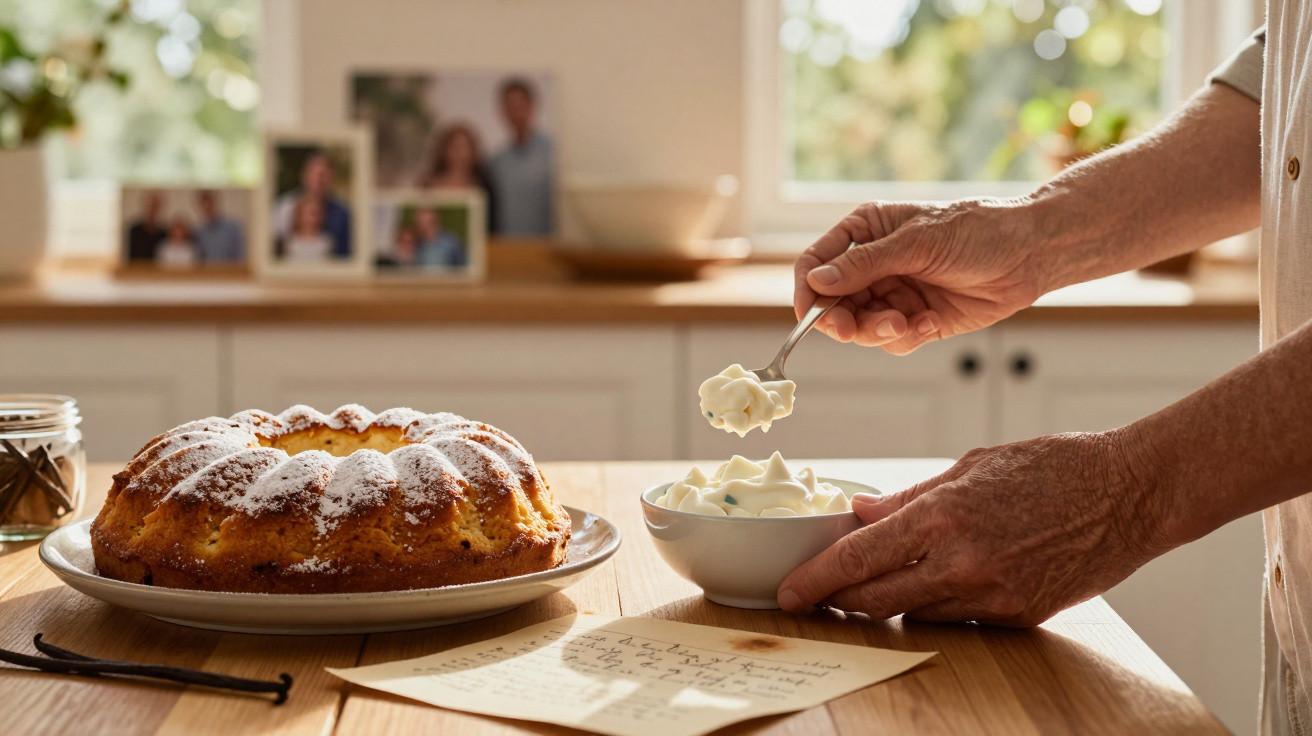
On Sundays at Janine’s, the yoghurt cake never stays on the cooling rack for long. At 81, she makes it almost without checking the quantities, using an old Pyrex mixing bowl that has seen floral tablecloths and rather too-noisy afternoon teas. The recipe dates back to 1968, the year she and her husband moved into a small flat whose walls were still damp. For decades, her children assumed that her cake was simply “more successful than the others”. It was softer, a little more golden, and carried that subtle scent which drew everyone back to the kitchen before the coffee had even been served. Between cutting two slices, Janine finally shared her secret. One spoonful, no more. Suddenly, everything makes sense.
Janine’s small touch for an unforgettable yoghurt cake
Janine follows the recipe familiar to so many people: one pot of plain yoghurt, two pots of sugar, three pots of flour, half a pot of oil, three eggs and one sachet of baking powder. At first glance, there is nothing remarkable about it. Her hidden addition comes just before the flour: she stirs in one tablespoon of thick crème fraîche, preferably full-fat, mixing it thoroughly with the yoghurt and eggs. It makes the batter smoother, faintly glossy and almost comforting to look at. We all know that moment when an ordinary recipe seems to contain something extra, even though we cannot quite identify it.
She says she discovered the trick one evening in November 1968, when there was not enough oil left in the cupboard. Her mother-in-law arrived unexpectedly for dinner and advised her to “add a spoonful of cream, my girl, it will save the day”. The cake rose more than usual, with a fine, tender crumb that remained soft until the following day. In Janine’s home, this recipe has featured at birthdays, before family holidays and even during unexpected visits after school. She has baked it hundreds of times, perhaps more. “I no longer count, otherwise I would feel old,” she jokes as she wipes the rim of the cake tin.
Crème fraîche contributes both fat and moisture, two things that genuinely alter the texture of a simple cake. The batter does not dry out as quickly in the oven and retains the gentle melt-in-the-mouth quality people often seek without finding. The yoghurt flavour is still there, but it becomes rounder, less tangy and almost milky. This is not a pastry-chef revolution; it is a lived-in kitchen tip. Let us be honest: nobody really does this every day. Yet when you want a cake that makes you reach for another small slice, that spoonful makes a surprising difference.
How to recreate Janine’s recipe without spoiling the texture
To make Janine’s cake, take the eggs and yoghurt out of the fridge around 20 minutes before you start. They do not need to become warm, merely less cold than they were in the refrigerator. Whisk the eggs and sugar together, then add the yoghurt followed by the crème fraîche, before stirring in the oil. Add the flour and baking powder last, sifting them if you have time. Pour the batter into a buttered 22–24 cm cake tin and bake at 180°C for roughly 35 minutes. A knife blade should emerge with a few damp crumbs attached, never completely dry.
The most common mistake is trying to improve the recipe further by doubling the amount of cream. It is tempting, especially for anyone who loves particularly soft cakes, but two spoonfuls can weigh down the batter and stop it rising so well. One is enough. Janine also uses full-fat crème fraîche, containing around 30% fat, without looking for any particular brand. She avoids reduced-fat versions, as they do not provide the same velvety texture. If the cake is browning too quickly, place a sheet of aluminium foil over the top towards the end of baking. Details like this prevent many needless disappointments.
Janine does not always flavour her cake in the same way: on some Sundays she adds lemon zest; at other times, a handful of chocolate chips is enough to delight the grandchildren. She does, however, keep to one very simple rule: never overwork the batter after adding the flour.
“A yoghurt cake should stay easy. If you make it too complicated, it loses its kindness,” Janine explains.
- Add one tablespoon of full-fat crème fraîche.
- Fold in the flour and baking powder gently.
- Start checking the baking from the 30-minute mark.
- Allow the cake to cool slightly before turning it out.
Why family recipes sometimes have a flavour you cannot replicate
Perhaps the most moving part of Janine’s story is not that spoonful of cream, but the silence that surrounded it for so long. She had not truly chosen to conceal her method; nobody had asked her the right question. Her family ate the cake, said it was delicious, then moved on. In family kitchens, secrets often lie in the gestures: a pinch added without thinking, baking judged by its smell, or a tin chosen because it “works better”. Recipes are not handed down on paper alone. They are also passed on through the memory of hands.
This yoghurt cake is a reminder that memorable flavours do not require rare ingredients. Crème fraîche from the fridge, plain yoghurt, a few eggs and a quiet hour can be enough to bring back very precise memories. Many readers will probably remember a Wednesday cake, the one that scented the hallway before it had even cooled. The strength of this recipe lies in its simplicity, but also in its freedom: you can add apples, vanilla, pears or a few drops of orange blossom water. The base, meanwhile, remains true to itself.
At 81, Janine smiles when asked why she is finally revealing her ingredient. “Because my grandchildren are starting to cook, and they have the right to know,” she replies. Her words sound light-hearted, yet they say much about the tiny acts of passing things on that matter more than we think. Trying her cake may mean rediscovering the scent of childhood, or creating a ritual for Sundays to come. And what if one simple spoonful of crème fraîche could become, in your home too, the detail everyone asks for without knowing how to explain it?
| Key point | Detail | Added value for the reader |
|---|---|---|
| Janine’s secret | One tablespoon of thick, full-fat crème fraîche is added with the yoghurt, before the flour is incorporated. This small amount enriches the batter without changing the very simple balance of the traditional recipe. | The cake has a softer crumb, is less dry the next day and has a rounder flavour. It is an accessible, inexpensive tip that is easy to try with your next batch. |
| The right mixing method | Combine the wet ingredients first, then incorporate the flour and baking powder without overmixing. The batter should be smooth, not beaten for a long time as though it were a brioche dough. | This approach reduces the risk of a dense cake. It keeps the light, well-risen quality expected from a homemade yoghurt cake. |
| Baking it properly | Allow around 35 minutes at 180°C in a medium-sized cake tin, checking from 30 minutes onwards. Then leave the cake to cool slightly for a few moments before turning it out. | The centre stays soft and the edges do not become hard. This straightforward step often turns a good cake into one people remember. |

















Comments
No comments yet. Be the first to comment!
Leave a Comment