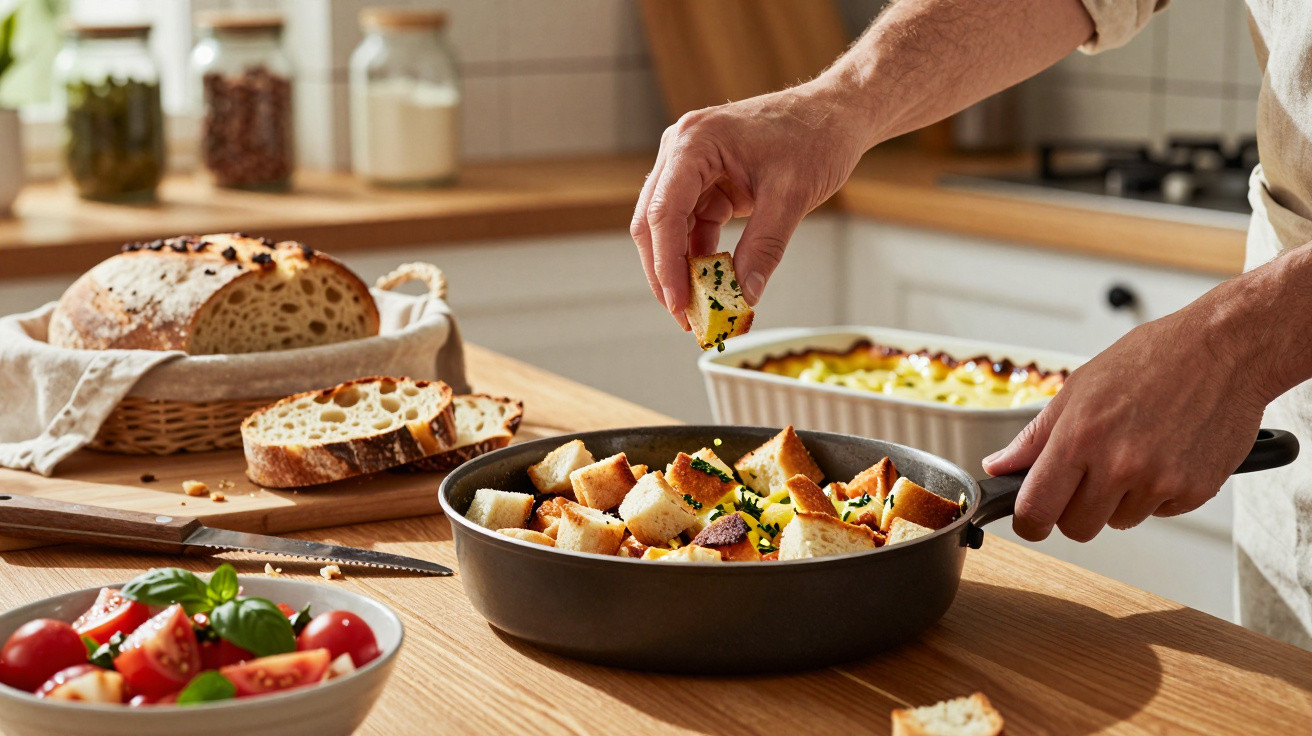
By 7 pm, the display is nearly empty, though not quite. Half a baguette remains, along with two pieces of country loaf and a slightly over-firm loaf nobody selected. We all know that moment of hesitation between the bin and the cupboard, with a flicker of guilt at the back of the kitchen. Yet day-old bread is not failed bread: it has merely taken on a new purpose. In many bakeries, unsold loaves are turned into croutons, breadcrumbs, Sunday desserts or quick meals served at home. The scent of melted butter, garlic and toasting bread can easily make you forget that it began as a leftover. What if that neglected piece became the best part of the meal?
Stale bread: nothing truly goes to waste in bakeries
Stale bread has an advantage that freshly baked bread does not yet possess: it absorbs flavours without falling apart. Bakers understand this well when making homemade breadcrumbs, often from pieces that are too dry to sell the following day. Simply break them up, bake them for a few minutes, then blitz them with a pinch of salt, dried herbs or even Parmesan.
At a local bakery, an unsold Saturday baguette may be made into croutons by Monday morning. Cut into cubes, drizzled with olive oil, rubbed with garlic and baked at 180°C for ten to twelve minutes, it is ideal with soup or salad. One baguette yields around 150 to 200 grams of croutons: enough for several meals, without spending another penny.
The idea is straightforward: once the bread's moisture has evaporated, its crumb becomes a sturdy sponge. It holds milk, eggs, tomato juices or stock without instantly turning to mush. That is the secret behind the first recipe worth remembering: savoury bread pudding, made with stale bread, milk, eggs, diced ham, cheese and whatever vegetables are lingering in the fridge drawer. It is a leftover dish, certainly, but seldom a dull one.
Six easy recipes that day-old bread truly deserves
For a bakery-style toasted sandwich, slice a slightly hard country loaf, then briefly run it under a trickle of water before adding the toppings. Tomato, mozzarella, softened onion, grated cheese or leftover chicken all work, provided it is baked in a hot oven for ten minutes. This small moistening step restores softness to the middle without making the crust limp.
Another favourite in family kitchens is French toast, and it is by no means limited to breakfast. Soak slices in a mixture of milk, egg, sugar and vanilla, then fry them in a little butter. For a savoury version, leave out the sugar and add pepper, herbs and cheese instead. Let us be honest: nobody really makes it every day, but on a Sunday morning it delivers something particularly comforting.
Meatballs are the fifth recipe to know: soak the crumb in milk, then combine it with minced meat or mashed lentils, an egg, herbs and a little onion. For the sixth, consider panzanella, the Italian salad in which stale bread soaks up the juices of ripe tomatoes, olive oil and vinegar.
“Dry bread is not waste: it is an ingredient waiting for its second recipe.”
- Seasoned breadcrumbs: ideal for topping bakes, coating food or thickening a stuffing.
- Garlic croutons: excellent in soup, salad or baked eggs.
- Savoury bread pudding: a generous way to use up vegetables, cheese and bread.
- Toasted sandwiches: an express supper for evenings when the fridge appears empty.
- French toast: sweet or savoury, depending on your mood and what remains on the table.
- Panzanella or meatballs: two very different ways to rescue dry crumb.
The right habit begins before bread turns stale
The easiest option is to freeze bread before it becomes too dry, either sliced or in small pieces. It can be reheated straight in the toaster, oven or frying pan, preventing the build-up of baguette ends that so often ends up at the bottom of a bag. If the bread is already very hard, a few drops of water over the crust and five minutes at 180°C can give it one final impressive outing.
These recipes also offer another way of looking at what we call leftovers. A forgotten loaf can become the foundation of a shared meal, while simple homemade breadcrumbs can turn an ordinary bake into a more indulgent dish. Stale bread may not look especially elegant at first glance, admittedly, but it still carries the flavour of the bakery and the work of those who made it.
At home, as with some artisan bakers, cutting waste does not require flawless organisation or magazine-worthy cupboards. Sometimes, it is enough to ask the right question before throwing something away: what could this piece still add? A heartier soup, an improvised dessert, a summer salad or meatballs for the children. The next day, that slightly dry bread may well be the one everyone asks to have again.
| Key point | Detail | Added value for the reader |
|---|---|---|
| Stale bread absorbs liquids more effectively | Its dry crumb holds milk, eggs, stock and vegetable juices | More flavourful bread puddings, meatballs and French toast |
| The oven gives it a second life | A few minutes are enough to make croutons or breadcrumbs | An economical accompaniment ready in very little time |
| Leftovers can become a proper meal | Toasted sandwiches, panzanella and bakes also use up odds and ends from the fridge | Less waste and more everyday meal ideas |

















Comments
No comments yet. Be the first to comment!
Leave a Comment