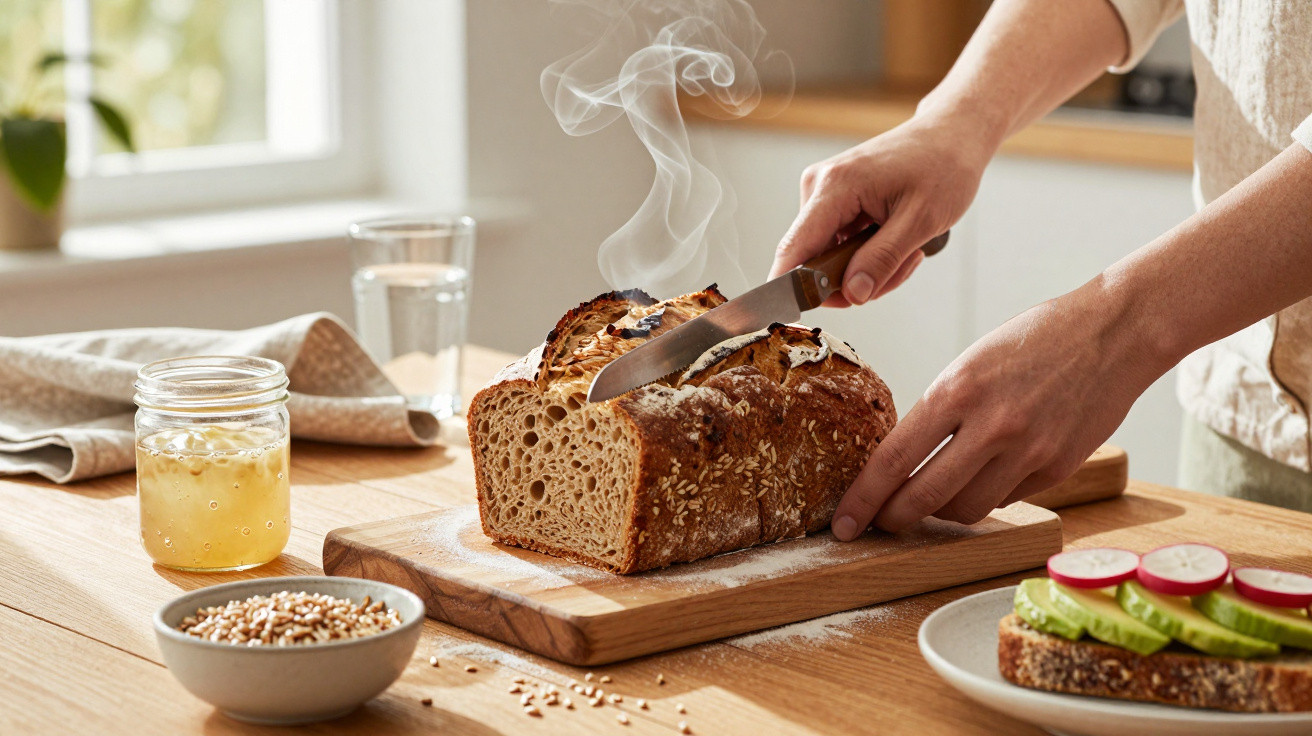
Between fashionable sourdough bakeries and bake-at-home rolls from discount supermarkets, one staple is easily overlooked: plain rye wholemeal bread baked in a loaf tin. Yet this unassuming everyday loaf can be a small revelation when its crumb, crust and flavour are right – and when it stays fresh for days.
Why rye wholemeal bread from a loaf tin is making a comeback
Rye was long regarded as a “farmer’s grain”. In many areas, a dark loaf-tin bread was once an entirely normal part of the table. Now, more people are choosing it again because they want extra fibre, fewer empty calories and a more satisfying feeling of fullness.
“A good rye wholemeal bread is not a diet product, but a substantial everyday loaf that keeps you full for a long time and offers surprising flavour.”
The loaf tin suits this renewed interest particularly well. It produces bread that is easy to slice, freeze and take with you. The slices are even, the crumb stays moist, and the crust is not overly hard. It is ideal for packed lunches, office snacks or an evening meal with the family.
What makes rye wholemeal bread so distinctive
Wholemeal rye flour differs markedly from wheat flour. It contains more of the bran and germ – precisely the parts of the grain that provide fibre, minerals and secondary plant compounds.
How it differs from white wheat bread
- Rye wholemeal provides more fibre and keeps you satisfied for longer.
- Its crumb remains denser and moister rather than light and fluffy like toast.
- It has a fuller flavour, with slightly sour and nutty notes.
- When handled correctly, the loaf remains fresh for several days.
The acidity usually introduced through sourdough also helps guard against mould and gives the bread its character. This effect is especially easy to manage in a loaf tin, as it supports the dough and prevents it from spreading outwards.
The essentials: rye, water, salt – and time
Many supermarket loaves contain enzymes, emulsifiers and additives that most people would not keep in a kitchen cupboard. A traditional rye wholemeal bread from a loaf tin needs only a small number of ingredients.
| Ingredient | Role in the bread |
|---|---|
| Wholemeal rye flour | Structure, flavour, fibre |
| Water | Moist crumb, flour hydration |
| Salt | Flavour, dough stability |
| Sourdough or a small amount of yeast | Leavening, shelf life, gentle acidity |
| Grains and seeds | Texture, nutrients, flavour |
The greater the proportion of rye and wholemeal flour, the more important dough handling becomes. Rye doughs often feel sticky, almost like mortar. That is entirely normal and does not mean the bake has gone wrong.
Keeping the loaf moist and hearty
Many people struggle with their first attempt because the bread turns crumbly or seems dry after two days. A few simple measures can prevent this.
A soaker for maximum moisture
One essential element is a soaker: seeds, cracked grain and, where desired, oats are covered with water in advance and left for several hours.
“The soaker acts like a water reservoir in the bread, ensuring that the crumb stays moist for days.”
Typical ingredients for a soaker include:
- Cracked rye or rye flakes
- Sunflower seeds or pumpkin seeds
- Linseeds or chia seeds
- Oats for a milder flavour
The seeds absorb plenty of water, then gradually release that moisture back into the loaf during storage. This keeps the tin loaf hearty without allowing it to become hard.
Getting the dough right for a loaf tin
For rye wholemeal bread, the dough should be soft and sticky rather than firm and compact. Inside a loaf tin, it can spread naturally instead of needing enough strength to hold its shape as a free-form loaf.
A few general guidelines are useful:
- The dough should flow slowly but visibly, rather than standing firm like a pudding.
- Fill the loaf tin to around two-thirds of its capacity.
- Proofing is complete when the dough sits just below the rim, or slightly above it, and springs back gently when pressed with a finger.
Anyone using only sourdough should allow several hours for the dough to rise. A small amount of yeast speeds things up, but the flavour can still be pronounced provided the dough is not left to rest for too short a time.
Staying fresh for longer: storage rather than preservation tricks
Shelf life is one of the major advantages of rye wholemeal bread from a loaf tin. When baked and stored properly, it remains pleasant to eat and full of flavour for four to five days.
“A rye tin loaf often develops its full flavour only after 24 hours – patience pays off.”
Two storage methods have proved particularly reliable:
- Keep it whole in a bread bin or wooden box, with the cut side facing down.
- Wrap it in a cloth at room temperature, away from direct heat from a radiator.
The fridge is only of limited use, as bread goes stale and dries out more quickly there. For longer-term storage, slice the loaf and freeze it in individual portions. You can then toast single slices whenever needed.
Everyday versatility: fitting bread into modern eating habits
Rye wholemeal bread may bring to mind a traditional evening meal with cold cuts and cheese. In reality, it can be used far more widely.
Topping ideas for open sandwiches
- Hummus, cucumber and cress for a quick vegan lunch.
- Cream cheese, smoked salmon and lemon zest for an effortless brunch snack.
- Avocado, egg and a little salt for an energy-rich breakfast.
- Quark, apple slices and cinnamon for a sweet but fibre-rich option.
Thanks to its firm structure, a slice of rye tin loaf easily holds generous toppings without becoming soggy. That makes it almost better suited to meal prep than many soft wheat breads.
Health considerations: the role of fibre and acidity
Many people opt for wholemeal rye because of its reputation as a “healthy bread”, without knowing what underlies it. Two aspects are especially important: fibre and the gentle acidity produced by sourdough.
“Fibre is not a buzzword, but a factor that affects digestion, blood sugar and satiety at the same time.”
The coarser elements of the grain swell in the gut, slow sugar absorption and stimulate bowel activity. Blood sugar rises more gradually, while intense hunger spells are less pronounced. This can be particularly useful for people aiming to make their diet a little more stable over the long term.
Sourdough acidity has several effects at once: it makes rye easier to digest, inhibits the growth of certain moulds and shapes the loaf’s characteristic flavour. Anyone used only to mild toast bread may notice this taste strongly at first, but experience suggests that it soon becomes familiar.
Common mistakes – and how to avoid frustration
Home bakers often report two issues: a crumb that is too dense and a knife that becomes sticky when slicing. Both are easy to explain.
- Dough that is too dense: Proofing was often too short. Rye needs visible time for air channels to form and for the surface to become slightly domed.
- Sticky crumb: The loaf was cut too soon. Rye breads should rest for at least 12 hours, and ideally 24 hours, before slicing.
- Dry bread: Either the dough contained too little water, or the loaf was stored uncovered in a draught.
Those who follow a few basic principles – high dough hydration, sufficient resting time, gentle cooling and protected storage – will encounter far fewer disappointments.
Practical advice for beginners
For anyone baking rye wholemeal bread in a loaf tin for the first time, a gradual approach works well. One possible schedule for the first three baking days is as follows:
- Day 1: Refresh or prepare the sourdough, make the soaker and leave it overnight.
- Day 2: Mix the main dough using wholemeal flour, water, salt, sourdough and the soaker; transfer it to the loaf tin, leave it to rise and bake it.
- Day 3: Leave the bread undisturbed, slice it only in the late afternoon and assess its flavour.
Spacing the stages out in this way removes pressure from the process. No one needs to spend hours continuously in the kitchen, and the result benefits from the resting periods.
Rye tin loaf in everyday life: small rituals, big results
Many people who find a reliable recipe for rye wholemeal bread from a loaf tin make baking it part of their weekly routine. A regular “bread day” lets everyone know that fresh bread will be in the house from the next day.
For example, a family might prepare the dough on Friday evening, bake on Saturday and use the loaf as a basis for the week ahead. Someone living alone can slice the bread after it has cooled, freeze part of it and remain flexible. Especially at a time when good bakery bread is becoming more expensive, a home-baked tin loaf is a dependable and predictable alternative.
Combined with seasonal spreads, leftover vegetables from the fridge or a quick omelette, a few slices of rye wholemeal bread can become a surprisingly varied range of meals. The loaf acts as a quiet anchor in an often hectic food culture: understated, robust and far more long-lasting than its modest appearance suggests.

















Comments
No comments yet. Be the first to comment!
Leave a Comment