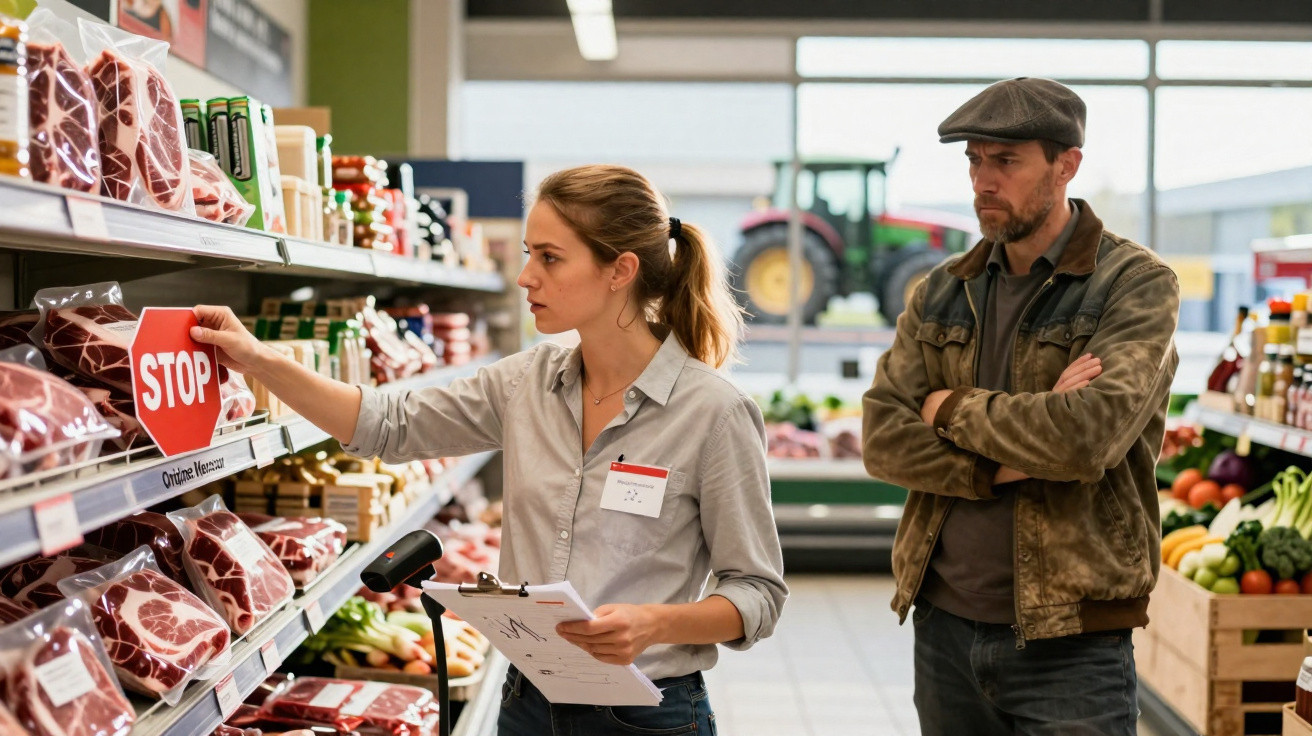
The European Union has just approved the free-trade agreement with the Mercosur countries, yet France’s leading supermarket groups have adopted an unequivocal united stance: South American meat will not enter their stores. This unprecedented position comes only days before the treaty’s formal signing.
EU-Mercosur agreement approved despite French objections
A confrontation was expected, although few foresaw such widespread agreement. On Friday 9 January, Brussels formally approved the EU-Mercosur trade deal, overriding reservations voiced by France and several other member states. Its signing, scheduled for 17 January, should in theory open the European market to agricultural produce from Brazil, Argentina, Paraguay and Uruguay. In theory only: French supermarkets have delivered a clear message that these goods will remain outside their supply chains.
Thierry Cotillard, president of Les Mousquetaires, the group behind Intermarché and Netto, was the first to state the position publicly. Appearing on France 2 on Monday 12 January, he made his group’s intentions unmistakable. “We took a position a year ago: we will not buy those products. We will not do so for chicken, nor will we do so for our own-brand products,” he insisted to the cameras. The declaration was swiftly echoed across the entire sector.
French supermarket chains present a united front
Intermarché is far from alone in its opposition. Carrefour, Système U and Leclerc: all the major supermarket groups are showing the same resolve. Alexandre Bompard, Carrefour’s chief executive, had already set out this approach on BFMTV on 7 January. Although he believes that “the adoption of Mercosur will have a fairly limited impact” on his group, that is precisely because its sourcing policy leaves little room for imports. “The Carrefour group and its banners have decided to source almost exclusively through French supply chains,” he explained, backing this up with figures: 100% French poultry, 97% French beef and 100% French-made pork.
Coopérative U has taken the same line. Its chief executive, Dominique Schelcher, spoke on TF1 that day to restate his chain’s commitment. In his view, importing South American products into France that would not meet the production requirements imposed nationally is out of the question. He also stressed that his group holds sufficiently large stocks to meet consumer demand throughout the year, without turning to South American imports.
Michel-Édouard Leclerc had anticipated this development as early as mid-December. Speaking on BFMTV, the head of the eponymous retailer was unequivocal: “As distributors, we will not open up to imports of chicken and meat produced under conditions that do not comply with safeguard clauses.” That principled stance is now being reflected throughout the sector.
Tensions at their height
This collective action comes at a time of exceptionally high tension in French farming. Livestock farmers, who strongly oppose an agreement they consider unfair, fear competition they cannot withstand from South American production, seen as less expensive but also subject to fewer health and environmental safeguards. By aligning themselves with French producers, supermarket groups are sending both a political and an economic signal.
One major question remains, raised by Thierry Cotillard himself: if retailers shut the door, what will food manufacturers do? “We will not buy these products abroad, but what will manufacturers do?” he asked. With ready meals, tinned goods and other processed products, supply chains remain more opaque. The Mercosur battle may only just be beginning.













Comments
No comments yet. Be the first to comment!
Leave a Comment