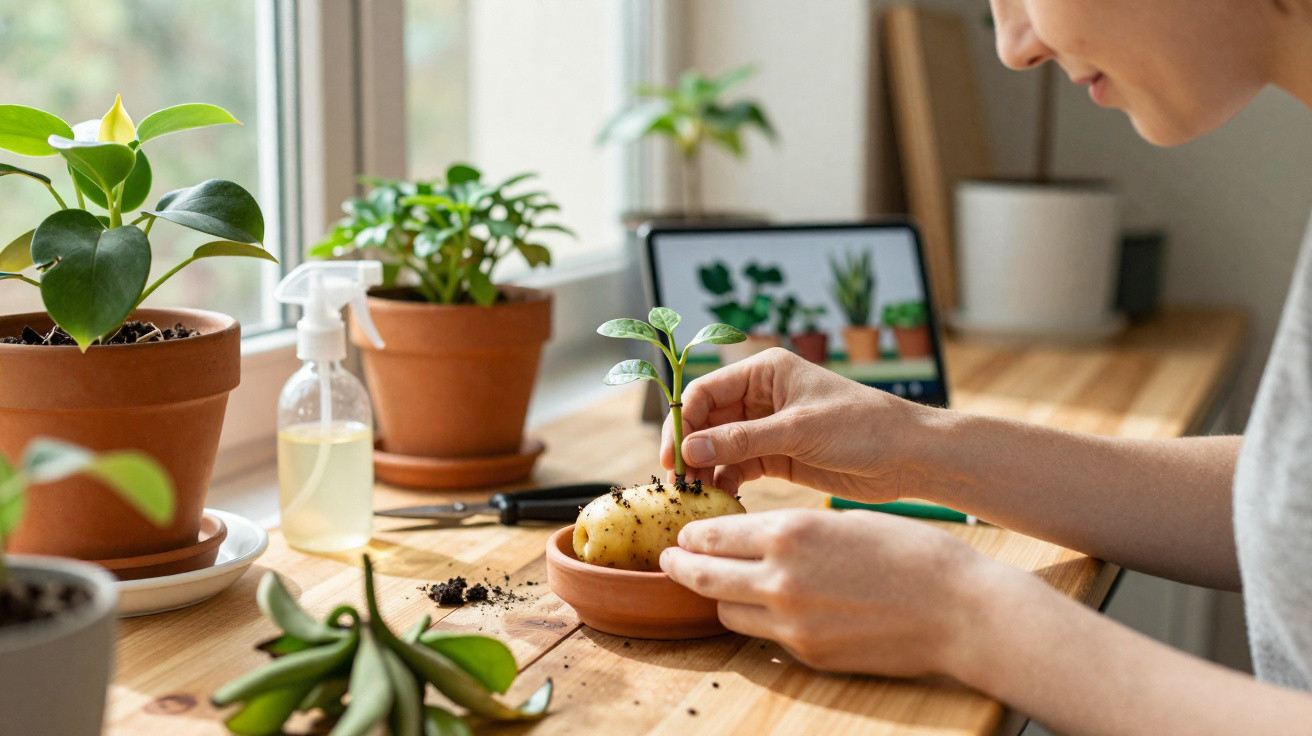
Social media insists that a raw potato can revive a dying houseplant.
Garden centres may be sceptical, but the idea continues to attract eager experimenters.
The concept sounds like a miniature miracle: rather than throwing away the drooping stem on your windowsill, you push it into a potato and wait for roots to emerge. With household budgets under pressure and indoor plants enjoying renewed popularity, the prospect of rescuing greenery with an everyday kitchen ingredient has obvious appeal. Yet beyond viral clips and striking “before/after” images, what really takes place inside that potato - and when, if ever, might this method work?
The origins of the potato plant-rescue hack
This approach did not emerge from nowhere. It combines traditional gardening advice with current zero-waste thinking and the sort of experiments popular on TikTok.
The claim behind the viral trend
In most clips, the technique appears almost too easy. Someone takes a wilted cutting, makes a hole in a fresh potato and places the entire setup in compost or a glass. A few weeks later, the video claims, roots have appeared and the plant has been brought back from the edge.
At the heart of the trend sits a bold claim: the potato acts as a natural rooting station, feeding and hydrating a weak cutting long enough for new roots to form.
It is an attractive story: no costly products, no specialist tools, simply a vegetable and some optimism. For novice gardeners in particular, the combination of little effort and a potentially big payoff is persuasive.
“Dead” versus “struggling”: the common misunderstanding
Much of the misunderstanding comes down to the words people use. Plenty of posts describe plants as “dead” when they are actually still alive.
A plant is dead when its stems are brown and dry from top to bottom, or when rotting tissue becomes soft and collapses. By this stage, the cells have broken down and those areas cannot produce new growth.
Like nearly every propagation technique, the potato method only has a chance with living plant material. This means:
- Stems need to retain at least some green or pliable tissue.
- Buds, nodes and tiny leaves should be solid rather than hollow or papery.
- The plant must not have a rotten smell or a slimy texture.
Without that small remaining sign of life, no potato, cinnamon or strategic placement will alter the result.
How the raw potato houseplant rescue is meant to work
Without the social-media drama, this is essentially an unusual way of propagating a cutting.
Step by step: the usual viral “protocol”
The standard equipment list is generally as follows:
- One firm raw potato that has not started sprouting.
- One stem or cutting that remains green and has some turgor.
- A clean knife.
- A pot containing light compost, or a glass capable of holding the potato upright.
Make a hole around two to three centimetres deep in the potato, then push the base of the stem into it. Place the potato in compost or a container with the stem facing upwards. Keep the growing medium lightly moist rather than saturated.
The potato creates a moist, relatively stable micro-environment around the cutting base, reducing the risk of dehydration during the first stressful days.
The theory is that the tuber’s water and starch will sustain the cutting until it can produce roots for itself.
Small additions enthusiasts make
Committed fans of the technique often introduce a few extra measures:
- Sprinkling cinnamon powder over the potato to help limit fungal growth.
- Adding a little charcoal to the pot to reduce odours and decay.
- Positioning the setup somewhere warm and bright, with indirect light, to encourage growth.
Some people test woody rose or shrub cuttings, while others use softer houseplants such as pothos, ivy or sweet potato vine. Results differ enormously, which has only intensified debate in comment sections.
What the science indicates: a helper, not a miracle
To judge whether this hack has any genuine basis, it helps to consider what a potato can actually provide for a plant cutting.
Why a potato could support rooting
A potato contains water, carbohydrates and limited amounts of minerals. Over a short time, these may provide an energy reserve for living cells at the cutting’s base.
Its dense, damp flesh also surrounds the stem like a biological “bandage”. Rather than being exposed to air and drying out quickly, or sitting in waterlogged compost, the cutting is held within a moderately protected, moist area.
In the best scenario, the potato behaves like a temporary cradle: it holds the cutting upright, keeps it moist and offers easily accessible sugars during root formation.
This may assist species that are naturally easy to root, particularly vigorous vines and soft-stemmed plants. Such plants can root in almost any reliably humid, stable environment, and a potato is simply another possible medium.
Where the method fails
However, the tuber creates several drawbacks too.
Firstly, a cut potato deteriorates rapidly. Microbes can develop in the damaged flesh within days. In a warm room, mould and rot can appear quickly - at times before roots have a chance to form. This deterioration may spread to the stem, destroying whatever living tissue remains.
Secondly, potatoes do not contain root-forming hormones. Gardeners normally depend on the plant’s natural auxins, or use rooting hormone powders or willow-water. A potato cannot provide this: it does not initiate root growth and merely maintains damp conditions.
Thirdly, the hack overlooks fundamental requirements involving light, temperature and oxygen around developing roots. A soaked potato buried in compacted compost may suffocate a cutting instead of helping it.
| Potato hack: potential benefits | Potato hack: key drawbacks |
|---|---|
| Short-term moisture around the stem base | Rapid rot and mould in the tuber |
| Some accessible sugars for living tissue | No rooting hormones provided |
| Holds the cutting upright and stable | Can suffocate the stem in dense, wet tissue |
| Low-cost, uses a kitchen staple | Often fails on genuinely weak or damaged plants |
Mixed results in practice: when it succeeds and fails
A brief look through gardening forums and social platforms reveals a familiar picture: a small number of reported successes followed by many disappointments.
Success stories, coincidences and hopeful assumptions
Some gardeners do root forgiving plants, including pothos, ivy, tomato side shoots and sweet potato vines, in potatoes. As these species often root in a glass of water on a kitchen shelf, a damp tuber is not especially challenging for them.
In many supposed “miracle” examples, the cutting would probably have rooted just as well in ordinary compost or plain water. The potato is therefore more of a dramatic prop than an essential part of the process.
The psychological boost often outweighs the biological one: people feel proactive and hopeful, which makes any small hint of regrowth feel dramatic.
Other trials finish predictably: the potato becomes slimy and foul-smelling, while the cutting blackens or turns grey at its base. Beginners may take this as evidence that the plant was “too far gone”, although the method itself may have increased the likelihood of infection.
Plants and conditions that give the hack its best chance
The technique is most likely to work when:
- The stem remains green, firm and only slightly stressed.
- The species naturally propagates readily from cuttings.
- Indoor temperatures are reasonably warm, with bright but indirect light.
- Part of the potato stays exposed to air and the surrounding compost drains freely.
More difficult situations - including geraniums badly damaged by frost, woody shrubs reduced to dry sticks, and shrivelled succulents - seldom improve. Their tissues do not contain enough living cells to restart growth, regardless of how generous the potato “support package” may seem.
Should you test it? Advice for curious gardeners
Anyone keen to try the potato trick can take a few precautions to make the test less disappointing.
Trying the experiment without putting everything at stake
Start with spare cuttings rather than the final surviving stem from a treasured plant. Take several pieces from the same parent plant and divide them between:
- Traditional water propagation in a clean glass.
- Light, freely draining compost without a potato.
- One or two cuttings placed in a potato as the “fun” option.
Comparing these methods side by side will quickly show whether the potato offers any advantage for that species under your home conditions. It also prevents you from assuming the tuber caused success when the cutting would have rooted perfectly well without it.
Think of the potato as one more experiment on the shelf, not as a last-chance cure for a cherished plant.
Better ways to rescue damaged plants
When a valued houseplant begins to decline, unglamorous measures frequently work better than viral hacks. Gardening professionals generally recommend:
- Cutting away every dead, brown or soft section with clean tools.
- Repotting into a fresh, airy growing mix suitable for that species.
- Changing your watering routine, particularly by reducing watering during low winter light.
- Increasing light by moving the pot nearer to a bright window.
- Using natural rooting aids, such as willow-water, for cuttings.
These approaches succeed because they tackle the underlying pressures: oxygen-starved roots, poor drainage, insufficient light and ongoing overwatering. A potato cannot correct these problems or identify what caused them in the first place.
What the trend says about our relationship with plants
The potato craze reveals as much about people as it does about gardening. Many plant owners feel uncomfortable discarding a failing plant, particularly after caring for it over years or paying more for a larger specimen. An inexpensive hack offers the prospect of redemption without requiring people to examine earlier mistakes.
Taking a closer look at the reason for a plant’s decline is more valuable in the long term. Did the pot lack drainage holes? Was the plant positioned above a radiator? Were sun-loving herbs planted alongside shade-tolerant ferns? Addressing these questions prevents future losses far more effectively than any tuber-based stunt.
For those who enjoy hands-on trials, however, the potato method can become a small home laboratory project: test various species, record success rates, adjust the conditions and use it as an enjoyable way to understand propagation. At worst, there is a mushy potato for the compost; at best, there are new plants and a sharper understanding of what genuine recovery looks like.













Comments
No comments yet. Be the first to comment!
Leave a Comment