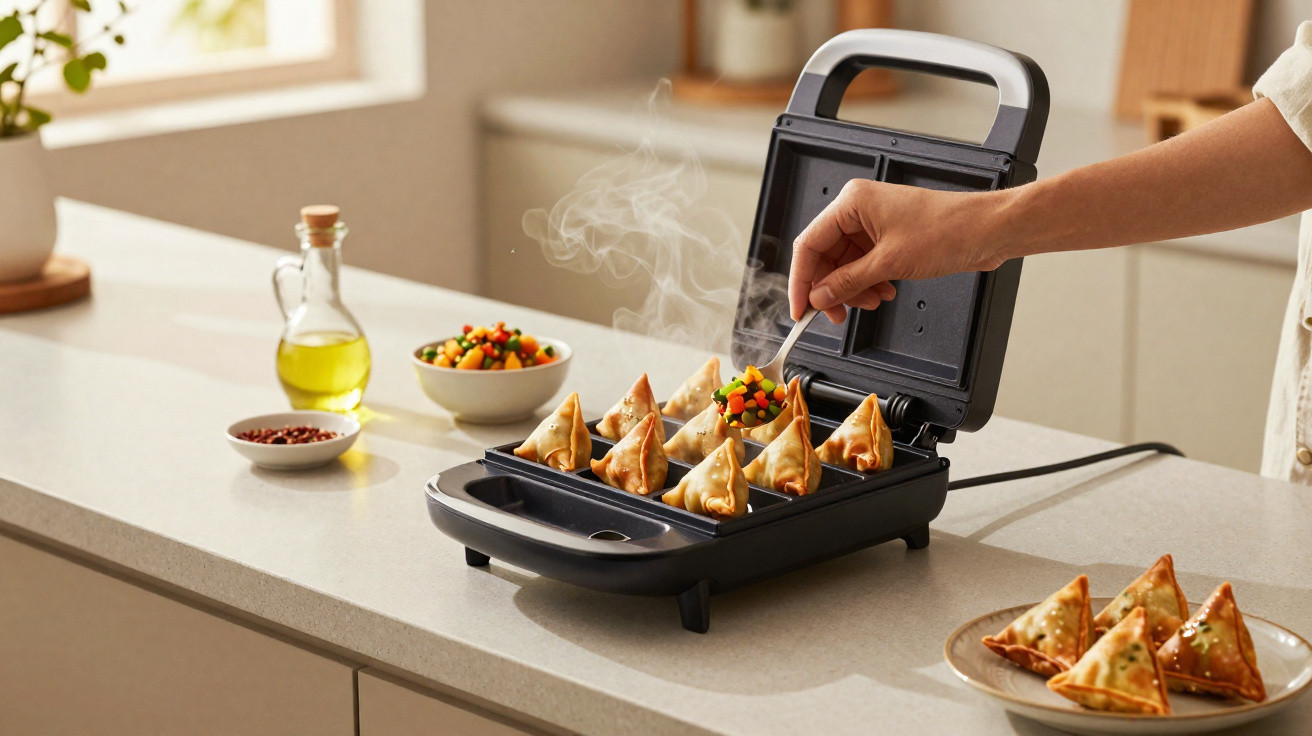
No need to switch on the large oven when unexpected guests arrive: this compact appliance cooks small snacks with almost no fat.
Anyone who enjoys savoury nibbles or sweet treats will know the issue: many small bites take up plenty of room in the oven, need a long cooking time and often cook unevenly. Princess’s dedicated samossa maker is now attracting attention because it can bake up to ten filled pastry parcels and other snacks at once, using virtually no oil and selling for well under €20.
Crispy bites without a hot oven: what the Princess appliance can do
Although it is classed as a small kitchen appliance, it offers considerable capacity. Measuring just 25 x 28 x 8.5 centimetres, it will fit in almost any kitchen, including single-person homes with very limited worktop space. Even so, it can bake as many as ten portions in one go – ideal for a quick television-night snack, an improvised buffet or Sunday brunch.
“The idea: lots of small, crispy snacks at once, without an oven, without a deep fryer, with considerably less fat.”
Its price makes it even more appealing: the Princess appliance currently costs around €17.99, clearly below its original retail price of just over €30. For an electric specialist appliance, that is a price at which many home cooks may ask themselves whether they need it or whether it will become another dust collector.
How the samossa maker works in everyday use
At the centre of the appliance is a baking plate measuring approximately 24.5 x 19 centimetres. Its wells are shaped to hold triangular pastry parcels and seal them neatly around the edges. According to the manufacturer, heat is distributed evenly across the entire surface. This is intended to ensure every portion cooks through and becomes crisp at the same time, without the need for constant turning or rearranging.
The coating is also important: the plate has a non-stick finish, which not only limits burnt food but also reduces the amount of fat required. Those who wish can brush the pastry very lightly with a little oil, although many users apparently do without it altogether.
What else can be baked in it
While the appliance is officially designed for samossas, it is suitable for far more than this single speciality. The mould effectively creates a mini oven with clearly portioned servings. Typical ideas include:
- classic samossas filled with vegetables or minced meat
- small bread- or bread-roll-dough bites, for instance with cheese inside
- sweet mini brioches for breakfast
- small chocolate cakes with a molten centre
- meringue portions that retain their shape
Anyone who enjoys experimenting can also make use of leftovers: remaining Bolognese, spinach with feta or a mushroom pan filling can quickly be wrapped in pastry and turned into a new snack. The firm mould structure prevents anything leaking out, provided the pastry edges are pressed together properly.
Operation: switch on, wait and fill
The controls have deliberately been kept straightforward. Rather than offering numerous buttons, the appliance uses automatic temperature control. It heats up, maintains the right temperature independently and indicates the stages with indicator lights. One lamp shows that power is on, while the other signals the end of the heating-up phase – then it is time to start filling.
The lid features a locking catch. On the one hand, this ensures even pressure is applied to the pastry parcels so that their edges seal neatly. On the other, it prevents accidental opening during baking. The grip area on the lid is thermally insulated, allowing it to be handled without burning your fingers.
“The concept is clearly aimed at users who do not want to fine-tune temperatures: close the lid, keep an eye on the light, and it is done.”
Cleaning and storage: very little effort required
Cleaning is where many specialist appliances fall short. Here, however, the effort remains limited. Once it has cooled, the description says a damp sponge or soft cloth is enough to remove crumbs and grease residue. The non-stick layer prevents stubborn baked-on deposits, as long as the pastry is not overfilled with complete disregard.
It is also practical for smaller kitchens, as the appliance can be stored upright in a cupboard. Its flat shape means it can be tucked between cookbooks or behind a kettle. For people reluctant to buy new appliances simply because there is no room left, this is a relevant advantage.
Who is the Princess samossa maker genuinely worthwhile for?
Not every household needs a samossa maker. It is primarily aimed at people who regularly prepare finger food or enjoy entertaining guests but do not have a huge kitchen. A quick look at typical user groups shows where buying one could pay off:
| Household type | Benefit |
|---|---|
| Singles | Quick snacks without lots of washing up and with minimal space required |
| Couples | Film nights, small tapas gatherings and sweet bites with coffee |
| Families | Child-friendly snacks, using up leftovers and brunch buffets |
| Shared households | Party snacks without a deep fryer, affordable cooking for a group |
On the other hand, anyone who makes pastry parcels or finger food only very occasionally will probably manage perfectly well with a standard baking tray. People whose cupboards are already packed with a waffle maker, sandwich maker and contact grill should also be honest with themselves: will this appliance really be used, or simply added to the collection?
Healthier snacking: less fat, more control
One key advantage is the substantially lower use of oil. Traditional samossas are often cooked in deep-frying oil. That delivers plenty of flavour, but also an enormous calorie count. In the baking appliance, a thin film of oil on the pastry is often sufficient, or no oil at all, depending on the filling and personal taste.
This not only lowers the energy density, but also makes life easier in the kitchen: no splattering fat, no deep-frying smell and no used oil to dispose of. For families with children or people with sensitive stomachs, that can be a decisive benefit.
Everyday practical examples
A typical routine for a quick snack evening could look like this:
- Switch on the appliance and allow it to preheat until the indicator light signals the end of the heating phase.
- In the meantime, prepare the filling, such as a potato and vegetable mix or seasoned minced meat.
- Cut ready-made pastry sheets to size or roll out your own pastry.
- Place the pastry into the moulds, add the filling, press the edges together, close the lid and lock it.
- Check the level of cooking after a few minutes and, if necessary, bake for a little longer.
Those who like to surprise guests can prepare several fillings: one vegetarian, one with meat and one sweet option with apple and cinnamon. This creates a mini buffet without anyone having to remain in the kitchen all the time. The appliance works while people are already eating at the table.
Alternatives and useful additions
Anyone who misses the current discount or generally wants greater flexibility can opt for combination appliances. Some manufacturers offer plate systems with interchangeable inserts, for example for waffles, sandwiches and pastry parcels in one unit. One example available in shops is a Tefal appliance with three different plate sets.
The dedicated samossa machine, by contrast, benefits from its clear specialisation: its shape and heat distribution are designed for small triangles. Anyone who loves this exact format and uses it regularly will usually find a specialist appliance more convenient than an all-in-one system that makes small compromises in every discipline.
It is worth considering safety too. The locking catch and insulated handle noticeably reduce the risk of burnt fingers. Even so, children should be kept away from the hot appliance, and cleaning should only begin once the plate has cooled completely.
Finally, the appliance is appealing for anyone who likes trying international cuisine but does not feel confident about deep-frying authentically. Using ready-made supermarket pastry and a simple vegetable or meat filling, it is possible to make bites in no time that can also be frozen. This gradually builds up a supply of homemade snacks that is ready quickly whenever visitors arrive or a craving strikes.









Comments
No comments yet. Be the first to comment!
Leave a Comment