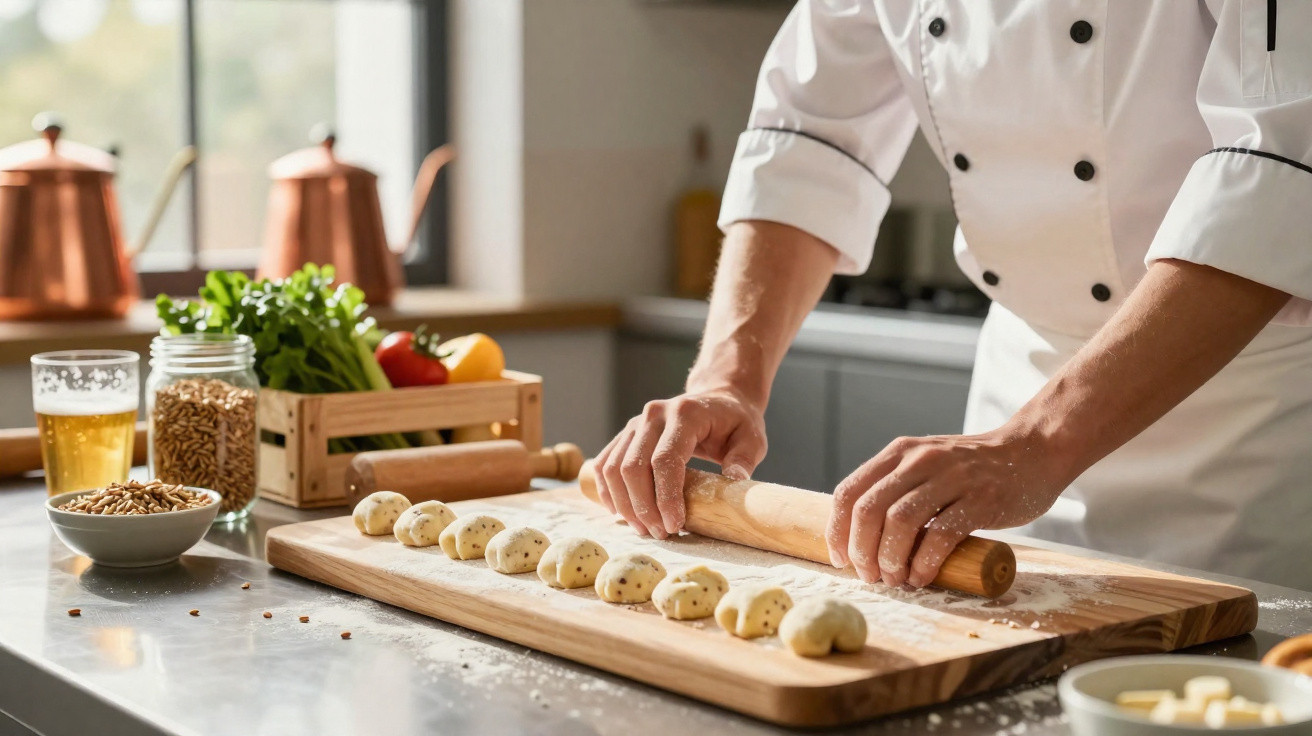
In France, two young founders have turned an apparently bizarre idea into reality: they produce gnocchi from a by-product of beer brewing. Behind this novelty lies a serious concept gaining momentum worldwide: food upcycling. It means transforming leftover food materials into new products of greater value.
What is really behind these ‘waste gnocchi’?
The key ingredient in these innovative gnocchi is not something exotic, but a familiar material for breweries: spent grain. This is what remains of the barley after it has been used up during brewing. Usually, almost all of this residue is used as animal feed.
Two young food entrepreneurs no longer wanted to accept that. Their reasoning was simple: if spent grain is suitable for cows and pigs, why should it not be suitable for people too, once properly processed and refined? They had the dried residue milled into flour and added it to a gnocchi recipe.
A largely overlooked by-product of the beer industry becomes a new food that saves nutrients instead of throwing them away.
Around 12 per cent of the gnocchi mixture consists of this spent-grain flour. As with traditional gnocchi, the remainder is made up of potatoes and conventional flour. This keeps the familiar texture while giving the flavour an extra dimension.
How beer spent grain becomes a food ingredient
Spent grain is produced in every brewery, often in substantial quantities. It is moist, high in fibre and spoils quickly unless it is used promptly. Until now, many breweries have sold it cheaply to farmers. The founders have chosen a different route by professionalising its processing.
The key stages from brewing residue to a gnocchi ingredient
- Collection at the brewery: Fresh spent grain is gathered immediately after brewing, while it is still hygienically sound.
- Drying: The material is carefully dried to make it shelf-stable while retaining as many of its nutrients as possible.
- Milling: The dried material is ground into a fine flour that can be processed easily.
- Recipe development: Baking and culinary professionals test how much spent-grain flour can be incorporated into the dough without spoiling its texture or flavour.
- Production and retail: The finished gnocchi are packaged and sold through organic retailers – in this case, via an organic chain at a price of around €3.40 per pack.
The entire process follows clear hygiene rules equivalent to those applied by other food manufacturers. This is the only way to create a product capable of competing on an ordinary supermarket shelf.
What do gnocchi made with spent-grain flour taste like?
Anyone who immediately associates the word ‘residue’ with musty flavours is mistaken here. Testers describe the gnocchi as having a pleasantly light roasted taste, almost like a delicate bread crust. The potato base remains clearly noticeable, while the spent-grain flour provides more of a background note.
Their texture is very similar to that of conventional gnocchi: soft, with a slight bite, and well suited to either frying or boiling. According to early tastings, the difference is barely detectable when served with a creamy cheese sauce or a simple tomato sauce; many people notice it only after a few mouthfuls, as a subtle nuance.
The remainder from beer brewing gives the dough a nutty, toasted flavour – a small adjustment with a noticeable effect.
For people who are sceptical of anything that even remotely sounds like ‘waste’, a blind tasting may help: try the food first, then hear the story behind it. Initial doubts often turn into enthusiasm.
Saving nutrients instead of wasting them
Spent grain is not worthless sludge, but a concentrated source of fibre and protein. These are precisely the components that are lost when the material is used only as animal feed or even disposed of. By incorporating it into gnocchi, people can now benefit from them too.
What benefits does spent grain bring to gnocchi dough?
- More fibre: It keeps people full for longer and supports regular digestion.
- Additional protein: The protein content rises compared with gnocchi made purely from potatoes.
- Less waste: Every bag of gnocchi keeps part of a product in circulation that would otherwise be largely overlooked.
- More conscious consumption: The example shows shoppers that resources can be handled differently.
Enormous quantities of edible or reusable food components end up in the bin across Europe. Food upcycling aims to counteract this through clever recipes, new processing methods and appealing products that customers willingly place in their shopping baskets.
Upcycling extends far beyond food
The idea of adding value to residual materials has so far been more familiar in the lifestyle sector. Old sails are turned into rucksacks or laptop bags, while worn bicycle tyres become belts. The underlying principle is unchanged: a product considered ‘finished’ receives a second life – ideally at a higher price and with more attention than before.
This way of thinking has been less common in food. The reasons include strict hygiene requirements, complex approvals and the often narrow margins of traditional food products. Spent-grain gnocchi demonstrate that the effort can still be worthwhile when a business specifically targets an interested, environmentally conscious audience.
Upcycling turns guilt about waste into a selling point – and residual materials into stories people are happy to share.
Where products like these could appear in future
Anyone now looking for ‘hidden treasures’ in their own kitchen cupboards is not entirely wrong. Many industries are already examining how by-products can be put to better use. Possibilities include:
- coffee grounds as a base for baked goods with a light coffee flavour
- citrus peel for flavoured salts or sugars
- rice and oat bran for cereal bars with a higher fibre content
- pressed fruit residue from juice production as an ingredient in snacks or biscuits
Spent-grain gnocchi could therefore be only the start of an entire wave of upcycled foods. The better these products taste, and the less they appear to involve ‘doing without’, the greater their market potential will be.
Opportunities and risks for consumers
With innovations of this kind, shoppers quickly ask: is it safe? As always, the answer depends on the specific implementation. Reputable manufacturers work with clearly defined supply chains, laboratory analyses and fixed quality standards. Spent grain from a brewery already producing food is fundamentally well suited to this approach.
Another issue concerns potential intolerances. Anyone who reacts to gluten should check products made from grain residues carefully, because barley, wheat and similar grains remain gluten-containing despite being upcycled. Suppliers must make this clear. The situation is different with fruit or vegetable leftovers, where this issue often does not arise.
For many people, the benefits outweigh the drawbacks: less waste, new flavour experiences and a slightly clearer conscience when shopping. Those wishing to make their diet more conscious can find an interesting addition in such products without having to give up familiar habits radically.
What consumers can learn from the gnocchi example
Perhaps the most important effect of this gnocchi story takes place in people’s minds. Suddenly, the term ‘food waste’ no longer seems to mean only something that smells unpleasant and needs to be thrown away, but a raw material with potential. Anyone who starts wondering where leftovers might be hidden during their next shop automatically thinks more critically about waste.
Ideas from food upcycling can also be adopted on a smaller scale at home. Stale bread becomes crunchy croutons, vegetable leaves go into soup rather than the food-waste bin, and overripe bananas make a quick cake. This is where an industrial project and a home kitchen meet: both aim to make more from what is already available.
Gnocchi made with spent-grain flour show how this principle can be translated into a modern product that is ready for the market. They offer an example for other start-ups as well as major manufacturers to follow. And they prove that ‘waste’ is sometimes simply another word for a resource that nobody has yet taken seriously.

















Comments
No comments yet. Be the first to comment!
Leave a Comment