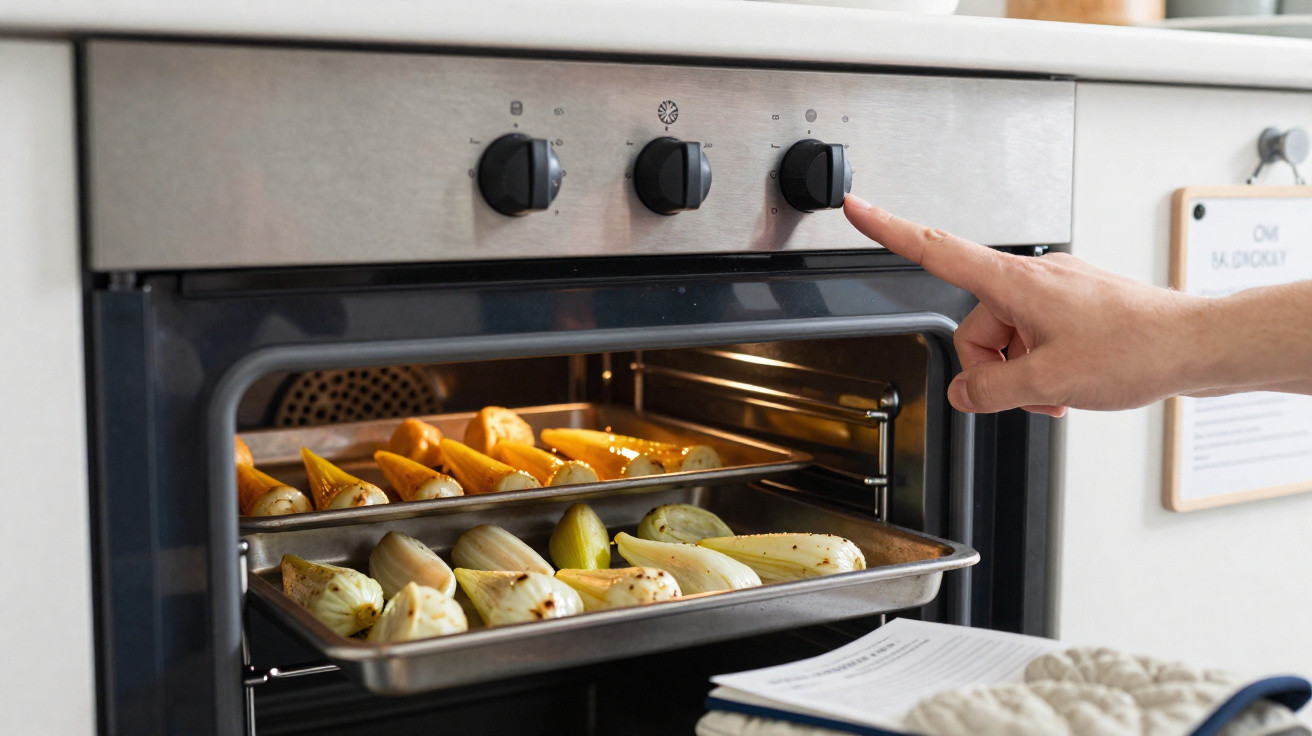
That small fan on the oven dial can make a surprising difference to dinner. Use the wrong setting and a cake may colour before it rises, chips may dry out, or a pie may have a pale base and an overdone top.
The key point is that a fan symbol does not always mean one single thing. Look for the circle, bars or grill marks around it: these usually show which heating element is on, while the fan moves heat around the oven. Your appliance manual is the final authority, but knowing the common symbols makes the dial far less mysterious.
Why oven fan symbols are easy to misread
Many people refer to every fan setting as a “fan oven”. Manufacturers, however, use fan-shaped symbols for several different functions. The number of fan blades is not important; the lines and markings surrounding the fan are.
The most common interpretations are:
- Fan inside a circle: usually a fan oven with a circular heating element at the rear.
- Fan with top and bottom bars: fan-assisted conventional heat, using elements above and below the cavity.
- Fan with a grill mark at the top: fan grilling.
- Fan on its own: often fan-only or defrost mode, though this varies by model.
- Top and bottom bars without a fan: conventional oven heat.
The circle around a fan normally represents the heating element positioned behind the rear panel of the oven.
Do not choose a function solely from a generic online chart, particularly if your symbol has extra lines or dots. Find the model number, usually around the door frame, and check the manufacturer’s instruction manual or support page.
Fan in a circle: the setting most people mean by “fan oven”
A fan enclosed by a complete circle is commonly the main fan-oven setting. The rear element heats the air and the fan distributes it around the cavity.
It is a practical choice for everyday cooking, including:
- roast potatoes and vegetables;
- oven chips, fish fingers and freezer foods;
- biscuits baked on more than one shelf;
- traybakes and many sponge cakes;
- reheating food in ovenproof dishes.
Because heat is circulated, the oven often feels more even than conventional top-and-bottom heat. It is not perfectly uniform, though. Food at the back or on the upper shelf can still brown more quickly, especially in a full oven. Turn trays or swap shelves where a recipe calls for an even finish.
UK recipes commonly give temperatures in the format 200°C/180°C fan/Gas 6. If a recipe gives only a conventional temperature, reducing it by about 20°C is a useful starting point for a fan oven. It is a rule of thumb rather than a guarantee: ovens vary, and food should be checked towards the end of the stated cooking time.
A plain fan may not be a cooking setting
A fan without a circle is one of the symbols most likely to cause mistakes. On many ovens it indicates fan-only operation, which can be used for defrosting because it circulates unheated air. On other models, it may have a different function.
Fan-assisted conventional cooking is more often shown by a fan alongside a line at the top and another at the bottom. That setting combines air movement with heat from the upper and lower elements. It can suit dishes that need a browned top and a well-cooked base, such as gratins, pies and some bakes.
Check a fan-only symbol before using it
- Locate the appliance model number on the door frame, inside the door or in the paperwork.
- Download the official instruction manual for that exact model.
- Compare the dial icon with the function chart in the manual.
- Check whether the function provides heat, fan-only airflow, or both.
If your oven has a fan-only defrost programme, use it only as the manual directs. For most foods, defrosting in the fridge is the safer option because it keeps food at a lower temperature. If food is defrosted in a microwave, cook it straight away. Follow the storage and cooking instructions on the packet, particularly for meat, fish and ready meals.
When conventional heat is the better choice
The symbol with one horizontal bar at the top and one at the bottom normally means conventional heat. There is no fan, so heat comes directly from the upper and lower elements.
This is not an inferior setting. The stiller air can be useful for delicate bakes where a fan may form a crust too quickly or cause uneven rising. Depending on the recipe and oven, conventional heat can work well for:
- soufflés and baked custards;
- cheesecakes;
- rich fruit cakes;
- bread and pastries where the recipe specifies conventional heat;
- dishes cooked on one central shelf.
Conventional ovens usually have more noticeable hot and cool spots. A central shelf is often sensible for cakes, and trays on separate shelves may need rotating during cooking.
Fan cooking is versatile, but the best setting is the one the recipe and the food actually need.
Other oven symbols worth recognising
Knowing the symbols around the fan can prevent accidental use of the grill or an element intended only for crisping a base.
Grill
A jagged line, a row of triangles or a thick bar at the top of the oven square generally means grill heat. It directs intense heat downwards for toast, cheese toppings and browning a dish.
Stay nearby while grilling. Food can burn quickly, and fat may spit from sausages, bacon or chops. Use a suitable tray and keep the oven door in the position specified by your appliance manual.
Fan grill
A fan shown with a grill mark normally means fan grilling. The fan helps heat reach thicker food more evenly while the grill browns the outside. It can be useful for chops, sausages and small cuts of meat, but it still needs close attention.
Bottom heat
One bar at the bottom generally means the lower element only. It may help crisp the base of a pizza, quiche or pastry case. It is usually a finishing function rather than the right setting for cooking a complete meal from start to finish.
Oven light
A bulb symbol often turns on the oven light without activating heat. This can help you inspect a bake without opening the door, although the exact operation differs between appliances.
Do you need to preheat a fan oven?
Preheating matters when timing and initial heat affect the result. It is usually worth doing for cakes, pastry, pizza, Yorkshire puddings and foods with instructions that state a preheated oven.
For roast vegetables, a weekday traybake or reheating leftovers, starting with a cold oven can be workable if you allow extra time and judge the food by its appearance and internal heat rather than the clock alone.
A fan oven may reach temperature quickly, but that does not automatically mean preheating can be skipped. Follow the recipe, packet instructions and your oven manual where they give specific guidance.
Common mistakes with fan settings
- Assuming every fan icon means fan-oven cooking. A plain fan may be fan-only or defrost.
- Using a conventional temperature in fan mode. Food may cook or brown faster than expected.
- Overfilling the oven. Air needs space to move around trays and dishes.
- Pushing trays against the rear panel. This can restrict airflow and cause uneven cooking.
- Opening the door repeatedly. The temperature drop is particularly unhelpful for cakes and Yorkshire puddings.
- Leaving grill food unattended. Grill and fan-grill settings can scorch food quickly.
- Using a defrost function as though it cooks food. Fan-only programmes may provide no heat at all.
Safer ways to get better results
Use dry oven gloves when handling shelves, trays and casserole dishes, and put hot cookware on a heatproof surface. Secure loose baking paper under food or a tray edge: airflow can lift it towards an exposed grill element, where it may scorch.
Clean built-up grease regularly, especially before grilling. Follow the appliance instructions for cleaning and ventilation. Never mix household cleaning chemicals: in particular, do not mix bleach with acidic products, limescale removers or ammonia-based cleaners.
An oven thermometer can be helpful if food repeatedly cooks too fast or too slowly. It cannot diagnose an appliance fault, but it can indicate whether the cavity temperature is broadly in line with the selected setting. If you suspect an electrical fault, stop using the oven and contact a suitably qualified appliance engineer.
Make the oven dial work for you
For everyday trays of food, the fan inside a circle is usually the most useful starting point. Choose conventional heat when a recipe asks for a gentler, stiller oven, and reserve fan grilling for foods that need browning under close supervision.
Take a clear photo of your own dial, match each symbol to the manual and keep the key functions in mind. That small bit of homework can prevent a burnt topping, an undercooked centre and plenty of guesswork at teatime.

















Comments
No comments yet. Be the first to comment!
Leave a Comment