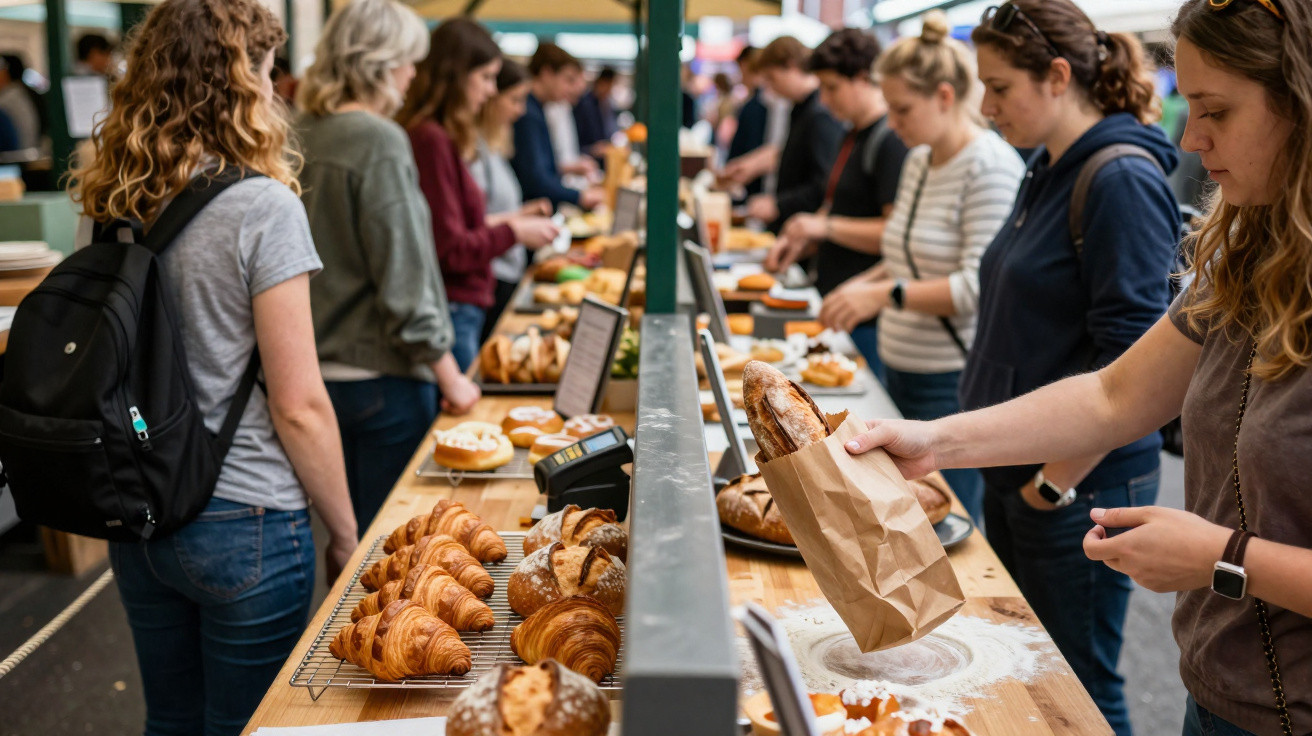
A queue outside a bakery can be a welcome sign: the pastries are good, word has travelled and customers are prepared to wait. In a busy shared market, though, a popular counter can also create blocked walkways, pressure around entrances and a less pleasant visit for everyone else.
That is the tension behind the idea that a bakery might outgrow its pitch. It is not necessarily a sign that the business has done anything wrong. It can simply mean that demand, the available space and the needs of a crowded market no longer fit comfortably together.
Why queues matter in a busy market
Borough Market is both a food-shopping destination and a working market, with visitors browsing, buying lunch, collecting ingredients and moving between independent traders. Its appeal depends partly on being lively, but visitors still need enough room to pass safely.
A line that runs neatly beside a counter is very different from one that spills across an entrance, obscures a neighbouring stall or creates a bottleneck in a narrow passage. At busy times, a few metres of lost space can affect how people move through the surrounding area.
Market operators may need to consider practical issues including:
- keeping emergency access routes clear;
- allowing space for wheelchair users, pushchairs and people carrying shopping;
- avoiding obstruction to neighbouring pitches;
- maintaining access for deliveries, cleaning and stock movement;
- reducing the risk of trips, collisions and frustration in a crowd.
A queue may show strong demand, but it also uses space that belongs to the whole market.
The same challenge can arise at street-food events, farmers’ markets, station kiosks and high streets with narrow pavements. A successful trader benefits from attention, but the venue must also work for other businesses and visitors.
What “too successful” may actually mean
The phrase can sound like criticism, but it does not have to be. Often, it means that the original setup no longer suits the scale or pattern of demand.
A bakery can be especially difficult to manage at peak periods. Fresh products may be released at set times, customers may want the same limited items, and payment and packing can take longer than a simple grab-and-go purchase. A small counter with limited staff can quickly become overwhelmed.
There may also be practical limits on what a compact pitch can accommodate, such as:
- sufficient storage for ingredients and finished products;
- enough staff space to serve customers efficiently;
- a separate point for collecting pre-orders;
- clear queue management without blocking a route;
- room to restock safely during trading.
Market agreements commonly cover matters such as opening hours, deliveries, use of shared areas and stall presentation. The exact arrangements vary between traders and venues. Unless both the operator and the business have explained a particular move, it is best not to speculate about why a trader has left or changed location.
The effect on neighbouring traders
A popular bakery can bring more people into a market, which may help nearby businesses. But that benefit is not automatic if customers cannot easily reach the surrounding stalls.
A long line can hide a greengrocer’s display, make it awkward to enter a cheesemonger’s shop or discourage visitors from browsing further along a crowded passage. Smaller traders often depend on people noticing something appealing while they are already walking through the market.
There is a practical side, too. Food businesses need room for routine work: receiving stock, removing waste, cleaning surfaces and moving equipment. Congestion can turn ordinary jobs into difficult ones, particularly where space is already limited.
A market may therefore work with a popular trader on solutions such as a revised layout, timed collections, a different pitch or limits on where customers wait. A larger unit, a separate shopfront or an off-site production kitchen may also give a bakery more capacity without turning every busy period into a bottleneck.
How a bakery can manage demand
Independent bakeries are valued for their fresh trays, seasonal bakes and small-scale character. Managing queues does not have to mean losing those qualities.
1. Make the customer flow obvious
Where the space permits, customers should be able to see the range before joining one clear queue to pay. A concise menu or product list placed before the counter can reduce delays caused by last-minute decisions.
Barriers, floor markings or a member of staff directing the line may help, but only if they do not create a new obstruction or block access to another trader.
2. Give pre-orders a separate collection route
Pre-orders can be useful for popular loaves, weekend bakes and larger orders. A timed collection slot or a separate collection point can prevent customers who have already paid from waiting through the main queue.
The arrangement needs to be realistic. A collection point that opens directly into a crowded passage can create as much congestion as the original line.
3. Spread releases through the day
Putting selected products out at intervals may help spread demand, rather than attracting everyone at one moment. It will not remove queues entirely, particularly for limited items, but it can make the rush more manageable.
Availability should be communicated honestly. If an item is sold out, it is better to say so clearly than encourage people to wait without knowing whether they will be served.
4. Simplify the busiest service periods
An extensive menu can slow service when the counter is under pressure. A tighter peak-time selection may help staff work safely and consistently, while a broader range can remain available at quieter times.
5. Build accessibility into the plan
Customers using mobility aids, people with pushchairs and those unable to stand for long should not be expected to force their way around a crowd. Traders should follow the venue’s access arrangements and speak to market staff if the queue is becoming difficult to manage.
The best queue is not the longest one. It is the one that moves safely and leaves space for everybody else.
What customers can do on a busy visit
Customers are not responsible for crowd control, but a few choices can make a market easier for everyone to use.
If possible, consider visiting outside the busiest periods. Weekday mornings or mid-afternoons can be quieter than Saturday lunchtime, although trading days and opening times should always be checked before setting off.
Use the marked queue rather than starting a second line close to the counter. Choose what you want before reaching the front, keep bags and pushchairs close, and avoid stopping in a passage to take photographs or compare purchases. If you are meeting friends, arrange to do so away from a trading entrance.
Small-batch businesses can sell out, especially when baking requires proofing, cooling and careful preparation. Courtesy matters when an item has gone: staff may not be able to produce another batch immediately, however long people have travelled.
Common mistakes when judging a trader’s departure
Online discussion can turn a business move into a simple story of success, failure or blame. In reality, shared markets involve many practical considerations.
Assuming a move means the bakery has failed. A trader may need more space, different trading hours or a location better suited to production and deliveries.
Assuming a market is against successful businesses. Successful traders attract customers, but market operators must also consider access, safety and the needs of neighbouring businesses.
Treating one crowded day as proof of a permanent problem. Weather, school holidays, social-media attention and a limited product release can all create an unusually busy period.
Overlooking neighbouring stalls. A viral counter may bring visitors in, but a market remains varied only if people can reach and support other traders.
Repeating unconfirmed explanations online. Unless the trader and venue have publicly set out the reasons for a change, the full picture may not be known.
Food and crowd safety come first
Busy bakery counters involve food handling, hot trays, heavy deliveries and sometimes sharp equipment. Customers should not lean over displays, touch unpackaged goods or crowd staff working near service and preparation areas.
Traders should not let a long queue lead to rushed food handling, poor cleaning practices or unclear allergen information. Anyone with an allergy should ask staff directly about ingredients and cross-contact risks rather than relying on assumptions.
Venue staff may need to intervene if an exit, entrance or access route becomes obstructed. That can be disappointing for people waiting for a particular bake, but clear routes are the sensible priority.
A successful bakery needs room to breathe
Borough Market’s attraction lies in its mix of bakeries, produce stalls, specialist food shops and places to eat. For that variety to work, the physical space must work as well.
When demand becomes too great for a small pitch to handle comfortably, the answer is not always a longer queue. Better service design, sensible pre-order systems, more space or a different location may allow a bakery to grow while protecting the experience around it.
For shoppers, the useful approach is to plan ahead, be patient and leave room for others. For a food business, a queue can be proof that something is going right - but the next stage of success is making that demand safe, fair and manageable.

















Comments
No comments yet. Be the first to comment!
Leave a Comment