For a moment, it seems as though things are going well. Then you stir the rice and notice it: dense, sticky and gathering round the spoon like soggy papier-mâché. You wanted light, separate grains. Instead, you have canteen-style mush.
You prod it, wishing it might somehow “dry out”. It will not. Your meal already feels like a compromise. Perhaps you smother it in sauce, quietly fault the rice brand, or decide your hob must be too fierce. Deep down, you wonder why every recipe displays immaculate, snow-white grains while your saucepan resembles a paste.
Here is the awkward fact those 30-second TikTok recipes never mention.
Why unrinsed rice becomes gummy and oddly sticky
Stand by the rice section in any supermarket and the unspoken uncertainty is almost audible. Long-grain, short-grain, jasmine, basmati, easy-cook, microwave pouches. Hardly any packet announces: “Rinse me unless you enjoy glue.” So, most of us simply tip it in, boil it and hope.
Rice appears clean and nearly glossy when it comes out of the bag. It seems plain, safe and reliable. That can make washing it feel unnecessarily fussy or old-fashioned, like something your grandmother did. But those harmless-looking grains carry a fine layer of loose starch on their surface, ready to make your pan unpleasantly sticky.
The trouble begins there, at a microscopic scale, well before the water reaches the boil.
Imagine a cup of uncooked rice as countless miniature chalk sticks coated with fine dust. Once the rice meets water and heat, that starch on the surface blooms. It expands, melts into the water and disperses through the pan. The water is no longer simply water: it becomes a starchy liquid that thickens as it warms.
That starchy liquid works as glue. Rather than letting grains remain light and distinct, it fills the spaces between them and binds them into clumps. That is why your spoon lifts a damp cake of rice rather than a tumble of individual grains. Microscopically, each grain has been coated in a starch sauce.
Rinsing rice is not mystical or especially “chefy”. It simply removes the powder before it can become paste in your saucepan.
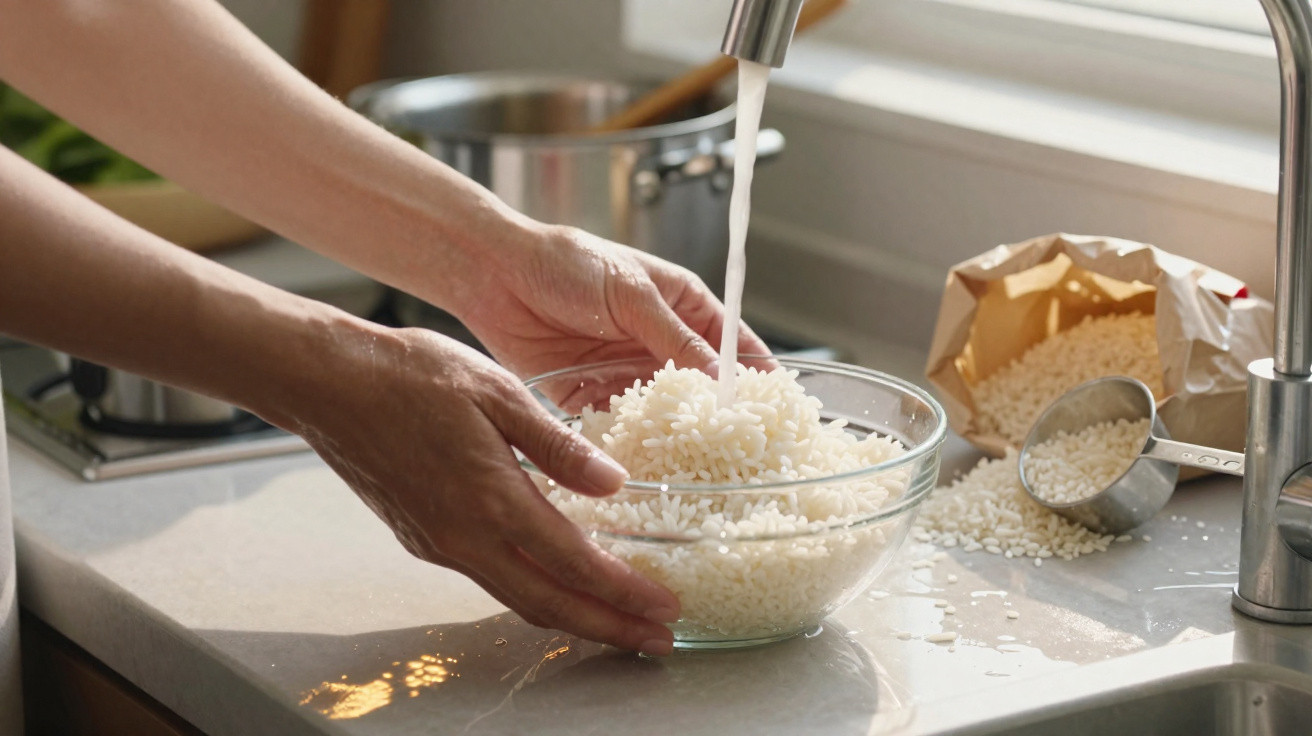
The visual difference can be remarkably obvious. Put rice and water into a bowl, then swirl it once. The water quickly turns cloudy, almost like milk. That haze is surface starch. Keep replacing the water and it will gradually look clearer. You can literally see tomorrow’s stickiness being washed away.
Home cooks who begin rinsing often spot a change almost immediately. With the same rice, saucepan and amount of water, the grains suddenly cling together less. The rice no longer lands in a weighty heap on the plate. It spreads and shifts, with a little spring to it. It is the gap between “that will do” and “oh, wow, I made that?”.
Food scientists have made this point for years: surface starch has a direct effect on texture. Rinse the rice and remove the surplus; miss that step and you are cooking with your own glue.
How to rinse rice properly without making it a chore
Here is the straightforward method you can remember on a Tuesday evening. Tip the rice into a bowl, add plenty of cold water, then use your hand as a paddle. Stir, rub and swirl the grains. The water will become cloudy quickly. Pour it away, then repeat until it is largely clear - normally after three to five changes.
If a sieve is more your style, place it in the sink, add the rice and run cold water over it as you gently rub the grains between your fingers. Treat it as loosening dust from tiny stones, rather than scrubbing. Once the water draining away is almost clear, you are finished. Leave the rice to drain for a minute before cooking it as usual.
That is it. You do not need elaborate routines or a timer: only water, a bowl and your hand.
This is where the divide appears between what people have heard and what they really do at home. Plenty of people have seen “rinse your rice” mentioned on social media. But after a long day, skipping one extra step is tempting. Let’s be honest: nobody really does it every day.
The answer is to build it into your routine rather than treat it as another job. Begin rinsing while your frying pan heats up. Swirl the grains as you clear a little worktop space. It becomes a background task instead of a major undertaking. Once you notice the result on your fork, returning to gummy rice is difficult.
On a difficult day, sticky clumps of rice can feel like yet another small defeat. On a good one, a bowl of fluffy, fragrant grains feels like a quiet success. It may be small, but you can taste it.
“The first time I rinsed my rice properly, I thought I’d changed brands by accident. Same bag. Same pot. Just less starch.”
There are several familiar mistakes to avoid. Rinsing with hot water starts cooking the outsides of the grains prematurely. Holding them under the tap for half a second does not give the starch time to come away. And soaking for an hour without changing the cooking time can put you back in mush territory, even if the rice was rinsed.
- Choose cold rather than warm water.
- Rinse until the water is mostly clear, not completely transparent.
- Drain thoroughly before cooking, so extra water does not quietly end up in the saucepan.
Rinsing rice as a small act of care and better flavour
When you make a point of rinsing rice, something subtle changes. The process makes you stop for a minute. Your hands are in cool water, grains pass through your fingers and cloudy water swirls away. It is practical, yet oddly grounding. You connect with your food before heat changes it.
As well as improving texture, it can alter flavour. Once the heavy starch has gone, fragrant varieties such as jasmine and basmati smell brighter and cleaner. The grains steam rather than stew. Fried rice is less likely to turn sticky in the pan. Sushi rice clumps when you intend it to, rather than because it is swimming in unnecessary paste. One brief rinse changes the behaviour of the whole dish.
At a deeper level, rinsing quietly connects you to kitchens throughout Asia, the Middle East and Latin America, where it is not a trend but an instinctive step. Generations had their own reasons for doing it long before terms such as “surface starch” and “texture profile” existed.
| Key point | Detail | Why it matters to the reader |
|---|---|---|
| Rinsing removes excess starch | A few washes in cold water remove the powdery coating around the grains | Achieve lighter, less sticky rice without switching brands |
| Rinsing is better than overcooking | Most disappointing rice results from starch, not solely from cooking time | Feel less stressed in the kitchen and get more consistent results |
| A simple action, a major difference | Just 30 to 60 seconds is needed before cooking | Improve everyday dishes without complicated recipes |

















Comments
No comments yet. Be the first to comment!
Leave a Comment