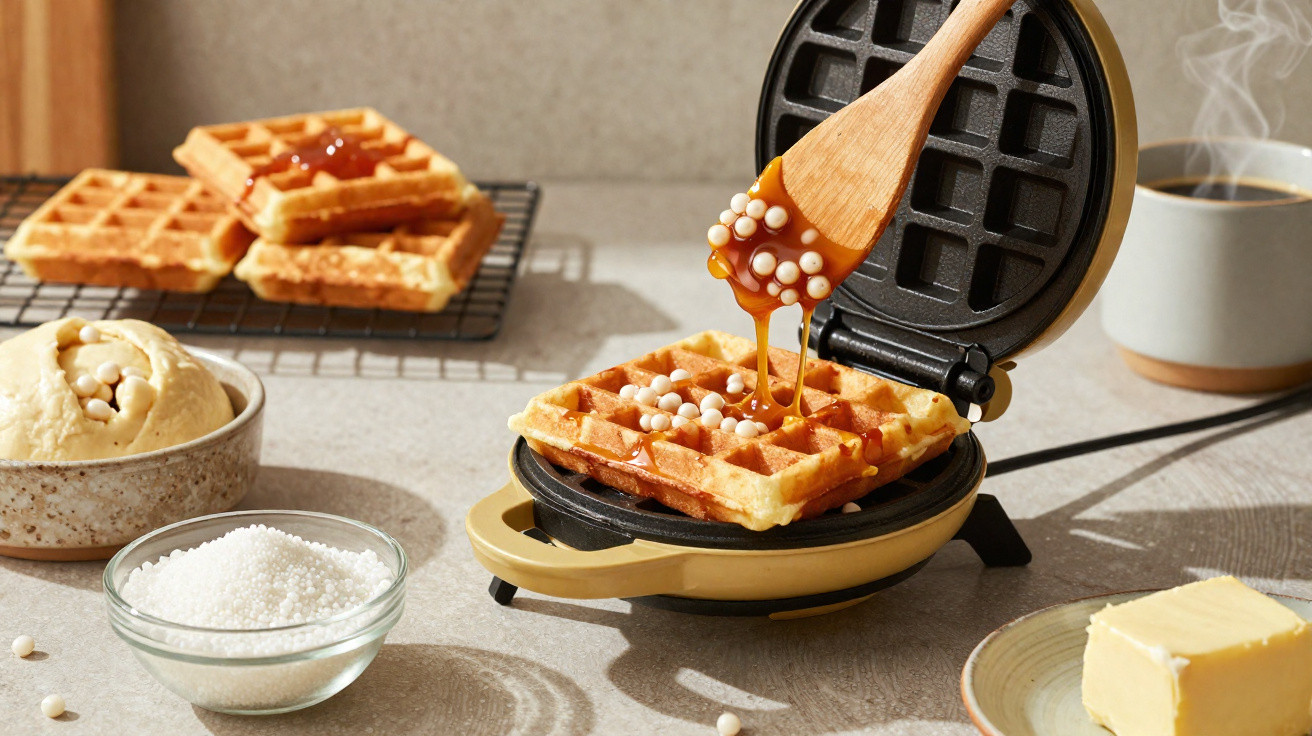
A Belgian trick delivers caramel crunch rather than rubbery waffles.
Many home bakers know the situation: the smell is wonderful and the appearance is reasonably good, but the first bite disappoints. The waffle feels more like a thick pancake, turns soft quickly and bears little resemblance to the crisp, caramelised treat sold from Belgian street stalls. A traditional technique from Liège addresses exactly this, using a special dough and one crucial stage.
Why homemade waffles usually turn soft
The underlying issue starts with the batter itself. Many people follow a recipe that is essentially a thicker pancake batter: runny, mixed together in moments and ladled straight into the iron. It works, but the resulting waffle lacks both flavour depth and texture.
“A typical Liège waffle is not made from a liquid batter, but from a light yeast dough – similar to brioche.”
That dough is what changes everything. It holds its shape more effectively, develops greater flavour through the yeast and creates a soft, fibrous crumb inside, while forming a firm caramelised crust outside. This contrast of a tender middle and a crackling exterior is what most standard recipes lack.
The foundation: rich yeast dough instead of thin waffle batter
To get closer to the original Liège version, it helps to consider how the dough is built. Its key ingredients are more familiar from bakery baking than from pancake making.
Typical ingredients for Liège waffles
- Wheat flour with good baking properties
- Fresh yeast or good-quality dried yeast
- Lukewarm milk for the liquid
- Eggs for colour and binding
- Plenty of soft butter for the brioche effect
- A touch of vanilla sugar and a little salt
- And, most importantly, coarse pearl sugar
The method closely resembles traditional yeast baking. First, activate the yeast in lukewarm milk, then work it with the flour, eggs and sugar into a smooth dough. Next, incorporate the soft but not melted butter until the dough pulls away from the bowl. This gives it elasticity and prevents it from spreading out in the waffle iron later.
No flavour without patience
Anyone who thinks the job is done after ten minutes is undermining their own result. The dough needs time to rest: at least two hours at room temperature, covered with a cloth, until it has increased noticeably in volume. During that time, subtle yeast flavours develop, the crumb becomes airy and the structure gains stability.
“Resting yeast dough is like a slowly rising plaited loaf – only in waffle form.”
This stage stops the waffles from becoming dense and cake-like. Instead, small strands and air pockets form, making every bite far more enjoyable.
The Belgian trick: when to add pearl sugar to the dough
The decisive point comes after the first rest rather than at the beginning. This is where many people go wrong: they add the sugar to the dough with all the other ingredients. It seems sensible, but it ruins the desired effect.
“The trick: work in pearl sugar only after the dough has rested for the first time – shortly before shaping the dough pieces.”
Once the dough has risen, gently press out the air, bring it back into a compact mass and then knead in the coarse sugar pieces. They should be much larger than ordinary granulated sugar, more like small pellets than crystals.
Why add it so late? If the sugar were kneaded in from the start, it would largely dissolve in the moist dough. The characteristic crunchy pockets of caramel would never develop. Adding it later keeps many pieces intact, leaving them dotted through the dough like small time-release capsules.
How the caramel magic happens in the waffle iron
When the dough bakes in a thoroughly preheated waffle iron, two things happen at once:
- Sugar pieces at the surface melt against the hot plates, spread slightly and caramelise.
- Pieces inside the dough remain partly solid, creating crisp spots throughout the crumb.
This pairing produces the famous glossy, slightly uneven crust, which hardens as it cools without shattering like glass. It is difficult to recreate with ordinary granulated or icing sugar, as both are too fine and disappear far too quickly.
How to bake Liège waffles in a waffle iron
After the sugar has been incorporated, divide the dough into portions, usually between 70 and 80 grams each. Shape these into small balls and allow them to relax for another 10 to 15 minutes. Meanwhile, heat the waffle iron thoroughly.
“High heat is essential: around 180 to 200 degrees provides the caramel shock.”
Place a dough ball in the centre of the iron and close it immediately. The heat melts the butter, activates the remaining yeast and caramelises the sugar. Baking time depends on the appliance, although a few minutes is generally enough. The ideal result is golden brown, with clearly visible caramelised patches.
Mistakes that ruin the crunch
- Too little heat: the sugar melts but does not caramelise properly, leaving the waffle pale.
- Too much dough: it spills out, the edges burn and the centre remains doughy.
- Opening too soon: the structure tears and dough sticks to the iron.
If you have never pushed your waffle iron to its limits, take it gradually and treat the first batch as a trial run. After that, you will usually know precisely which amount of dough and baking time suit your own appliance.
How to keep waffles crisp
Once the first batch is ready, another trap awaits, and it often leads straight back to soft waffles. Many people stack the hot waffles to save space or keep them warm. Condensation then forms between them and softens the crust.
“Always cool waffles side by side on a rack, never in a stack.”
A simple wire cooling rack is entirely sufficient. Air can circulate, the surface sugar sets and the butter inside settles back into place. This creates the characteristic bite: crisp outside and fluffy within.
For the following day, a toaster is more suitable than a microwave. A brief re-crisping brings the caramel back into shape and loosens the fat in the dough without destroying its structure. A few minutes in a hot oven also work well when several waffles need reheating at once.
What pearl sugar is – and what can replace it
Pearl sugar is essentially very coarsely compressed sugar broken into small chunks. It melts more slowly than ordinary granulated sugar and retains its shape for longer. If you cannot find pearl sugar in the supermarket, there is room for a little improvisation.
- Crush sugar cubes into coarse pieces.
- Use very coarse sugar nibs.
- Do not grind it too finely; break it rather than pulverising it.
The result will not be completely identical, but it comes far closer to the original than standard granulated sugar. The grain size is crucial: the larger the pieces, the more pronounced the caramel pockets.
What pairs best with a Liège waffle
The classic version is eaten plain, straight from the hand. With its generous butter and sugar content, it feels almost like a pastry in its own right rather than a neutral base. If you still want to add something, choose carefully:
- Dark chocolate highlights the bitter notes of the caramelised sugar.
- A spoonful of lightly sweetened whipped cream softens the sweetness and adds freshness.
- Tart berries provide contrast to the buttery dough.
Very sweet toppings, such as sweetened caramel or thick syrups, can quickly become excessive. They are still often chosen to make children happy – the waffle can handle them flavour-wise, but loses some of its balance.
Why the extra effort is worthwhile
At first glance, this method seems more involved than making a quick waffle batter. However, the yeast dough is easy to prepare ahead, and can even rise overnight in the fridge. The following day, only the sugar and the heat need to do their work.
Once you understand how profoundly the late addition of pearl sugar changes the outcome, you start to see waffles differently. A simple snack becomes a small pastry somewhere between brioche, a caramel sweet and a street-bakery treat – while also explaining why the Belgian originals so rarely go soft.

















Comments
No comments yet. Be the first to comment!
Leave a Comment