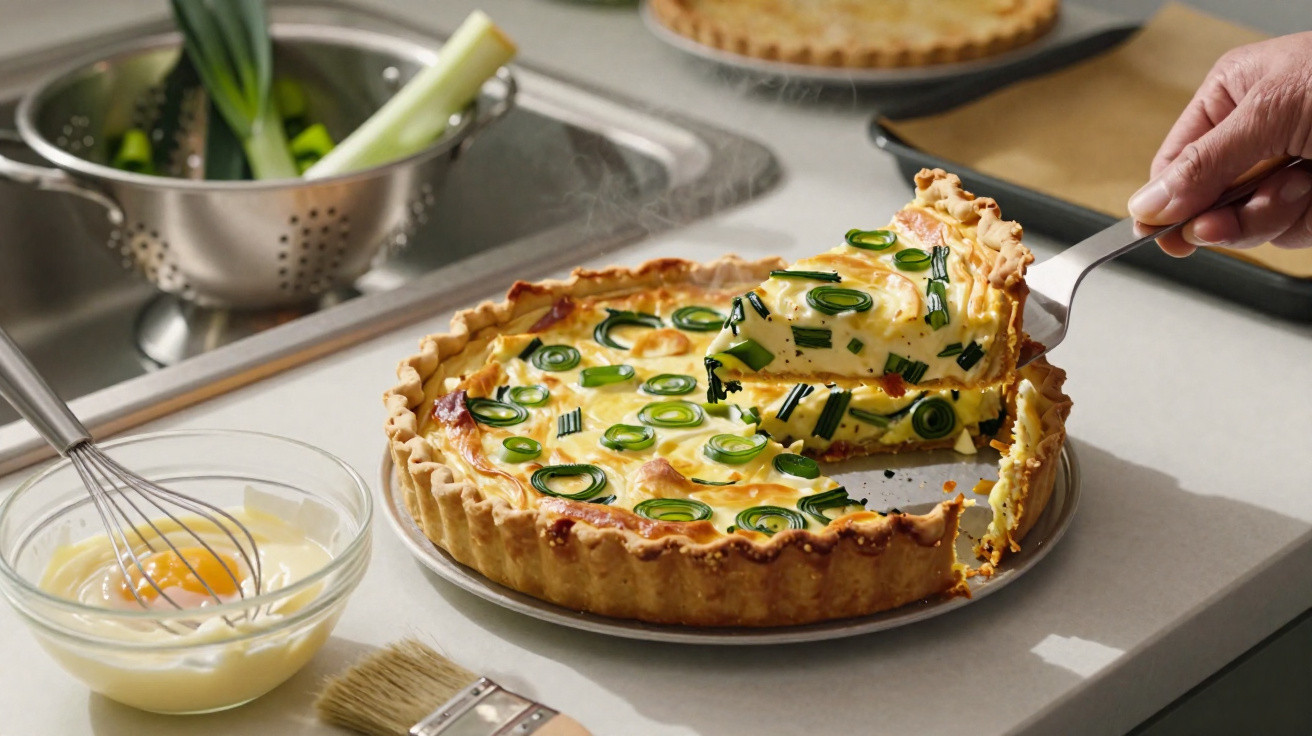
What goes wrong with leek quiche?
Many home cooks know this exact situation: the quiche looks as though it has come straight from a cookbook, yet the pastry sticks to the knife when it is cut. Rather than crisp, the base is soft, damp and somehow undercooked. The reason is almost never the oven or the tin, but one common preparation mistake – especially when leeks are involved.
Why leek quiche pastry often turns soggy
Leeks are an excellent winter vegetable: flavoursome, gently sweet and ideal for savoury bakes. That is also where the difficulty lies. Leeks are made up of around 90 per cent water. When heated, their cells burst, releasing liquid straight onto delicate shortcrust pastry.
Many people follow this approach: soften the leeks in butter, cook them until tender, spread them immediately over raw pastry, pour over an egg-and-cream mixture and put everything in the oven. It sounds sensible, but it undermines the quiche's texture.
“The combination of extremely water-rich leeks and unprotected, cold pastry prevents thorough baking – leaving the base soggy.”
Putting very hot leeks onto ice-cold pastry straight from the fridge also creates condensation. That moisture gathers exactly where the pastry ought to become crisp. Even at 180 degrees, the starch in the pastry then has little opportunity to cook properly.
The main cause: overly wet leeks on unprotected pastry
The real mistake has two parts, each making the other worse:
- The leeks still hold too much water.
- The pastry base has no protective layer.
Leek pieces may look appealingly glossy when they come straight from the frying pan, but they are full of liquid. During baking, that liquid runs downwards and soaks into the pastry. Without a barrier, the base is less baked than effectively steamed.
A practical guideline from professional kitchens: reduce the moisture in the leek mixture by at least a good third before filling the tin. It may sound laborious, but a few straightforward steps will achieve it.
The three-part defence against a soggy leek quiche base
1. Prepare and drain the leeks properly
The first line of defence starts with the vegetable itself:
- Wash the leeks thoroughly and slice them into rings.
- Sweat them in a little butter or oil over a medium-low heat.
- Do not use a lid – the moisture needs to escape.
- Continue cooking until the released liquid has visibly evaporated.
Then take an additional step: transfer the leek mixture to a fine sieve and leave it to drain for at least 15 minutes. Better still, shake the sieve gently and press the mixture carefully several times with the back of a spoon. This helps release excess water.
Next, allow the leeks to cool briefly until merely lukewarm. A hot filling on cold pastry can quickly create condensation again.
2. Use the egg-and-cream mixture to capture water
The second line of defence is hidden in the custard. Many cooks simply mix eggs, cream, a little milk, salt and pepper. A better professional-kitchen trick is to add a spoonful of thickening agent.
Suitable choices include:
- plain flour
- cornflour (such as Maïzena)
Add one tablespoon to the custard and whisk vigorously until no lumps remain. This small amount binds liquid that the leeks release during baking, keeping the filling creamy rather than watery.
“One tablespoon of starch in the custard acts like an invisible sponge and saves the base from a build-up of liquid.”
3. Add a protective layer to the pastry base
The third line of defence sits directly between the pastry and filling. Several options are available, and they can be combined according to taste.
A popular method is known as a “pastry varnish”:
- Place the rolled-out pastry in the tin and prick it several times.
- Scatter a thin layer of grated Parmesan over it.
- Put it briefly in the oven until the cheese melts slightly and begins to brown.
The melted cheese creates a thin, flavoursome barrier that lets less moisture penetrate the pastry. If cheese is not wanted, use beaten egg white instead, pre-baking it in the oven for a few minutes. Once it has set, the base is sealed.
Assembling and baking a crisp, sturdy leek quiche
Alongside the three protective measures, a few practical assembly techniques also help the quiche succeed.
The “blotting paper” trick: an invisible moisture barrier
A very thin layer of dry ingredients can be scattered over the raw pastry base to work like blotting paper. Suitable options include:
- fine semolina
- breadcrumbs
- ground almonds
One to two tablespoons are entirely sufficient. These ingredients absorb liquid, combine with the filling as the quiche bakes and are barely noticeable when eaten.
Blind baking for extra crispness
For an especially crisp result, pre-bake the pastry base. Line the tin with the pastry, prick it with a fork, cover it with baking parchment and weigh it down with dried pulses or dedicated baking beans. Bake it for a few minutes in a hot oven, until the pastry takes on a little colour.
After blind baking, the “varnish” and “blotting paper” techniques can be combined: first add cheese or egg white, then, if desired, a little semolina or breadcrumbs. Finish with the well-drained leeks and the thickened custard.
| Step | Purpose |
|---|---|
| Sweat and drain the leeks thoroughly | Significantly reduce the amount of water |
| Thicken the custard with flour or starch | Capture remaining liquid |
| Protect the pastry base (cheese, egg white, semolina) | Prevent the pastry from becoming soggy |
| Optional: blind bake | Add extra crispness to the base |
Common mistakes – and how to avoid them quickly
A few frequent pitfalls repeatedly cause frustration:
- Putting leeks straight from the frying pan, still dripping and very hot, onto cold pastry.
- Using custard without a thickening agent despite the high water content of leeks.
- Baking the quiche at too low a temperature, until the surface has browned but the centre still seems watery.
- Cutting into the quiche immediately while it is hot from the oven.
The final point surprises many people: a quiche needs a few minutes of resting time even after baking. During this period, the filling sets and becomes firmer. Cutting too soon pushes the still-fluid filling from the middle towards the edges – and the pastry base suffers once more.
Tips for even more flavour and a better texture
Anyone who tackles the “soggy base” systematically soon notices an improvement in flavour too. The pastry develops toasted notes, the filling remains creamy without becoming runny, and the leek flavour is more concentrated because it is no longer swimming in its own juices.
Interesting additions to leek quiche include:
- A little smoked bacon or ham, rendered until crisp beforehand.
- Some grated hard cheese in the custard for greater depth.
- One spoonful of mustard, spread thinly over the pre-baked base.
If cream does not suit you, replace part of it with milk or unsweetened yoghurt, but do not forget to bind the filling with starch. The more liquid the base mixture, the more important the combination of drained leeks, a thickening agent in the custard and a protective layer on the pastry becomes.
With these steps, classic leek quiche changes from a potentially slippery affair into a dependable crowd-pleaser. The difference does not depend on expensive ingredients, but on handling water more consciously – and allowing a few extra minutes for preparation.

















Comments
No comments yet. Be the first to comment!
Leave a Comment