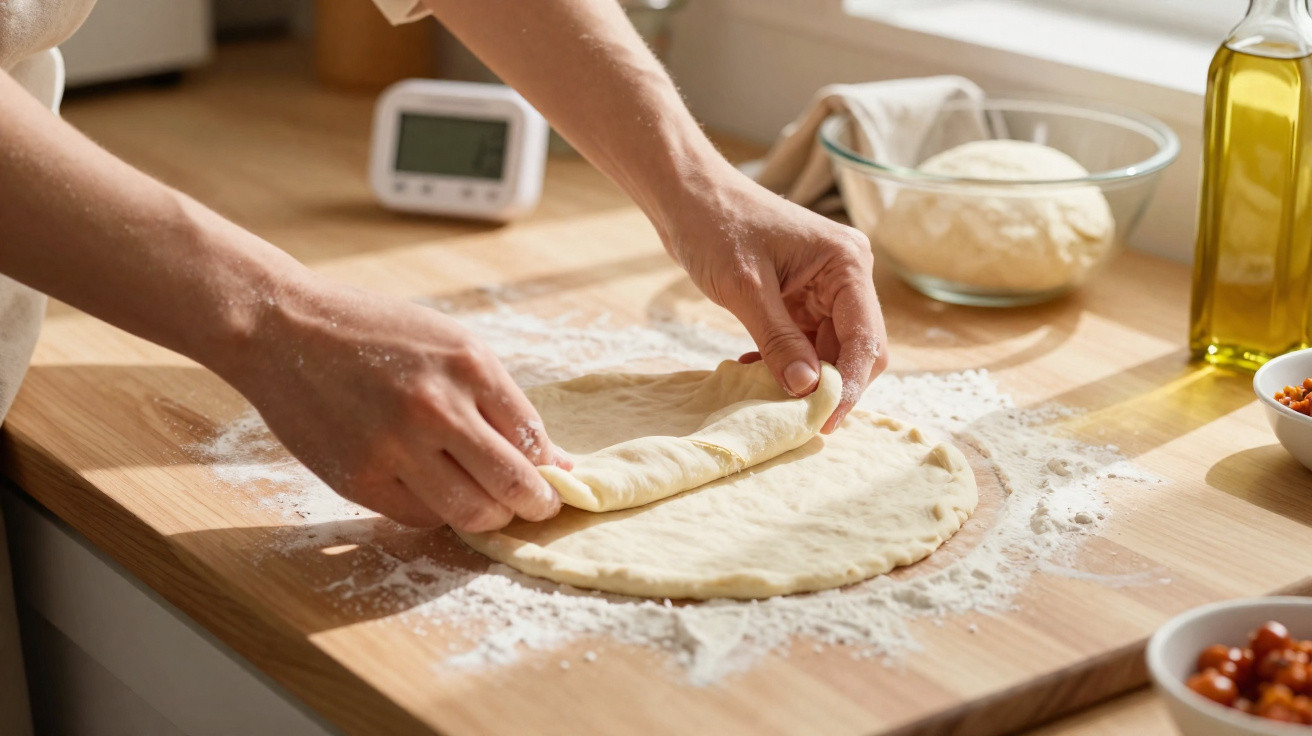
Picture a Saturday evening: flour all over the kitchen worktop and me facing what resembled a pizza dough disaster zone. It was riddled with holes like Swiss cheese, with ragged tears around the edges and one patch thin enough to see through. The children were starving, my husband had the familiar “shall we just get a takeaway?” expression, and I was close to giving up. We have all had that experience, when stretching pizza dough seems as delicate as doing surgery in oven gloves. Fortunately, most pizza mishaps follow the same familiar pattern and are much easier to put right than they seem.
Why Pizza Dough Fights Back (And Usually Wins)
Impatience is usually the main reason pizza dough goes wrong. You take a lovely dough ball out of the fridge and start pulling it into shape straight away. It springs back like elastic, tears seem to form instantly, and you begin to suspect your grandmother’s recipe might be cursed.
Last month, I saw my neighbour try to stretch dough straight from the refrigerator. In under thirty seconds, she had made something resembling a dough doily-full of attractive holes but entirely unsuitable for pizza. Cold dough is stubborn dough, and stubborn dough doesn’t stretch. She had to begin again with a new dough ball, which added another hour to dinner preparations.
Temperature has a major effect on how gluten behaves. In chilled dough, the gluten proteins remain tight and resist being stretched. At room temperature, by contrast, dough becomes more flexible and easier to handle. It is straightforward science, yet this essential rule is easy to overlook when everyone is hungry and dinner needs to be on the table quickly.
The Five-Minute Fix That Changes Everything
The crucial step is this: leave your dough at room temperature for 30-60 minutes before attempting to stretch it. I realise meal planning is not everybody’s strength. Still, this one action prevents roughly 80% of pizza dough issues before they start.
There is no need to feel guilty if this step slips your mind regularly. In reality, hardly anyone gets their pizza-making schedule exactly right every day. If you have cold dough and hungry people waiting, use the “warm bowl trick”: put the dough in a bowl, cover it with a slightly damp towel, then place it close to-but not on-a warm hob or heating vent.
Professional pizza makers favour a light touch. As one chef told me:
“You’re not wrestling the dough into submission-you’re coaxing it into cooperation. The dough wants to stretch; your job is just to give it the right conditions.”
When stretching dough, avoid these common errors:
- Using a rolling pin (which produces a tough, dense crust)
- Pulling from the centre outwards (which leads to tears)
- Forcing the process when the dough is resisting
- Failing to flour the work surface sufficiently
Beyond Temperature: The Human Touch
Making pizza involves more than simply obeying instructions-it requires learning how the dough feels. Each batch reacts a little differently according to the humidity, the type of flour and the length of its rise. On some days, it will stretch as smoothly as silk; on others, it may resist at every stage. That is completely normal. A capable pizza maker learns to notice those signs and adapt, rather than becoming discouraged when the first attempt is not perfect.
| Key point | Detail | Value for the reader |
|---|---|---|
| Temperature timing | 30-60 minutes at room temp before stretching | Prevents 80% of tearing and snapping issues |
| Gentle stretching technique | Work from edges inward, not center outward | Creates even thickness without holes |
| Proper workspace prep | Well-floured surface and hands | Prevents sticking and allows smooth movement |

















Comments
No comments yet. Be the first to comment!
Leave a Comment