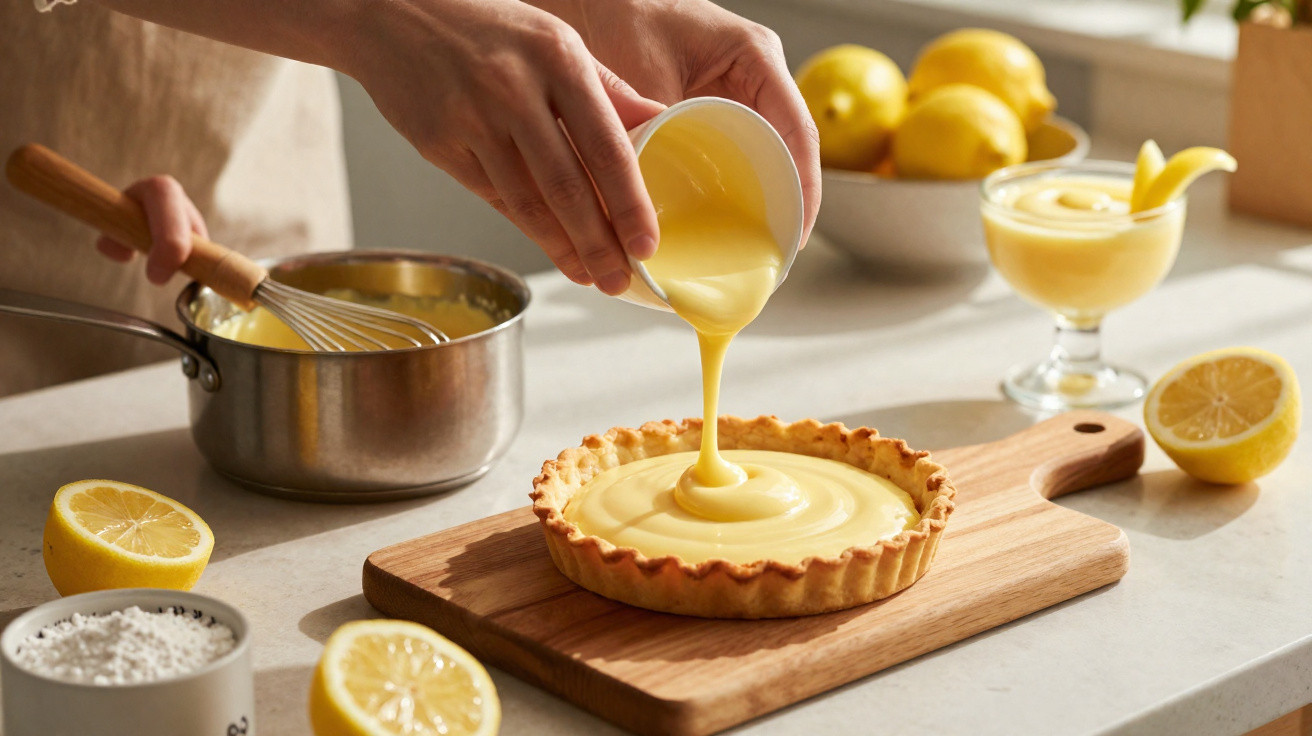
Many home bakers love the bold, sharp flavour of a lemon tart, yet struggle with its notoriously tricky cream. Either the eggs curdle or the mixture stays as runny as lemonade. A technique used in pastry training solves the problem: it creates a stable, creamy lemon filling directly on the hob in around three minutes, with no bain-marie or thermometer required.
Why lemon cream so often goes wrong
Lemon cream sounds straightforward: eggs, sugar, lemon juice and butter. In reality, it can quickly turn into scrambled egg with a citrus flavour. The reason is simply temperature.
- Egg yolks start to set at around 68°C.
- Egg whites firm up at roughly 82°C.
- Between these points, a brief burst of heat is enough to create lumps.
This is exactly why so many recipes use a bain-marie. It moderates the heat, but takes time and patience. Constant stirring, fluctuating temperatures and one inattentive moment can be enough to spoil the cream.
The key question is: how can you protect the eggs from excessive heat without relying on a slow bain-marie?
The professional answer is to give the eggs a “protective shield” - made from an ingredient that most people already have in the cupboard.
The CAP trick: express lemon cream without a bain-marie
In pastry training, a direct method for making lemon cream is already standard practice. Rather than protecting the egg by heating it gradually over water, it is enclosed in a protective layer of starch and sugar. The result is a lemon curd that thickens on the hob within three minutes.
Ingredients for the speedy cream
- 150 g sugar
- 1 lightly heaped tablespoon cornflour
- 3 eggs (medium)
- 150 ml freshly squeezed lemon juice (around 3–4 lemons)
- 50 g cold butter, cut into small cubes
The 3-minute method, step by step
- Set out a cold saucepan or casserole pan.
- Thoroughly combine the sugar and cornflour in the cold pan.
- Add the eggs and whisk until no streaks remain.
- Stir in the freshly squeezed lemon juice until the mixture is smooth and liquid.
- Place the pan over a medium heat and stir continuously, ideally in figure-of-eight motions.
- From this point, time about three minutes. As soon as the cream has thickened noticeably and the first clear bubbles rise, remove it from the heat.
- Add the cubes of butter to the hot cream and allow them to melt briefly.
- Blend with a hand blender for around 30 seconds until smooth and the surface is properly glossy.
At first, the cream may still seem fairly soft. As it cools, it will set to the firm yet creamy consistency wanted for a tart or for filling pastries.
Good to know: Stored in a tightly sealed jar, this quick lemon cream keeps in the fridge for up to one week.
Why starch saves lemon cream
The starch trick is more than a kitchen myth. At molecular level, this is what happens: as it heats, the starch granules swell and position themselves between the protein chains in the eggs. This slows down the point at which the egg sets and prevents rapid clumping.
This creates a kind of safety zone. Even if the telephone rings and the whisk is left for ten seconds, the cream is not immediately ruined. Starch makes the mixture more forgiving of brief interruptions, whereas without that protection it can catch and turn grainy within seconds.
Sugar and citric acid also have a part to play. Both affect the way egg proteins link together and help maintain a smooth texture. Adding the butter at the end does more than improve the flavour: it stabilises the emulsion and gives the typical pastry-chef finish - smooth, shiny and free from dull patches.
Lemon tart, layered desserts or cake filling: how to use the cream
This express lemon cream is surprisingly versatile and works well beyond a classic lemon tart.
- Classic lemon tart: Simply pour it into a pre-baked shortcrust pastry case, leave to cool and serve.
- Pastry filling: Ideal for Swiss rolls, profiteroles or layer cakes.
- Quick layered dessert: Layer it in glasses with crushed biscuits and whipped cream.
- Breakfast highlight: Spread a thin layer over brioche, plaited yeast bread or pancakes.
It is particularly useful because the cream can also be served warm. If unexpected guests are already at the table, use a ready-made pre-baked pastry case, cook the cream fresh, fill the case and serve it warm - a dessert that looks as though you spent half the day in the kitchen.
How does the quick cream compare with other lemon desserts?
Anyone who enjoys baking with lemon will know that there are several ways to make lemon cream. The three most common options compare well:
| Method | Time required | Consistency | Use |
|---|---|---|---|
| Traditional bain-marie | Slow, often 15–20 minutes | Very fine, but prone to failure | Tart, layered desserts |
| Oven-baked lemon cream | Around 12 minutes, plus preheating | Soft, more like a custard | Individual ramekins, cream desserts |
| 3-minute cream with starch | About 3 minutes on the hob | Firm and spreadable | Tart, filling, spread |
Oven versions work well as a dessert in their own ramekin, but they require a preheated oven and some precision with the cooking time. Bain-marie versions can theoretically produce the finest texture, but demand constant attention and experience.
The starch method is clearly designed for everyday practicality: minimal risk and equipment, with a result that also looks as though it came from a pâtisserie.
Practical tips for an even better lemon tart
A few small adjustments can get even more from the cream:
- Adjust the sharpness: For a milder result, replace one third of the lemon juice with orange juice.
- Boost the aroma: A little finely grated lemon zest gives the cream more depth.
- More intense flavour: Rub the zest briefly into the sugar before adding the eggs.
- Extra shine: Pass the cream through a sieve after blending to remove air bubbles.
For a particularly stable tart, use a shortcrust pastry case with a slightly higher edge and blind-bake it. Pour in the cream while it is still slightly warm, let it cool briefly to room temperature, then chill. This keeps the pastry crisp rather than allowing it to become soggy.
What to know about starch and eggs in creams
Using starch in egg creams is not merely a fallback solution, but a proven principle also used for vanilla cream and crème pâtissière. Starch shifts the point at which the egg curdles and provides a substantial margin of safety. For home bakers who rarely work with a thermometer, that is invaluable.
One point still matters: the cream must not boil vigorously. Small bubbles around the edge are enough, and the pan should then be removed from the heat. Anyone with a particularly powerful hob should lower the heat early and stir for a little longer instead. The three- to four-minute window remains short, but manageable.
It is also interesting how readily the technique can be adapted. The same principle can be used to make similar creams with lime, blood orange or a mix of citrus fruits. Keep the amounts of juice and sugar within a similar range so that the acidity does not destabilise the structure.

















Comments
No comments yet. Be the first to comment!
Leave a Comment