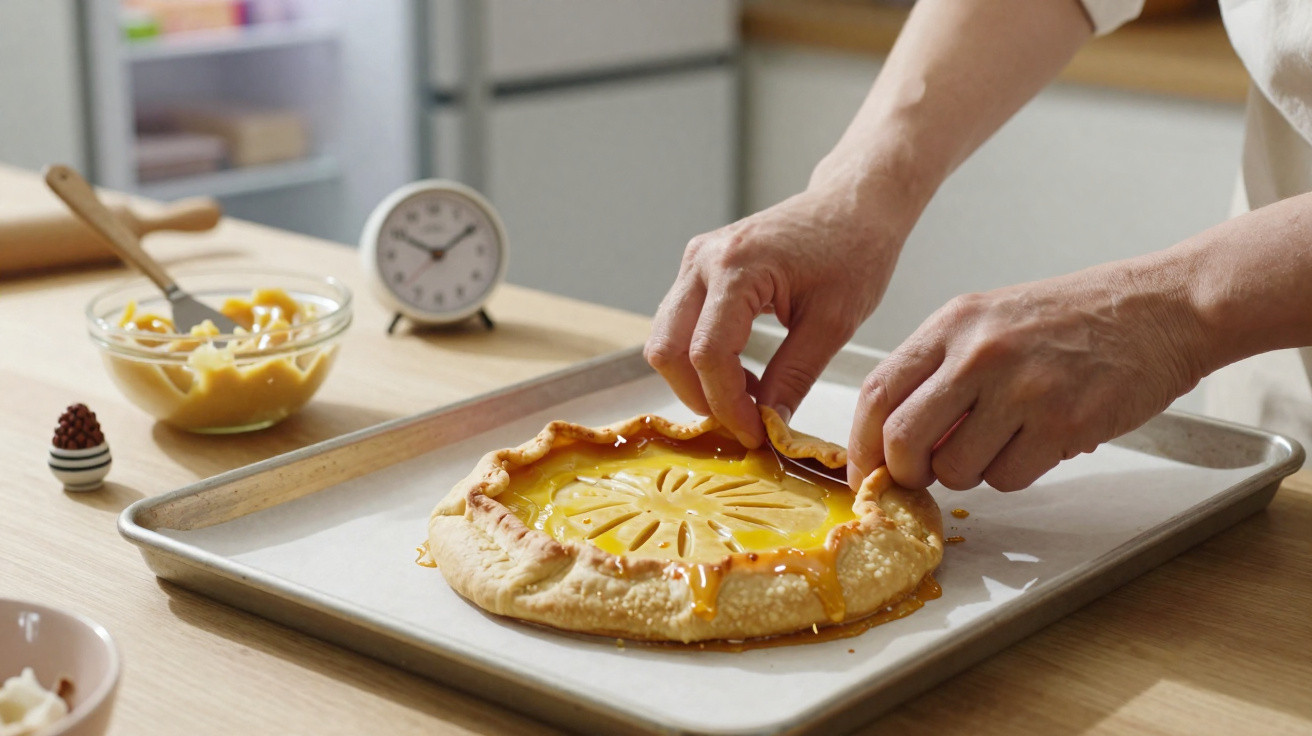
January arrives, the oven is blazing, and another homemade Epiphany cake splits open like a badly made pasty.
It may look beautifully golden through the oven glass, yet slicing reveals escaped filling, distorted layers and an Epiphany dessert that feels like a baking disaster. One straightforward action, done before the cake enters the oven, largely determines whether the frangipane remains neatly contained or pours across the baking tray.
Why homemade Epiphany cake often bursts in the oven
Anyone who has made an Epiphany cake will recognise the problem. It rises unevenly, the join at one side splits, and hot almond cream leaks out, scorching on the tray and leaving an empty pastry case. Home bakers frequently blame their puff pastry, oven setting or recipe.
Usually, however, puff pastry itself is responsible. Rolling it stretches the gluten structure while trapping fat between fine sheets of dough. This is what creates its appealing flakes, but it also leaves a highly elastic pastry that tries to pull back as it bakes. Put an assembled Epiphany cake directly into the oven and the pastry can contract sharply. This tugs at the joins, weakens the seal holding the two discs together and gives the filling an easy route out.
A number of familiar mistakes make matters worse. Too much filling in the middle increases the pressure when the cream heats and expands. Over-whisking frangipane adds air, which swells during baking and presses more firmly on the edges. Spreading the filling to the very edge leaves no protective border. Even a small weakness in the seal can then let cream break through and spill onto the tray.
Most “burst” Epiphany cakes are not a pastry disaster at all, but the result of skipping a short rest before baking.
The overlooked step: chilling the assembled Epiphany cake
The most reliable solution is remarkably simple: refrigerate the fully assembled, unbaked Epiphany cake well before it goes into the oven. This means chilling the complete cake, rather than only the pastry or the filling.
After spreading the frangipane, inserting the small token, topping it with the second pastry disc and applying a first egg wash, place the whole cake in the fridge. At least two hours is suitable for most home kitchens. Many French bakers make theirs discreetly the evening before, wrap it carefully and bake it the following day.
Resting in the cold alters the pastry's behaviour. The gluten relaxes, meaning the dough becomes less springy and contracts less severely in the oven. The fat within the puff pastry also sets firmer, allowing the layers to retain their form as they rise. Meanwhile, the frangipane thickens a little, so it creates less pressure at the edges as it warms.
A chilled Epiphany cake enters the oven calmer: less elastic dough, a firmer filling, and seams that hold instead of tearing.
The fridge rest also makes planning easier. You can prepare the cake before a family lunch, refrigerate it overnight and remove it 10–15 minutes before baking. Use this brief interval to renew the egg wash, score the traditional spiral or leaf design, then bake it in a thoroughly preheated oven at about 180°C for approximately 40–45 minutes, until the bottom is a deep golden colour.
Essential assembly steps for a leak-proof Epiphany cake
Chilling is highly effective, but it will not compensate for careless assembly. A few accurate steps from the outset avoid most later difficulties.
Preparing the bottom pastry
Begin with two equal-sized circles of puff pastry. Set one on a baking tray lined with baking paper. Lightly prick the base using a fork, taking care not to pierce it completely. These small holes release steam caught underneath and limit uneven bubbles, which can misshape the top and force open the joins.
Managing the frangipane filling
Spread the almond cream outwards from the middle, maintaining an uncovered border of roughly 2 cm around the entire edge. Do not be tempted to heap it up; a restrained, level layer provides a stronger result than a tall mound that slumps and pushes outward.
The consistency matters too. Frangipane whipped until it is exceptionally light contains considerable air. That air expands in the oven and encourages leakage. A creamier, slightly denser mixture is more predictable. It should be creamy, rather than resembling mousse.
Sealing the edge correctly
When the filling is positioned and the token concealed, brush the exposed pastry border lightly with water. Put the second pastry circle on top, lining it up precisely. Using your fingertips, press the edges together around the full circle to form a consistent seal. Do not press with such force that the laminated pastry layers are flattened.
Do not crimp the edge with a fork; it flattens the puff pastry and prevents that characteristic tall, airy rim.
Many bakers then notch the edge by using the back of a small knife to create little diagonal marks around the rim. As well as being decorative, this reinforces the seal and directs how the pastry expands.
Steam vents and final checks
Before refrigeration, lightly egg-wash the top, keeping the cut edge clean and dry to achieve the best lift. Cut a small central hole, known as a chimney, then make several subtle slits or tiny holes within the decorative design to allow steam to escape.
Immediately before baking, check the following:
- The Epiphany cake has chilled for a minimum of two hours.
- The filling finishes around 2 cm short of the edge all the way around.
- The join feels securely sealed when lightly pressed with a fingertip.
- No egg wash has run down the sides, where it would stick the layers together.
- The top includes a chimney and small steam vents.
- The oven has fully heated to about 180°C, ideally with a hot baking tray or stone to brown the base.
Mistakes that cause filling to spill onto the tray
Cooks often make the same errors every year without connecting them to a dramatic leak. This quick guide makes them easier to avoid.
| Habit | What happens in the oven |
|---|---|
| Baking straight after assembly | The pastry contracts quickly, the edges separate and filling pushes out. |
| Using too much cream in a tall mound | The centre rises, the sides split, and cream spills and burns on the tray. |
| Whisking frangipane until extremely airy | Air pockets expand, press on the seams and distort the top. |
| Applying egg wash to the cut edge | Layers stick together, restricting the rise and forming weak areas. |
| Omitting vents or the chimney | Steam becomes trapped and escapes through any available crack. |
A guide to important baking terms
Epiphany cake recipes contain terminology that may seem more complicated than it is. Understanding these expressions makes the process more straightforward.
Frangipane generally refers in France to almond cream combined with pastry cream, creating a rich filling that is slightly lighter than plain almond paste. Some home bakers leave out the pastry cream and use only butter, sugar, eggs and ground almonds; this denser version benefits even more from thorough chilling.
Gluten relaxation describes how the protein structure in flour releases tension when dough is rested. For puff pastry, this limits shrinkage, helps the circle stay round and reduces strain on the joins.
Chimney simply means a small hole in the centre of the Epiphany cake that provides a steam outlet. Without one, pressure builds unpredictably and may split the sides.
Practical ways to fit an Epiphany cake into a busy schedule
For many households, Epiphany occurs during a busy working week, when there is little time for involved baking. Rather than being inconvenient, the chilling stage can make the preparation easier to organise.
One workable approach is to make the frangipane the evening before, roll the pastry, fully assemble the Epiphany cake and give it its first egg wash. Put it on a tray, cover it well and refrigerate overnight. The next day, while the oven heats, remove it from the fridge, refresh the glaze, cut the decorative pattern and bake. The hands-on preparation still takes less than half an hour, while the oven does the remaining work.
For anxious first-time bakers, a trial bake may be useful. Make a small Epiphany cake from pastry trimmings and a smaller quantity of filling, then handle it exactly as you plan to handle the full-sized version. How it rises, browns and seals will provide a clear indication of what to expect from the main dessert.
Beyond tradition: fillings, risks and sensible variations
Once you can make a close-sealed Epiphany cake confidently, trying different flavours becomes less risky. Hazelnut cream, pistachio, chocolate chips and citrus zest behave much like traditional frangipane. The key is to retain a similarly firm consistency and avoid adding excessive moisture.
Versions containing plenty of fruit, such as pear slices or apple layered over the cream, introduce another consideration: juice. Too much fruit, or fruit that is very ripe, releases liquid while cooking. This thins the filling and increases the likelihood of leaks. In such cases, lightly dusting the fruit with ground almonds or breadcrumbs absorbs extra moisture and preserves the structure.
Mastering this unobtrusive fridge rest improves more than appearance. An Epiphany cake that stays sealed has a generous, consistent layer of cream from edge to edge, a crisp and well-risen rim, and a base baked through properly rather than steamed by leaked syrup. The token remains where it was hidden, portions slice cleanly, and the January tradition becomes a pleasure to repeat each year rather than a test of nerves.

















Comments
No comments yet. Be the first to comment!
Leave a Comment