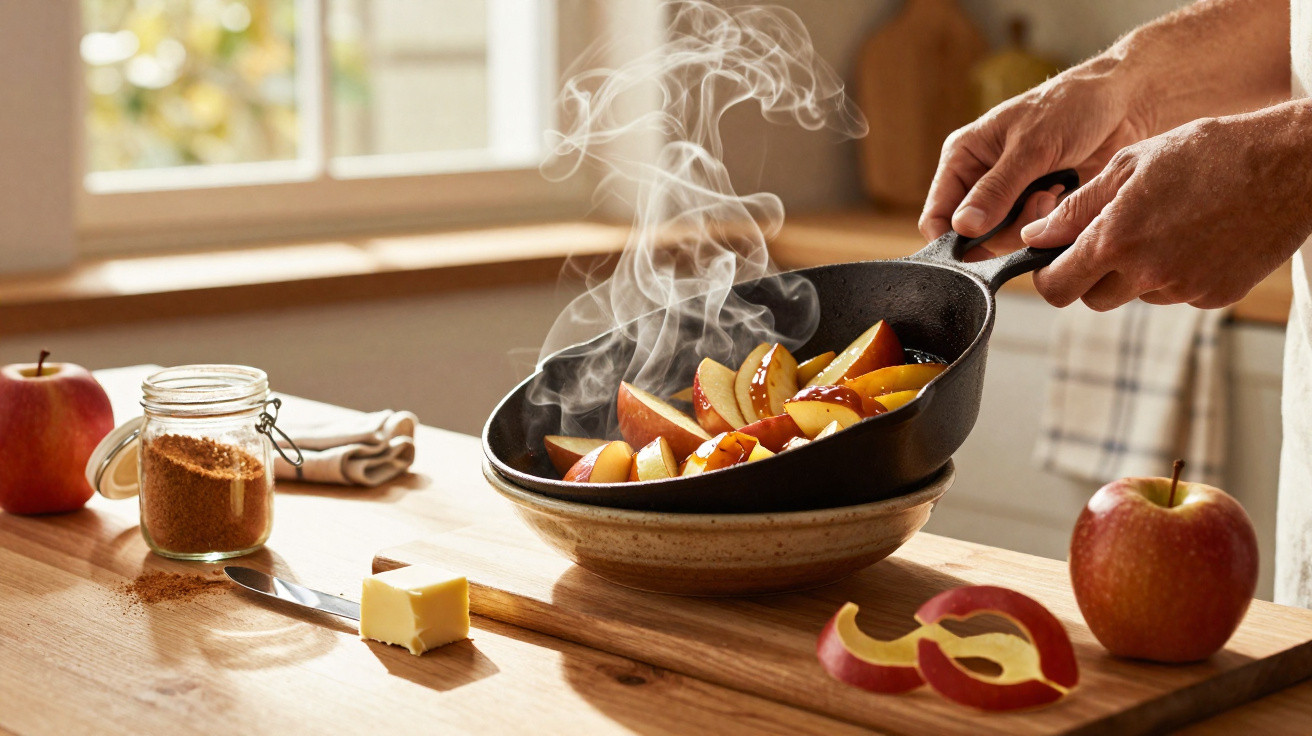
The apples in the fruit bowl were on their last legs.
You know the situation: it is Tuesday evening, there is half a tub of softening vanilla ice cream in the freezer, and three bruised, forlorn apples are looking at you like another job to deal with. You are hungry and slightly worn out, and making pastry seems about as plausible as running a marathon in flip-flops.
Yet the craving is oddly precise. You do not simply want “something sweet”. You want that aroma: the warm, buttery, cinnamon-hazed scent of homemade apple pie floating through the house.
Almost automatically, you take out a skillet. Butter. Sugar. A squeeze of lemon. The apples sizzle the second they meet the pan, and suddenly this is no longer a compromise. It is more like a shortcut your grandmother never mentioned.
The first spoonful tastes as though somebody spent hours baking.
Only you know it took 15 minutes.
Why this skillet apple dessert tastes like proper pie
There is a reason this speedy skillet dessert presses the same emotional button as a genuine apple pie.
You are doing more than heating fruit. In one pan, you create a small storm of flavour: butter browning around the edges, sugar turning to caramel and cinnamon coming alive from the jar.
At first, the apples are firm and slightly reserved. In the heat, they loosen up, becoming tender enough to feel comforting without turning weary. The kitchen transforms quickly. One moment it smells of supper; three minutes later, it smells like a celebration.
You hover over the skillet with a spoon, tasting the sauce as it thickens.
That is the understated pleasure of it: seeing everyday apples become a dessert that feels as if it belongs at your favourite café.
Imagine coming home late on a cold evening with a friend who “isn’t really hungry” before suddenly remembering they have not eaten since noon. A takeaway feels too slow and too costly. You have apples, butter, sugar and exactly one clean pan.
Slice the apples directly into the skillet, with no fuss and no need for immaculate wedges.
They soften as their edges become slightly translucent, filling the room with that familiar pie scent that draws people towards the hob as though it were a campfire. Your friend peers in, partly amused and partly impressed: “You just… threw that together?”
Spoon the gleaming apples into two bowls over yoghurt, ice cream or even a slice of toast standing in for shortcake.
For the first three bites, nobody says a word. That is when you realise this “non-recipe” is almost embarrassingly close to homemade pie.
So why does it taste so much like pie without any pastry?
It comes down to three things: texture, caramelisation and spice.
The apples cook to the point where a spoon slides through them easily, while they still retain some shape. Butter and sugar coat each slice in a syrupy glaze, echoing the sticky filling of a classic pie.
Your brain fills in the missing crust.
The fragrance of cinnamon, nutmeg and perhaps a trace of vanilla calls up memories of pies cooling on racks, even though you have only stirred fruit in a pan. The appeal is not solely in the pastry. It is the way heat, sugar and spice work together on your senses.
The easy skillet apple dessert method for instant “pie”
Begin with a wide skillet and slightly more butter than you might expect to need. Around 30–45 ml is a good amount. Melt it gently over a medium heat until the edges begin to smell faintly nutty. This creates the base of the flavour.
As the butter melts, thinly slice the apples. There is no requirement for flawless wedges or for removing every strip of peel. A combination of sweet and sharp apples is ideal: try Gala, Honeycrisp and Granny Smith together in the same pan.
When the butter is foaming, scatter in a few spoonfuls of sugar. Leave it over the heat for a minute, until it loosens and reaches the shade of weak tea. Tip in the apples, along with a pinch of salt and a shake of cinnamon. Stir, breathe and wait.
You are already halfway to dessert.
Timing is the part that tends to worry people. Either apples remain too crisp or they collapse into baby food. The ideal point usually arrives after 8–10 minutes over a gentle heat, with an occasional stir. You want slices that bend rather than break.
Should the pan seem dry, pour in 15 ml of water, apple juice or even a splash of orange juice. The steam softens the apples without scorching them. If the sauce seems overly thin, allow it to bubble for a minute with the apples moved to the sides, so it reduces into a glossy syrup.
We have all had that point when making dessert starts to feel stressful instead of enjoyable. This one-pan recipe guides you in the opposite direction.
Let us be honest: nobody actually makes this every single day.
That is precisely why it feels special when you do.
One minor finishing touch makes all the difference: add a small squeeze of lemon at the end to lift the entire pan. A drop of vanilla makes it smell like the inside of a bakery at 7 a.m.
“People think you need crust for comfort,” laughs Elise, a home baker who started making skillet apples on weeknights. “What you actually need is warm fruit, real butter, and five quiet minutes to stand over the stove. The rest is romance we’ve been sold by cookbooks.”
Serving is another part of this dessert’s appeal. It is a chameleon:
- Spoon it over vanilla ice cream for a five-minute “pie à la mode”
- Add it to thick yoghurt with a scattering of granola for a comforting breakfast
- Layer it over toast or brioche as a cheat’s tarte tatin
- Fold it into pancakes or waffles when you want weekend energy on a weekday
- Eat it straight from the pan while standing at the hob, because nobody is watching
One pan and a few apples can suddenly give you plenty of choices.
The gentle appeal of a low-effort, high-comfort dessert
You do not need visitors or a holiday as an excuse to make a skillet of caramelised apples.
Sometimes all you need is a spoon and something warm that has not come from a cardboard box. This small ritual can change the feeling of an evening, not because it is elaborate but because it is intentional.
There is something steadying about slicing fruit, hearing the sizzle and smelling spices meet the heat. Time slows down slightly. You are not scrolling, hurrying or automatically reheating leftovers. Instead, you are consciously turning what is already in the kitchen into something softer, sweeter and more generous than it was before.
That is the real luxury: not the ingredients or the presentation, but giving yourself ten minutes to draw comfort from a skillet.
| Key point | Detail | Value for the reader |
|---|---|---|
| Fast “pie” flavour | Caramelised apples with butter, sugar and spice in one pan, ready in about 15 minutes | Enjoy homemade-pie vibes without rolling pastry or heating the whole oven |
| Flexible and forgiving | Works with mixed apples, adjustable sweetness, easy to fix if too dry or too saucy | Reduces stress and food waste, turns random fruit into a reliable treat |
| Endlessly adaptable | Serve with ice cream, yoghurt, toast, pancakes or straight from the skillet | One base recipe that fits dessert, breakfast or last-minute entertaining |

















Comments
No comments yet. Be the first to comment!
Leave a Comment